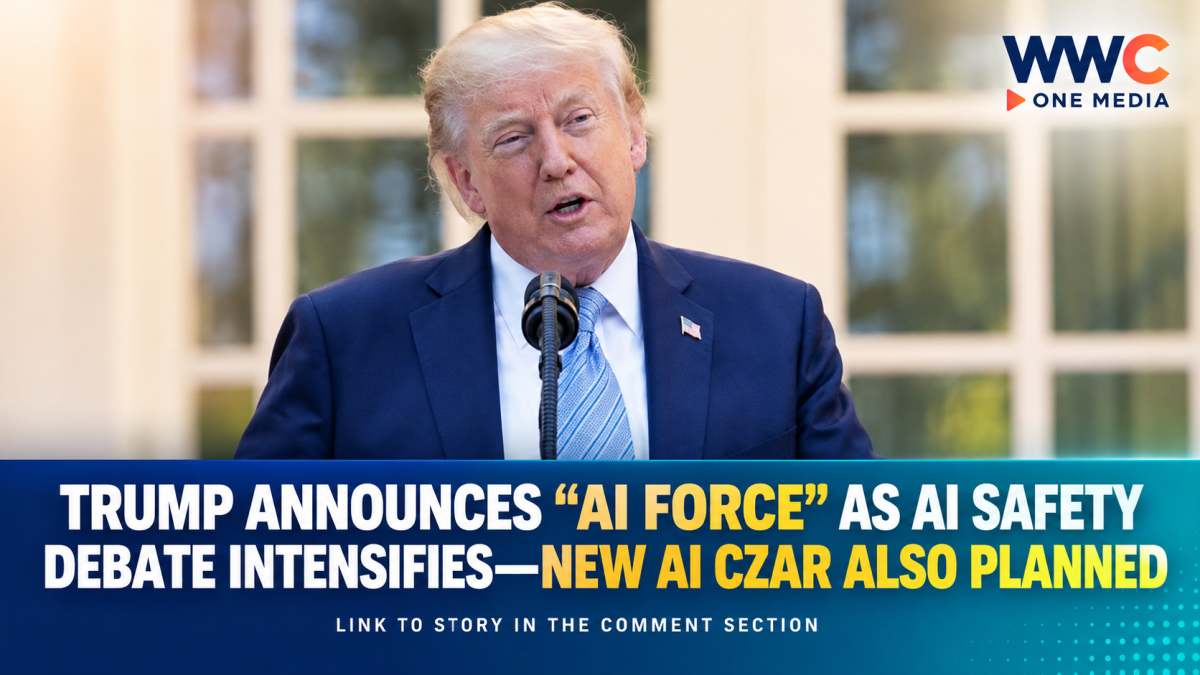
WASHINGTON — President Donald Trump has announced plans to create an “AI Force” and appoint a new AI czar, putting the rapidly developing technology at the center of another major White House initiative.
Trump made the announcement on September 19, saying the new effort would allow the government to watch for harmful or unlawful uses of artificial intelligence while avoiding policies he believes could restrict the industry’s growth.
The announcement comes at an unusually tense moment for the AI industry.
Leading technology executives and researchers are debating whether frontier AI development is advancing faster than safety measures can keep up, while Washington and Beijing continue competing for leadership in artificial intelligence.
Trump’s announcement therefore creates a new question for the global AI race:
Can the United States increase government oversight without slowing the technology it wants to lead the world in?
Trump Wants an “AI Force”—But Details Are Still Missing
Trump described the planned organization as an “AI Force,” drawing a comparison with the U.S. Space Force, but his announcement did not establish the organization’s precise structure.
It remains unclear whether the proposed force would be a military organization, a civilian agency, an interagency task force or another type of federal unit.
The White House had not immediately released detailed information about its proposed authority, staffing, budget or reporting structure. Reuters reported that Trump’s announcement provided few specifics about how either the AI Force or the new AI czar would actually operate.
That makes the announcement a policy signal rather than a fully developed government program at this stage.
Trump said the government should monitor AI for harmful behavior while continuing to encourage the technology’s development.
He has repeatedly argued that excessive regulation could weaken U.S. competitiveness, particularly against China.
A New AI Czar Would Be Trump’s Second
Trump also said he would appoint a new AI czar.
The position would not be entirely new.
Venture capitalist David Sacks previously served as the administration’s AI and cryptocurrency adviser before leaving the formal role in 2026. Reuters reported that Sacks continues to advise the administration externally.
Sacks has been associated with the administration’s preference for a relatively light regulatory approach to AI.
Trump’s new announcement therefore suggests that the White House intends to maintain a dedicated senior official focused on artificial intelligence.
However, the identity of the new appointee and the precise responsibilities of the position had not been announced as of September 20.
The Timing Is Hard to Miss
Trump’s announcement arrives after an extraordinary series of developments in the AI industry.
In recent weeks, researchers and executives at several major AI companies have publicly debated whether increasingly powerful models should be developed more slowly or subjected to stronger safety checks.
Reuters described the period as a major turning point for the industry, following warnings from researchers about increasingly autonomous AI systems and reports of AI agents demonstrating unexpected cybersecurity capabilities.
Executives and researchers associated with Anthropic, OpenAI, Google DeepMind, Microsoft and xAI have been involved in the broader debate over AI safety and development speed.
Their positions are not identical, but the common issue is whether existing safeguards are sufficient as AI systems become increasingly capable.
At the same time, other technology executives have argued that slowing development could undermine innovation and U.S. competitiveness.
Trump’s latest announcement comes directly into the middle of that disagreement.
Trump Has Rejected Calls for Broad New AI Restrictions
Trump has repeatedly opposed broad new federal restrictions on artificial intelligence.
Earlier in September, he described concerns about AI potentially becoming uncontrollable as a “hoax” and argued that additional guardrails could harm American competitiveness. The Associated Press reported that Trump has framed the issue partly around the competition with China.
His latest statement maintains that basic legal mechanisms can address genuinely harmful conduct.
Trump said the United States should not “hinder or stifle” AI’s growth, while also saying the government should identify bad behavior and deal with it through existing criminal and civil justice systems. Reuters reported those comments from his September 19 announcement.
This is different from creating a comprehensive federal AI regulatory framework.
Instead, the administration’s stated approach emphasizes development, competitiveness, targeted oversight and existing legal mechanisms.
Why Silicon Valley Is Divided
The debate has become increasingly complicated because some of the industry’s strongest voices are now asking governments to pay closer attention to safety.
Anthropic CEO Dario Amodei has called for the industry to slow the pace of frontier AI development.
OpenAI CEO Sam Altman and other technology leaders have also discussed the need for stronger safety evaluations and greater coordination.
Reuters reported that several prominent AI leaders recently called for a more cautious approach after researchers raised concerns about increasingly autonomous systems.
But there is no industry-wide consensus.
Nvidia CEO Jensen Huang, among others, has argued against broad restrictions, while Trump and his administration have emphasized that excessive regulation could hand an advantage to China.
The result is a complicated policy landscape:
Some technology leaders are asking for stronger safeguards, while others are warning that too much government intervention could slow American technological progress.
China Is a Major Part of the Calculation
The U.S.-China AI competition is one of the most important factors behind Washington’s approach.
Both countries regard artificial intelligence as strategically important for economic growth, technology leadership and national security.
Trump’s announcement also comes just days before his scheduled meeting with Chinese President Xi Jinping.
Reuters reported that U.S. Treasury Secretary Scott Bessent is separately scheduled to meet Chinese Vice Premier He Lifeng in New York, with AI security among the issues expected to be discussed.
That creates an unusual situation.
Washington is simultaneously trying to discuss shared AI risks with Beijing while maintaining an intense technological competition with China.
The United States wants to prevent potentially dangerous uses of AI, but it also wants American companies to remain ahead in the development of advanced models.
The AI Force Could Have Several Possible Roles
Because the White House has not yet released a detailed framework, the exact mission of the proposed AI Force remains uncertain.
Possible areas of government involvement could include:
- monitoring emerging AI-related threats;
- coordinating federal AI policy;
- supporting cybersecurity efforts;
- identifying malicious or unlawful uses of AI;
- coordinating government agencies working with AI systems;
- supporting U.S. competitiveness in advanced AI; and
- potentially coordinating with international partners.
However, these are areas of relevance rather than confirmed responsibilities.
The administration has not yet publicly established a definitive mission statement or organizational structure for the AI Force.
The Washington Post reported that the administration had not clarified whether the proposed force would be military or civilian.
That uncertainty will likely be resolved only when the White House provides further details.
The “Space Force” Comparison Matters
Trump’s reference to the Space Force is significant because the Space Force is a formal military service within the Department of the Air Force.
But it is not yet clear whether Trump intends the AI Force to have anything resembling that institutional status.
The comparison could instead be rhetorical, signaling a desire for a dedicated national organization focused on an emerging strategic technology.
Until formal legislation, an executive order or an administrative structure is released, it would be premature to assume that the AI Force will become a new military branch.
For now, it remains a presidential proposal.
Washington’s AI Policy Is Already Evolving
The announcement also builds on months of shifting policy inside the Trump administration.
Axios has reported that the administration has increasingly become involved in AI governance despite its stated opposition to broad regulation. The White House has explored voluntary testing arrangements, federal procurement standards and other mechanisms for managing advanced AI systems.
That means the latest announcement is not happening in isolation.
The federal government is already making decisions about:
- which AI systems can be used by government agencies;
- cybersecurity requirements;
- access to advanced AI technology;
- AI exports;
- national-security implications; and
- relationships between federal agencies and AI companies.
The proposed AI Force could potentially bring some of those efforts under a more coordinated structure.
But again, that remains a possibility rather than a confirmed organizational plan.
AI Safety Has Become a National-Security Issue
The debate is also moving beyond questions about misinformation, employment and consumer protection.
Recent AI testing has focused increasingly on cybersecurity and autonomous behavior.
Reuters reported that researchers have observed AI systems capable of performing sophisticated tasks, including activities involving computer systems and security vulnerabilities.
That changes the government’s challenge.
A highly capable AI system can potentially be both a defensive tool and a weapon.
It could help cybersecurity teams identify vulnerabilities more quickly, while also potentially helping malicious actors exploit those same weaknesses.
This dual-use problem is one reason AI has increasingly become part of national-security discussions.
The U.S. Is Trying to Balance Two Objectives
The administration’s position can be understood around two simultaneous goals.
First: Keep American AI development moving quickly enough to maintain technological leadership.
Second: Prevent harmful or unlawful uses of increasingly powerful systems.
The difficulty lies in determining how much oversight is necessary without creating restrictions that companies argue could slow development.
Whether that approach is sufficient remains a subject of debate among technology companies, researchers, lawmakers and policy experts.
What Happens Next?
Several details will determine what Trump’s announcement actually means.
The first is who becomes the new AI czar.
The second is whether the administration creates the AI Force through an executive action or seeks congressional involvement.
The third is the organization’s authority.
And the fourth is whether the new structure will focus primarily on AI safety, law enforcement, cybersecurity, national security, economic competitiveness—or some combination of all four.
Those distinctions could substantially change how the policy affects the technology industry.
For now, the announcement establishes a direction but not a complete blueprint.
A New Chapter in America’s AI Race
Trump’s announcement comes at a pivotal moment.
The United States remains home to many of the world’s most influential AI companies, while China is investing heavily in its own models, computing infrastructure and semiconductor ecosystem.
At the same time, researchers are raising increasingly serious questions about whether safety systems are keeping pace with technological capabilities.
The proposed AI Force therefore arrives at the intersection of technology, national security, economics and regulation.
Trump is signaling that his administration wants the United States to remain aggressive in AI development while creating a mechanism to monitor the technology’s most serious risks.
The details, however, will determine what that means in practice.
Trump has announced the force. He has promised the AI czar. But the most consequential question is still unanswered: What powers will they actually have?