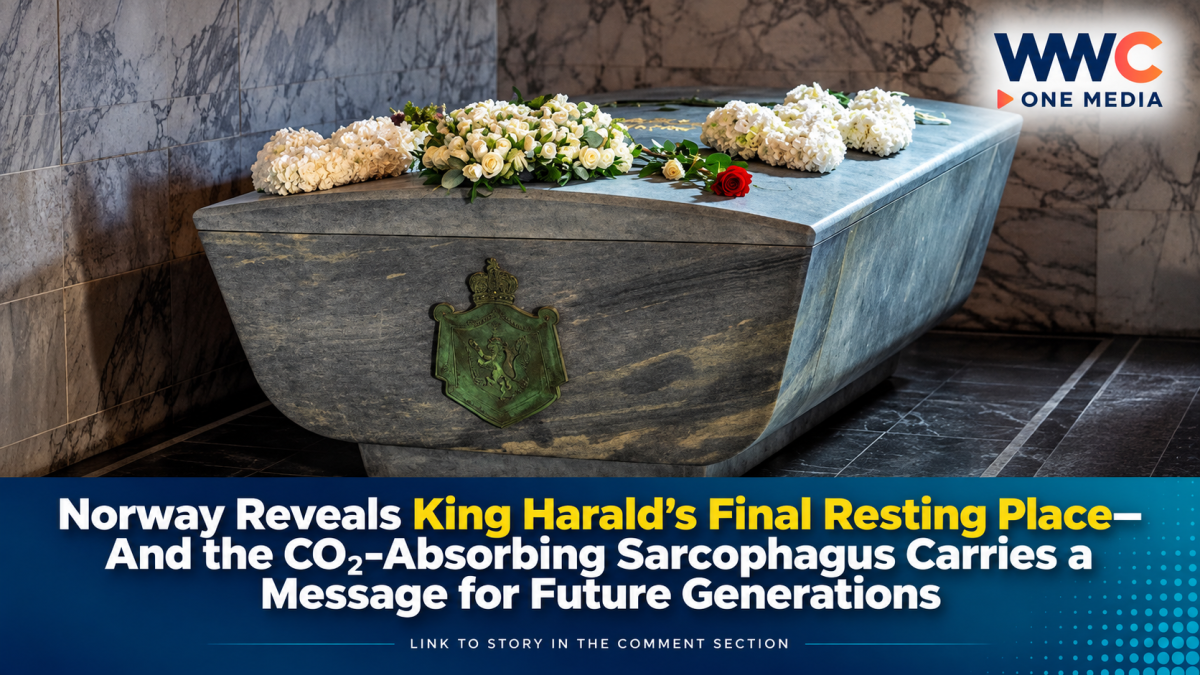
OSLO — Norway has finally revealed the design of King Harald V’s final resting place, it is far more symbolic than an ordinary royal tomb.
The late monarch has been laid to rest at the Royal Mausoleum at Akershus Castle, inside a distinctive, ship-shaped sarcophagus carved from Norwegian olivine stone, a rock with the natural ability to absorb and bind carbon dioxide.
The Norwegian Royal Court unveiled details and photographs of the sarcophagus on September 18, more than a week after Harald’s state funeral in Oslo.
The design combines several elements closely associated with Harald and his family: the sea, Norway’s natural landscape, the country’s royal history and concern for future generations.
And there is a striking detail beneath the symbolism.
The stone itself can take up and bind CO₂.
A Royal Tomb Designed Like a Ship
The sarcophagus has been designed in the form of a vessel with a rounded bottom.
According to the Royal Court, the design was inspired by Harald’s lifelong relationship with the sea.
The ship is also a reference to ancient Scandinavian traditions in which ships were associated with the final journey of the dead.
The symbolism is particularly fitting for Harald, who was known for his lifelong passion for sailing and spent much of his life closely connected to Norway’s maritime culture.
The Royal Court explained that the vessel symbolizes a ship carrying its passenger safely onward—turning the sarcophagus into a representation of a final voyage rather than simply a stone burial container.
It also connects the modern Norwegian monarchy with much older Nordic traditions.
The Stone Comes From Norway
The material chosen for the sarcophagus is olivine stone, a greenish rock formed deep inside the Earth and brought to the surface through the geological forces that shaped Norway.
The Royal Court says the stone used for the sarcophagus comes from Sunnmøre, a region of western Norway that has particular significance to Queen Sonja because of her extensive travels and hiking there.
The stone is believed to have formed roughly 400 million years ago, making the material itself vastly older than the Norwegian monarchy.
That geological history was an intentional part of the design.
The Royal Court says the same forces that created the stone also helped shape the mountains, fjords and landscapes that define Norway.
In other words, Harald’s final resting place was designed using a piece of the country itself.
Why the Sarcophagus Can Absorb CO₂
The unusual choice of olivine is not merely aesthetic.
Olivine can undergo natural chemical reactions that remove carbon dioxide from the environment and store the carbon in more stable mineral forms.
The Norwegian Royal Court specifically highlighted the stone’s ability to take up and bind CO₂.
For the designers, that characteristic carries symbolic meaning.
The greenish stone represents Queen Sonja’s connection to Norwegian nature and the couple’s concern for the natural environment and future generations.
That does not mean Harald’s individual sarcophagus is a significant carbon-capture device capable of offsetting his lifetime emissions.
Rather, the CO₂-binding property is primarily part of the symbolism and material choice behind the monument.
That distinction is important.
The Royal Court Kept the Design Secret
The sarcophagus was deliberately kept out of public view until after the king had been laid to rest.
Before Harald’s September 9 funeral, officials had confirmed that he would be buried at the Royal Mausoleum but had withheld details about the design.
Euronews reported before the funeral that the sarcophagus was expected to cost around 20 million Norwegian kroner, equivalent to roughly US$2 million at the time, but that its appearance remained secret.
The Norwegian Royal Court subsequently released photographs and detailed information about the completed monument on September 18.
The unveiling therefore provided the first public look at the final resting place.
Harald’s Funeral Drew Thousands
The sarcophagus reveal follows a major state funeral that brought Norway to a standstill.
King Harald V died on August 28, 2026, at the age of 89, after more than three decades on the Norwegian throne.
His funeral took place in Oslo on September 9 after 13 days of national mourning.
Thousands of people lined the streets as the funeral procession traveled from the Royal Palace to Oslo Cathedral.
A nationwide minute of silence was observed during the ceremony.
European monarchs and international leaders also attended, including representatives from Sweden, Denmark, Spain, the Netherlands, Belgium, Luxembourg, Monaco and Jordan.
Britain’s Prince William and Japan’s Crown Prince Akishino were among the foreign royals present, while Ukrainian President Volodymyr Zelenskyy also attended.
The Final Stop: Akershus Castle
Following the public funeral ceremony at Oslo Cathedral, Harald’s coffin was taken to Akershus Castle, the historic fortress overlooking Oslo’s harbor.
There, a private ceremony was held before the king was placed in the Royal Mausoleum.
The mausoleum already contains the remains of previous members of Norway’s royal family.
The new sarcophagus now stands alongside those of King Olav V and Crown Princess Märtha, as well as King Haakon VII and Queen Maud.
Harald’s final resting place therefore places him directly within the modern history of Norway’s constitutional monarchy.
A Monument Built for Two
The sarcophagus is intended not only for Harald.
It will eventually serve as the final resting place of Queen Sonja as well.
That makes the design a shared memorial to the royal couple.
The symbolism consequently brings together elements associated with both.
For Harald, there is the sea and the ship.
For Sonja, there is Norwegian nature and the mountains of Sunnmøre.
The Royal Court describes the result as a meeting point between the things that have been important to each of them during their lives.
The Royal Details Are Hidden in the Design
The sarcophagus is not minimalist in every respect.
Its lid carries symbols associated with the Norwegian royal regalia, including the:
- royal crown;
- orb;
- scepter; and
- royal sword.
The Norwegian royal coat of arms is displayed at the foot of the sarcophagus.
The decorations were handcrafted and cast in bronze, while the lettering on the sarcophagus was cut from brass and gilded.
Two crowns incorporated into the design contain peridot, the green gemstone variety of olivine.
That creates another connection between the monument’s material and its royal symbolism.
The stone and gemstone are therefore related through the same mineral family.
The Sarcophagus Was Designed by Norwegian Architects
The monument was created specifically for Harald’s final resting place rather than being an existing historical sarcophagus adapted for the occasion.
The design was commissioned before his death, reflecting the longstanding practice of preparing royal burial arrangements in advance.
Its vessel shape, natural stone and environmental symbolism give it a distinctly Norwegian identity.
Rather than imitating the grand marble tombs associated with some European royal families, the design draws heavily from Norway’s landscape and maritime history.
Harald’s Reign Comes to an End
Harald V became king in 1991, succeeding his father, King Olav V.
Over more than three decades on the throne, he became a familiar figure in Norwegian public life.
His reign was marked by efforts to maintain a modern and accessible image of the monarchy.
His funeral therefore became more than a royal ceremony.
It was also a national farewell to a monarch who had spent most of his adult life representing Norway.
The Guardian reported that tens of thousands of people lined Oslo’s streets for the funeral, which formally brought the country’s 13-day period of national mourning to an end.
A New King, a New Chapter
Harald’s death also marked the beginning of a new chapter for Norway’s monarchy.
His son succeeded him as King Haakon VIII.
The transition took place amid the formal funeral and mourning ceremonies.
The symbolism of the sarcophagus therefore arrives at the same moment that the Norwegian monarchy moves from one generation to another.
Harald’s reign is now part of history.
His final monument, however, was designed to connect that history with the country’s future.
More Than a Tomb
The most striking aspect of Harald’s sarcophagus may ultimately be what it represents.
It is simultaneously:
a ship, symbolizing Harald’s relationship with the sea;
a piece of Norwegian geology, made from stone formed hundreds of millions of years ago;
a royal monument, decorated with symbols of the Norwegian crown;
a tribute to Queen Sonja’s connection with nature;
and a symbolic acknowledgment of environmental responsibility through the CO₂-binding properties of olivine.
The Norwegian Royal Court has made clear that the environmental dimension is intentional.
The choice of stone was meant to symbolize the couple’s relationship with nature and their concern for those who will come after them.
So while the sarcophagus will eventually become the place where two Norwegian monarchs rest, its symbolism points beyond death.
It points toward the sea, the land and the generations still to come.
And perhaps that is the most remarkable part of King Harald’s final voyage:
Norway’s late king was given a royal tomb designed not only to remember his past—but to carry a message about the country’s future.