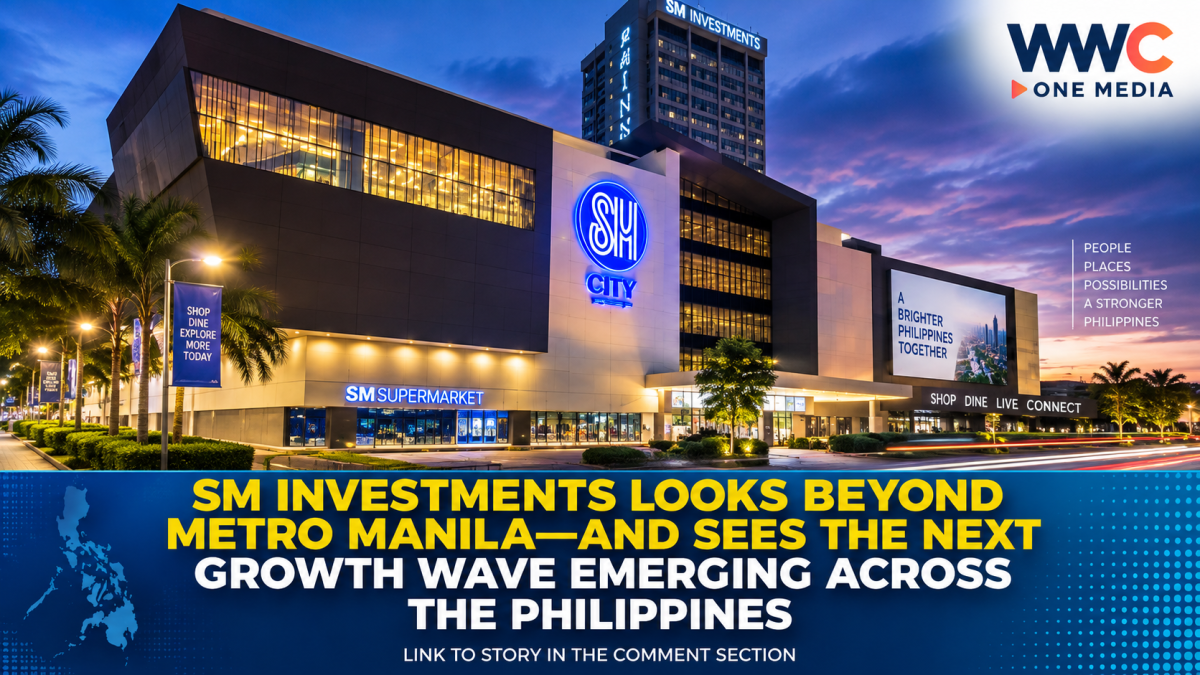
MANILA — The Philippines’ next major business opportunities may not be concentrated in Metro Manila.
For SM Investments Corp. (SMIC), the country’s regional markets are becoming increasingly important as rising incomes, changing consumer aspirations and expanding economic activity create new pockets of demand across the country.
SM Investments President and CEO Frederic C. DyBuncio highlighted that shift during the 24th MAP International CEO Conference, where business leaders discussed how companies can identify long-term opportunities amid rapid technological, economic and consumer changes.
DyBuncio said SM’s nearly seven decades of operating in the Philippines have reinforced the group’s strategy of looking beyond short-term economic cycles.
The bigger opportunity, he said, is increasingly visible outside Metro Manila.
“As incomes rise and aspirations evolve, opportunities are opening across the regions.”
That message is significant because SM’s businesses span some of the sectors most closely linked to rising household incomes and regional development: retail, banking, property and a wide range of portfolio investments.
The Provinces Are Becoming Harder to Ignore
For decades, Metro Manila has dominated the Philippine economy and remained the country’s primary center for corporate headquarters, finance, consumption and major infrastructure.
But economic activity has increasingly spread into regional centers.
That creates a different growth map for companies such as SM.
Instead of focusing exclusively on the country’s traditional economic core, businesses can increasingly follow population growth, household spending, tourism, infrastructure development and emerging commercial centers.
SM’s own strategy reflects that direction.
The group’s businesses have continued expanding their presence outside the capital, while SM Prime has identified opportunities for large-scale property development in provincial and emerging urban centers. SM’s portfolio also extends into logistics, food manufacturing, natural resources, office properties and other businesses that can benefit from broader economic activity.
SM’s Financial Numbers Give the Strategy More Weight
The regional-growth message comes after SM Investments reported stronger financial results in the first half of 2026.
SMIC recorded ₱45.9 billion in consolidated net income during January to June, an 8% increase from ₱42.6 billion during the same period a year earlier.
Consolidated revenue rose 6% to ₱339.2 billion.
Banking accounted for the largest share of net income at 47%, followed by property at 27%, retail at 15% and portfolio investments at 11%.
Those results help explain why SM continues to emphasize long-term expansion.
The company says its diversified structure allows it to generate cash across different parts of the economy and reinvest in areas where it sees longer-term potential.
Consumer Spending Remains the Key
One of the biggest questions for regional expansion is whether consumers outside Metro Manila have enough purchasing power to support sustained growth.
SM’s recent results provide one indication.
Despite economic pressures during the first half of 2026, the company reported that consumer spending remained resilient across its retail and mall businesses.
SM Retail’s net income increased 5% to ₱8.9 billion, while operating income rose 12% to ₱14 billion.
The mall business also recorded revenue growth of 8% to ₱41.8 billion, supported by higher occupancy, stronger tenant sales and improved operational efficiency.
For a company whose business model is deeply connected to Filipino consumption, those figures matter.
The more regional household incomes rise, the more attractive those markets can become for retailers, banks, property developers and service providers.
Regional Growth Is Already Visible in the Data
The economic case for looking beyond Metro Manila is not based solely on corporate expectations.
According to the Philippine economic data cited in recent reporting, regional economies have continued to expand, although growth rates differ substantially from one region to another.
That variation is precisely why companies cannot simply treat the Philippines as one uniform market.
A city experiencing rapid infrastructure development may generate demand for property and retail.
A tourism-heavy region may create opportunities for hotels, restaurants and transportation.
An emerging manufacturing or logistics hub can generate demand for warehouses, financial services and commercial space.
For a conglomerate with multiple business lines, identifying those differences can create opportunities to deploy capital across several sectors at once.
SM’s Business Model Gives It an Unusual Advantage
SM is not simply a mall operator.
Its ecosystem includes major interests in retail, banking, property and portfolio investments, including BDO Unibank, China Banking Corp. and SM Prime Holdings.
Its portfolio investments also cover areas such as logistics, mining, food manufacturing, office properties and other businesses.
That diversification means regional economic development can potentially benefit several parts of the group simultaneously.
A new commercial district, for example, could generate demand for:
- retail stores;
- shopping centers;
- housing;
- banking services;
- logistics;
- offices;
- food and consumer products; and
- transportation and other services.
That interconnected model is central to why SM continues to describe the Philippines’ long-term growth potential as an important investment opportunity.
Technology Is Changing How Companies Find Those Opportunities
DyBuncio’s message was not simply about geography.
The MAP conference also focused on artificial intelligence, data and rapidly changing consumer behavior.
AI can help companies identify patterns more quickly and analyze enormous quantities of information.
But DyBuncio emphasized that technology does not eliminate the need for business judgment.
Executives still have to decide what matters, where capital should be deployed and when to act.
That becomes particularly important when companies are deciding which regional markets deserve investment.
Population growth alone may not be enough.
Companies also need to examine purchasing power, infrastructure, competition, connectivity, employment, tourism, housing demand and the sustainability of local economic growth.
The Strategy Is Not a Retreat From Manila
SM’s focus on regional markets should not be interpreted as abandoning Metro Manila.
The capital remains one of the country’s largest economic and consumer centers.
Instead, the strategy is better understood as broadening the geographic base of growth.
SM can continue investing in established markets while directing additional capital toward regions where economic activity and consumer demand are expanding.
That approach is consistent with the company’s stated strategy of expanding its core businesses nationwide, particularly in provinces showing strong economic momentum.
Property Could Be One of the Biggest Beneficiaries
Among SM’s businesses, property development is particularly exposed to regional expansion.
As populations and businesses move into emerging economic centers, demand can develop for housing, retail space, offices and mixed-use developments.
SM Prime has previously highlighted provincial opportunities alongside large-scale urban developments.
The company has also continued to expand its portfolio beyond traditional economic centers, reinforcing the broader strategy of following long-term population and economic trends rather than relying solely on established markets.
Recent developments such as SM’s planned ₱3.2-billion mixed-use project in Clark also demonstrate how the Sy-led group continues to pursue opportunities outside Metro Manila.
Banking Adds Another Layer
Regional growth also creates opportunities for SM’s banking interests.
As households and businesses outside Metro Manila expand, demand can increase for loans, deposits, payments, investment products and other financial services.
SM’s banking businesses already represent the largest contributor to group earnings.
In the first half of 2026, banking contributed 47% of SMIC’s consolidated net income, according to the company’s results.
That gives the group another channel through which regional economic expansion can translate into growth.
Logistics Could Become Increasingly Important
There is another piece of the regional-growth equation that receives less attention: moving goods between markets.
As consumption spreads geographically, logistics infrastructure becomes increasingly important.
SM’s portfolio includes 2GO Group, which operates across passenger travel and logistics.
SM reported that 2GO recorded revenue growth in the first half of 2026, supported by higher passenger volumes and increased logistics activity associated with online purchases.
That provides another example of how changing consumer behavior can create opportunities beyond the traditional retail and property businesses.
Why the Timing Matters
DyBuncio’s remarks come at a time when Philippine businesses are dealing with multiple uncertainties.
Companies face changing interest rates, geopolitical risks, energy costs, technological disruption and evolving consumer behavior.
A short-term approach can make businesses overly focused on quarterly fluctuations.
SM is arguing for a different approach: identify structural changes that could create demand over many years and invest accordingly.
The company’s recent financial performance gives it room to continue pursuing that strategy, although future results will still depend on economic conditions, consumer spending and execution.
The Bigger Philippine Business Story
SM’s regional strategy reflects a broader transformation in the Philippine economy.
The country’s growth story is increasingly being shaped not only by Metro Manila but also by Cebu, Davao, Clark, Iloilo, Cagayan de Oro and other emerging economic centers.
As infrastructure improves and incomes rise, businesses have more reasons to examine markets that were previously considered secondary.
For large conglomerates, that can create a substantial new investment map.
And for consumers outside the capital, it can mean more malls, banks, housing developments, logistics services, retail options and employment opportunities.
But the opportunity is not automatic.
Regional markets have different economic conditions, infrastructure constraints and consumer profiles. Companies will have to determine which areas can sustain investment and which may not.
That is where capital allocation becomes critical.
The Next Growth Story May Be Regional
For SM Investments, the message from DyBuncio is clear: the next generation of Philippine demand may be increasingly distributed across the regions.
The company’s financial results show that its diversified businesses remain capable of generating substantial earnings, while its nationwide footprint gives it multiple ways to participate in regional development.
The question now is not whether opportunities exist outside Metro Manila.
It is which regions will emerge as the next major centers of consumer spending, property development, financial activity and logistics—and how quickly major companies move to capture them.
For SM Investments, the money is already beginning to follow the growth.
And the next big Philippine business story may be unfolding far from the capital.