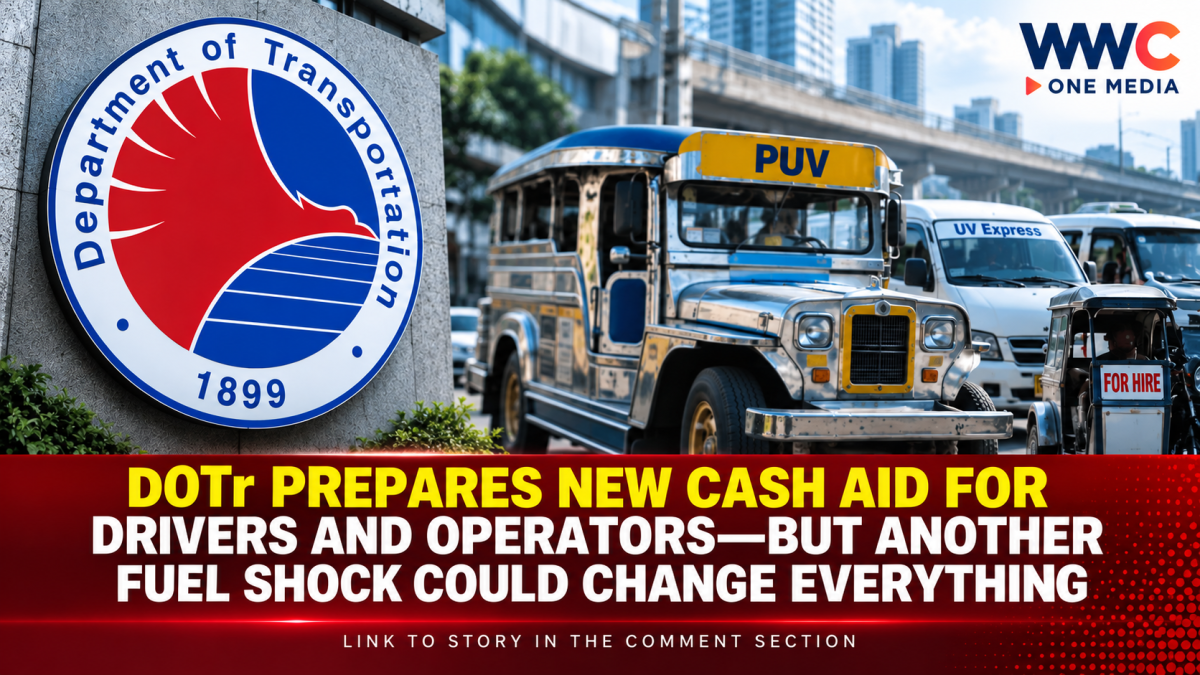
MANILA, Philippines — Public utility vehicle drivers and operators could soon receive another round of government assistance as the Department of Transportation (DOTr) moves to cushion the transport sector from another sharp surge in fuel prices.
The DOTr said on Saturday, September 19, that it is preparing another round of targeted financial assistance under the Department of Social Welfare and Development’s (DSWD) Assistance to Individuals in Crisis Situations (AICS) program for qualified transport drivers and operators affected by soaring fuel costs.
The move comes as motorists brace for another potentially steep increase in pump prices. Industry estimates cited by Philstar put the possible September 22 increase at around P10 to P10.50 per liter for diesel and P4.50 to P5 for gasoline, although the final adjustment remains dependent on the latest international oil and foreign-exchange movements.
Another round of transport aid
The planned assistance is part of a broader government response to the renewed fuel-price shock.
According to recent reports, the Unified Package for Livelihoods, Industry, Food and Transport (UPLIFT) committee presented additional measures to Executive Secretary Ralph Recto following its September 17 meeting.
Among the measures being pursued are targeted AICS assistance for qualified transport workers, relief measures for provincial buses, commuter fare discounts and other interventions intended to reduce the impact of higher fuel and transportation costs.
The latest announcements, however, have not yet established a final payout schedule or a new fixed amount for this additional AICS round. The government is still working out the implementation arrangements.
That means drivers should be cautious about social-media posts claiming that a specific amount or payout date has already been officially announced.
The P5,000 aid earlier this year
The new assistance follows the government’s earlier transport-sector relief program launched amid the first major fuel-price shock in 2026.
Under the DSWD’s AICS program, qualified PUV drivers received P5,000 in cash relief assistance. The initial rollout covered tricycle drivers, followed by other transport workers including jeepney drivers, TNVS drivers, motorcycle-taxi drivers and delivery riders.
By May, the DSWD said more than 1.5 million PUV drivers had already been served through the special cash-aid operations.
The government also stressed that the AICS cash assistance was separate from the DOTr-LTFRB fuel subsidy program.
Fuel subsidy faces another complication
The transport sector is also dealing with uncertainty surrounding the government’s fuel subsidy.
The Philippine Information Agency reported on September 11 that the LTFRB’s Central Visayas office had distributed fuel subsidies to more than 19,000 PUV units, exceeding 80% of its regional target.
Under the program, traditional jeepney operators receive P5,000 per unit, while their drivers receive P1,500. Modern UV Express operators receive P10,000, with their drivers receiving P5,000.
But GMA News reported on September 19 that distribution of the P12-per-liter fuel subsidy had been suspended because of the election-period restrictions on social-service spending. The Commission on Elections has indicated that an exemption could allow the program to proceed, but GMA reported that the LTFRB had not yet formally requested one.
The timing is particularly significant because fuel prices are again moving sharply upward.
Government also turns to modern PUV operators
The DOTr is separately providing financial support to transport cooperatives and corporations participating in the government’s Public Transport Modernization Program.
The Daily Tribune reported that qualified transport service entities operating modern PUVs will receive P20,000 per modern PUV per month for three months, or until available funds are exhausted.
The assistance is primarily intended to help settle existing loans with accredited financial institutions and reduce the risk of modern PUVs being repossessed because of unpaid amortizations. Cooperatives and corporations that have already fully paid their modernized units may use the assistance for operating expenses, subject to LTFRB guidelines.
This comes as financing pressures continue to weigh on modernization operators.
Why the new aid matters now
The latest fuel shock is putting pressure on both sides of the transport equation.
For drivers and operators, higher diesel prices directly raise daily operating expenses. For commuters, prolonged increases can translate into pressure for higher fares.
The government has therefore been pursuing a combination of cash assistance, fuel subsidies, fare relief, toll exemptions and public-transport support rather than relying on a single intervention.
Other relief measures reported by Philstar include continued toll exemptions for provincial buses, an extended terminal-fee waiver for PUVs at the Parañaque Integrated Terminal Exchange, discounts on MRT-3 and LRT-2 fares, Piso RORO terminal fees and continued Libreng Sakay services.
At the same time, the DOTr has been seeking continued funding for fuel subsidies. Philstar reported that the department’s request for a fuel-subsidy allocation was not included in the proposed 2027 National Expenditure Program, prompting calls for Congress to restore funding.
What drivers should watch for
For drivers and operators, the most important details to watch are the government’s eventual announcement on:
- Who qualifies for the new AICS assistance
- How much each beneficiary will receive
- When the payouts will begin
- How beneficiaries will be validated
- Whether payments will be made through cash, banks or digital wallets
- Whether the assistance will cover drivers, operators or both
Earlier AICS payouts relied heavily on beneficiary lists validated through transport regulators. The DSWD previously clarified that LTFRB-supplied lists were used for PUV driver beneficiaries, while DSWD handled the actual financial assistance under AICS.
The government has also increasingly favored digital disbursement for transport-related assistance. In April, DOTr officials said fuel-subsidy payments were being distributed through banks and e-wallets to reduce the need for drivers and operators to line up at LTFRB offices.
The bigger question
The latest aid package may provide short-term relief, but the government’s response is unfolding against a much larger fuel-price problem.
With diesel potentially climbing by double digits per liter, transport operators are once again facing higher operating costs at a time when the availability of government fuel subsidies is becoming uncertain.
For now, the next major development will be the DOTr and DSWD’s final mechanics for the additional AICS assistance—including the amount, beneficiaries and payout schedule.
Until those details are formally announced, drivers and operators should rely on official DOTr, DSWD and LTFRB announcements rather than unverified claims circulating online.