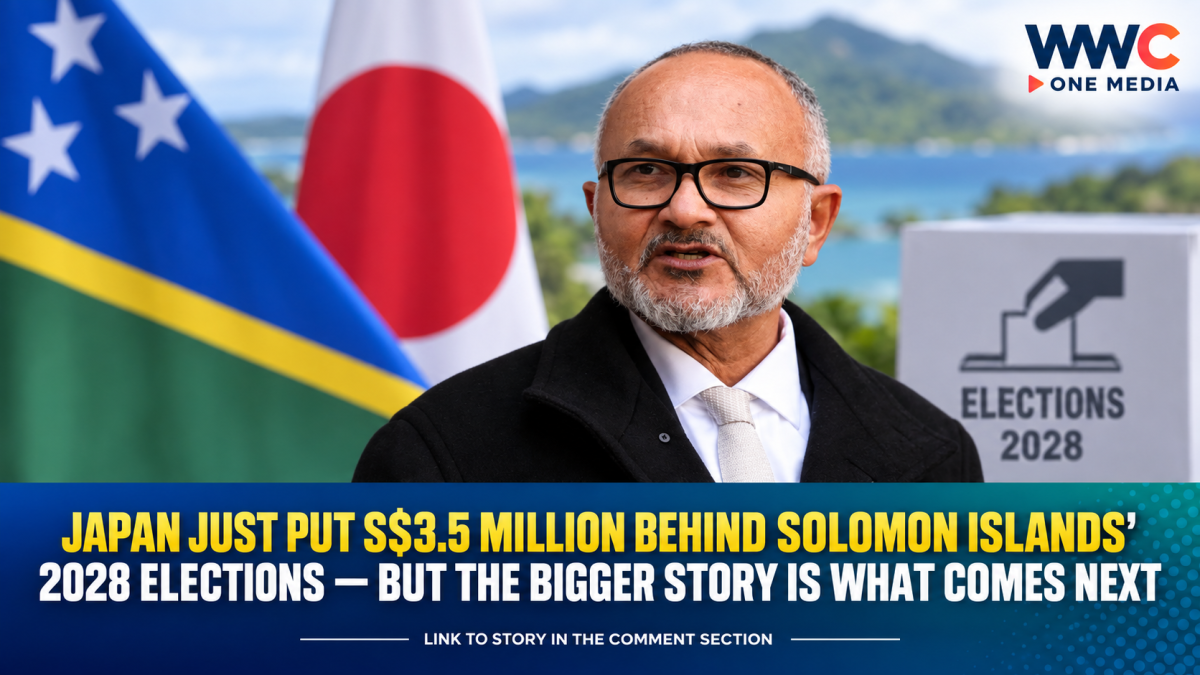
HONIARA/TOKYO — Japan is stepping up its support for electoral preparations in the Solomon Islands, providing up to ¥430 million — roughly S$3.5 million — for a programme aimed at strengthening the country’s election institutions ahead of the 2028 joint elections.
The grant, formally signed on September 8, will be delivered through the United Nations Development Programme (UNDP) and implemented in partnership with the Solomon Islands Electoral Commission (SIEC) and the Office of the Registrar of Political Parties.
Japan’s Foreign Ministry said the assistance will provide technical and advisory support to the electoral authorities, while also backing voter-awareness activities. The broader objective is to strengthen the capacity of Solomon Islands institutions to conduct inclusive and credible elections.
UNDP puts the Japanese contribution at ¥430 million, or about US$3 million, for the Solomon Islands Democratic Governance and Electoral Assistance Project, known as SIDGEAP.
What Japan’s money will support
The funding is not simply for polling-day operations.
According to Japan’s Embassy and UNDP, the programme will support technical training, institutional strengthening, electoral facilities and civic education, with particular attention to widening participation.
UNDP said the programme is also intended to strengthen participation by women, young people and persons with disabilities, while improving the legal, institutional and operational readiness of the electoral system.
The initiative builds on the experience of the 2024 Solomon Islands Joint Elections, when national, provincial and Honiara City Council elections were held simultaneously for the first time nationwide. The Solomon Islands Electoral Commission has identified further electoral reforms as priorities for the 2028 cycle.
One potentially significant reform is out-of-country voting. Local reporting citing UNDP says work is underway on a possible legal and regulatory framework that could allow Solomon Islanders living overseas to participate in the 2028 elections. The details of how such voting would work have not yet been finalised.
Japan joins a wider international effort
Japan is not entering the electoral-support effort alone.
UNDP said its new partnership expands a programme already backed by Australia and the United Kingdom, while the European Union supported the previous electoral cycle.
UNDP has also been involved in electoral assistance in Solomon Islands for more than a decade. Its previous Strengthening the Electoral Cycle Project supported electoral institutions, legal reforms, voter education and greater political participation before concluding in August 2026.
The new Japanese contribution therefore represents an expansion of an existing international effort rather than the creation of an entirely new electoral-support system.
Why the Solomon Islands matters beyond its elections
The timing of Japan’s announcement is significant because the Solomon Islands has become an important focus of strategic competition in the Pacific.
The country signed a security agreement with China in 2022 under the previous government. In June 2026, newly elected Prime Minister Matthew Wale said his government would review that agreement.
Wale’s government has subsequently pursued closer engagement with Australia. ABC reported in September that Canberra and Honiara had reached an in-principle understanding on a new bilateral treaty, with a package involving more than A$980 million in Australian support described in a leaked communication. The details and political implications of that package remain subjects of discussion.
At the wider regional level, Reuters reported that Australia and the United States announced a combined US$580 million in new Pacific funding in September, amid heightened competition for influence in the region.
Against that backdrop, Japan’s electoral assistance places democracy and governance alongside its broader engagement with Pacific island states.
Japan’s Foreign Ministry said the Solomon Islands’ strategic location means stronger relations contribute to its vision of a “Free and Open Indo-Pacific” based on the rule of law.
The road to 2028
The next major electoral test will be the 2028 Solomon Islands Joint Elections.
The Solomon Islands Electoral Commission’s strategic plan identifies continued electoral reform, including possible out-of-constituency and overseas voting, as areas for further development.
For UNDP, the objective is to use the years before polling day to strengthen the system rather than wait until an election is imminent.
Japan’s contribution will support that effort through 2028, with the stated focus on electoral institutions, voter participation and preparations for future elections.
The development also adds another layer to the increasingly active international engagement surrounding the Solomon Islands — where electoral governance, development assistance and competing strategic partnerships are now unfolding at the same time.
The key question heading toward 2028 is not simply how much foreign assistance the Solomon Islands receives, but how that support translates into stronger institutions and broader participation while keeping the electoral process nationally led.