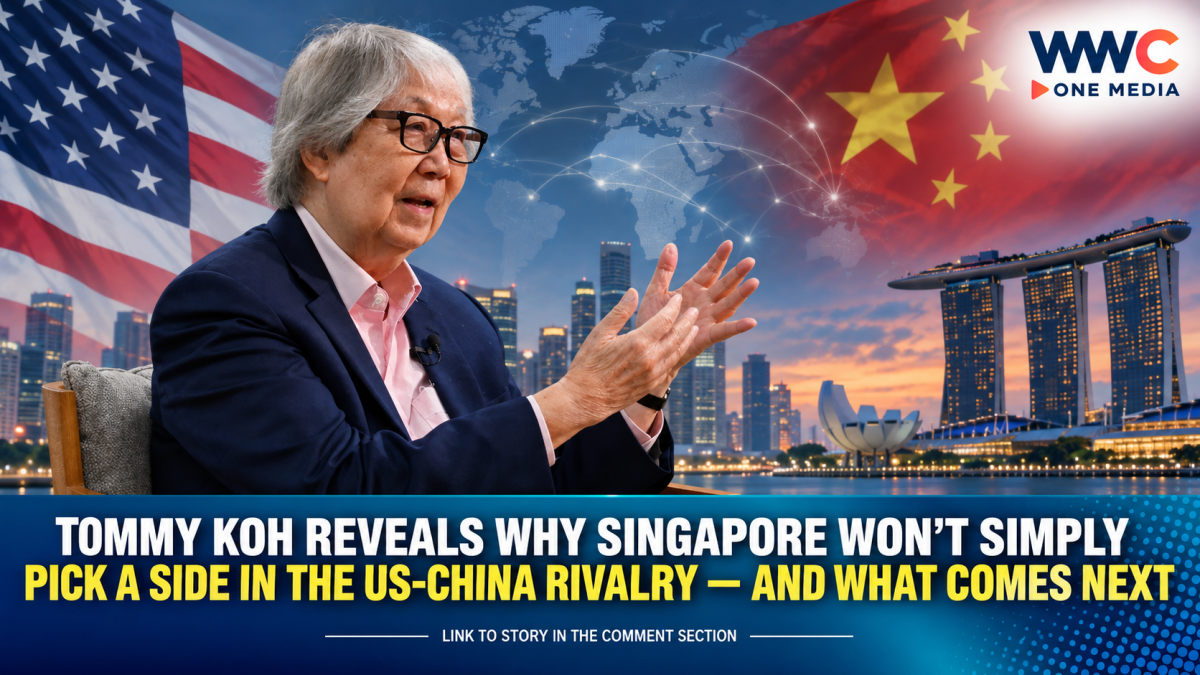
SINGAPORE — Singapore’s foreign policy is grounded in realism, but that does not mean the Republic simply accepts the actions of larger powers without responding, veteran diplomat and international law expert Professor Tommy Koh has said.
In a wide-ranging interview with The Straits Times on Sept 15, Mr Koh argued that Singapore’s approach is to recognise the realities of global power while preserving its ability to act, speak up and protect its national interests.
The comments came shortly after Mr Koh retired from Singapore’s Ministry of Foreign Affairs at the end of August after 55 years in the foreign service. At 88, he is Singapore’s longest-serving diplomat.
His views offer a window into how the city-state has navigated an increasingly complicated international environment marked by strategic competition between the United States and China, conflicts in Europe and the Middle East, and growing pressure on the multilateral system.
‘Accepting the world as it is’ does not mean standing aside
Mr Koh recalled one of the earliest lessons of his diplomatic career.
In 1968, shortly after he was posted to the United Nations, the Soviet Union invaded Czechoslovakia. Attempts at the UN Security Council to condemn the invasion were blocked by Moscow.
The experience left a lasting impression on him about the limits of international law when confronted by overwhelming military and political power.
But Mr Koh said this does not mean smaller countries have no ability to influence events.
Singapore, he argued, has agency.
“Accepting the world as it is doesn’t mean that we have no agency,” he said, adding that Singapore can push back and hold larger countries accountable.
That approach can be seen in Singapore’s historical record.
The Republic condemned Vietnam’s invasion and occupation of Cambodia in 1978 and supported efforts at the United Nations calling for the withdrawal of Vietnamese forces.
Singapore also condemned the Soviet invasion and occupation of Afghanistan in 1979 and the United States’ invasion of Grenada in 1983.
More recently, Singapore has spoken out on international-law issues despite maintaining relationships with major powers involved.
Singapore’s strategy: autonomy rather than choosing a superpower
One of Mr Koh’s key arguments concerns Singapore’s decision not to become a formal ally of the United States after the Cold War.
When the Soviet Union collapsed in 1991, Singapore’s policymakers debated whether the country should align itself with the remaining superpower or maintain an independent position.
The eventual approach was to remain close to the US without becoming its ally.
Mr Koh said the decision was intended to preserve Singapore’s autonomy and room for manoeuvre.
That calculation has become particularly significant as the international system becomes more multipolar.
Mr Koh expects China to become a complete superpower and a strategic rival to the US, but he does not expect the global system to be defined solely by Washington and Beijing.
He pointed to other important centres of influence, including the European Union, Japan, India and the BRICS grouping.
For Singapore, maintaining relationships across these different centres can provide greater room to pursue its own national interests.
Singapore’s position is also reflected in current government policy
Singapore’s official foreign-policy framework similarly emphasises realism, independence and strategic flexibility.
The Government states that its foreign policy is driven by realistic assessments of Singapore’s national interests and vulnerabilities, while also advocating a rules-based international system and respect for international law.
It identifies three fundamental objectives: protecting Singapore’s independence and sovereignty, keeping essential supply and transportation links open, and expanding economic opportunities while maintaining Singapore’s international relevance.
Foreign Minister Vivian Balakrishnan made a similar point in Parliament in February 2026, describing Singapore as a small state that must exercise agency rather than simply accept the choices imposed by larger powers.
He said Singapore would continue building relationships with major and middle powers while maintaining strategic space for itself.
The Government has also stressed that Singapore does not take sides in competing territorial claims in the South China Sea, while supporting freedom of navigation, peaceful dispute settlement and international law.
In September 2026, Dr Balakrishnan said Singapore was actively participating in ASEAN-China negotiations on a South China Sea Code of Conduct.
Why multilateralism still matters to Singapore
Mr Koh also defended multilateral institutions at a time when confidence in the international system has been challenged by wars and geopolitical rivalry.
He argued that although major powers have violated international rules, the UN system remains important because most of its 193 member states continue to support the organisation.
He criticised the withdrawal of the US from several international initiatives, arguing that Washington remains important but is not indispensable to the continuation of multilateral cooperation.
His broader argument is that smaller and middle-sized countries have an interest in preserving institutions where states can work together rather than leaving international affairs entirely to the largest powers.
This is closely aligned with Singapore’s longstanding position that a rules-based international order provides smaller countries with greater protection than a system governed purely by power.
ASEAN will remain a key test
Another major issue is ASEAN.
Singapore is scheduled to take over the ASEAN chairmanship in 2027, putting Myanmar and other regional challenges high on the agenda.
Mr Koh said ASEAN could face continued difficulty over Myanmar if the country’s military does not fundamentally reconsider its use of force.
Nevertheless, he remains supportive of ASEAN’s consensus-based decision-making system.
He argued that ASEAN’s practice of consultation and unanimity should be preserved rather than replaced by majority voting, warning that voting could damage the organisation’s ability to function as a regional “family”.
His comments come as ASEAN approaches its 60th anniversary in 2027, with the regional grouping facing challenges ranging from Myanmar’s conflict to strategic competition between the US and China.
Domestic unity is part of foreign policy
For Mr Koh, Singapore’s foreign policy is not determined solely by diplomats and international relationships.
He said the Government also has to persuade Singaporeans that its foreign-policy choices serve the national interest.
That includes explaining why Singapore does not simply choose between Washington and Beijing and why the Republic may take positions on international conflicts that do not neatly align with public sentiment.
He argued that national emotions should not override what he described as rational calculations of Singapore’s interests.
This emphasis on domestic consensus is also reflected in Singapore’s official foreign-policy framework, which states that effective foreign policy begins at home and depends on national unity and a well-informed population.
A balancing act that is becoming more difficult
Mr Koh’s assessment comes at a time when Singapore faces a more fragmented international environment.
The US-China strategic rivalry is intensifying, conflicts continue to test international institutions, and countries are increasingly seeking partners beyond traditional alliances.
A recent analysis by former Singapore diplomat Bilahari Kausikan similarly highlighted the tension between international principles and the practical requirements of state survival, drawing on former Foreign Minister S. Rajaratnam’s distinction between the ideals countries express and the practical diplomacy required to protect national interests.
For Singapore, the challenge is therefore not simply choosing which major power to support.
It is maintaining enough diplomatic, economic and strategic space to work with different countries while protecting the Republic’s sovereignty and interests.
Mr Koh’s message is ultimately that realism and activism are not contradictory.
Singapore can recognise the realities of power while still defending international law, building partnerships, supporting multilateral institutions and speaking up when it believes fundamental principles have been breached.
As global power becomes increasingly dispersed, that room for manoeuvre could become one of Singapore’s most important strategic assets.