JAKARTA — A decade after Indonesia’s devastating 2015 forest-fire crisis sent thick smoke across South-east Asia, the haze has returned — raising a difficult question for Indonesia and its neighbours: why does the problem keep coming back despite years of reforms, enforcement efforts and regional cooperation?
For more Indonesia environment and regional haze coverage, see our Indonesia hub and Asia desk.
The answer is more complicated than simply blaming a dry season.
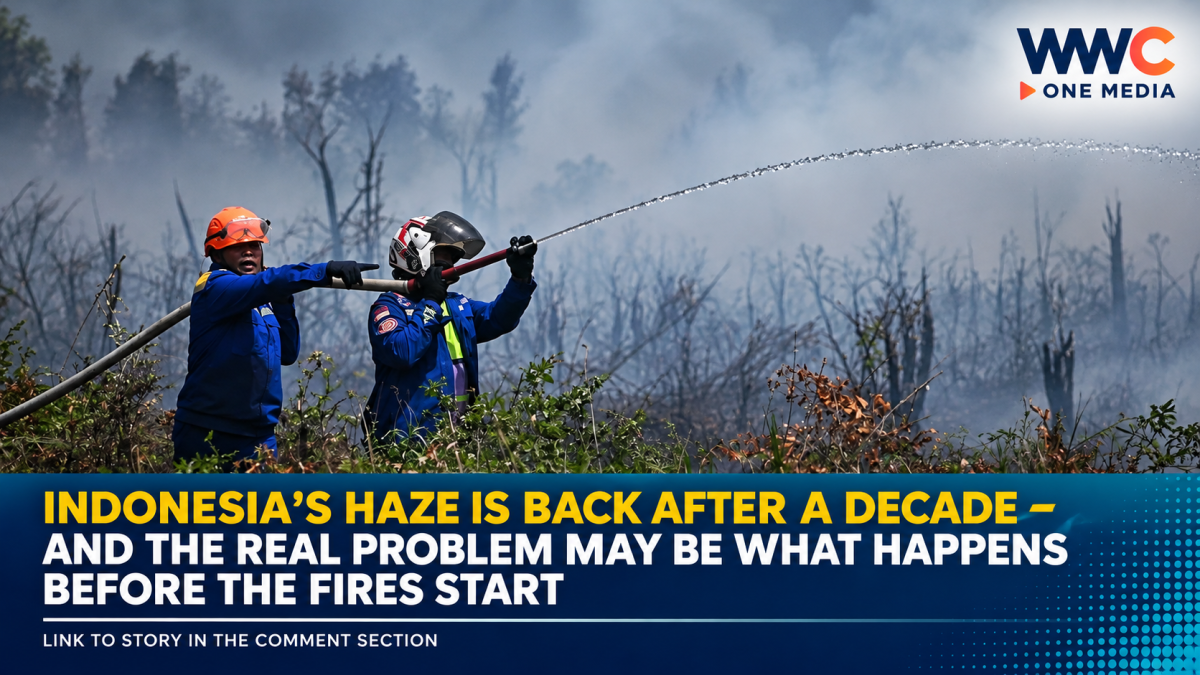
Indonesia’s 2026 fire season is serious, but it has not yet reached the scale of the catastrophic 2015 disaster. About 2.6 million hectares burned in 2015, while roughly 1.65 million hectares were affected by fires in 2019, according to figures cited by The Straits Times. The scale of this year’s fires varies considerably depending on the monitoring system used, but independent monitoring cited by the newspaper estimated nearly 900,000 hectares had burned by late August. Indonesian government figures, using a different methodology and reporting period, put the January-July figure at about 202,000 hectares.
What is clear is that the 2026 crisis is already significant.
Reuters reported that more than 12.5 million people across seven Indonesian provinces had been exposed to hazardous haze, while respiratory cases rose from 50,891 to 113,336 in just over a week, according to Indonesian Health Ministry data. The fires have also affected neighbouring Malaysia and Singapore.
And the fire season is not necessarily over.
Indonesia’s Forestry Minister Raja Juli Antoni said on Sept 16 that fires could continue until early November, with the arrival of the rainy season delayed.
The weather is making an old problem much worse
One major factor behind the 2026 fires is an unusually severe El Niño pattern.
Hotter and drier conditions make vegetation and drained peatlands far more vulnerable to fire. NASA reported in early September that fires were smouldering both above ground and underground in Indonesia’s peatlands as drought conditions persisted.
ASEAN’s Specialised Meteorological Centre raised its southern ASEAN haze alert to Level 3 in August after detecting large clusters of hotspots in Kalimantan and Sumatra, accompanied by moderate to dense smoke haze. The agency warned that continuing dry weather and strengthening El Niño conditions could increase the risk of severe transboundary haze.
But El Niño alone does not explain the crisis.
Why peatlands remain at the centre of the problem
Indonesia’s peatlands are particularly vulnerable.
When peatlands are naturally waterlogged, they resist burning. But drainage for agriculture and plantations can turn them into highly combustible landscapes. Once ignited, peat can continue burning underground, making fires much harder to detect and extinguish.
Research and satellite monitoring have repeatedly shown fires occurring in areas used for plantations and other commercial activities.
A recent Straits Times analysis found that nearly a quarter of Indonesia’s forest and peatland fires occurred inside business concessions, including areas associated with oil palm, mining and pulpwood operations. However, a hotspot inside a concession does not by itself prove that the concession holder started the fire or is legally responsible for it.
The economic calculation also remains difficult.
In some areas, clearing land without fire can cost substantially more than burning it, creating an incentive for some land users to continue using fire despite restrictions. That means enforcement alone cannot completely solve the problem unless land-management alternatives are affordable and practical.
Indonesia did make progress after 2015
It would be misleading to say that nothing changed after the 2015 disaster.
Indonesia introduced stronger fire-prevention measures, expanded monitoring, increased enforcement and invested in peatland restoration.
The government also established the Peatland Restoration Agency in 2016, followed later by the Peatland and Mangrove Restoration Agency. The programmes included efforts to rewet vulnerable peatlands, monitor groundwater levels and strengthen community-based fire prevention.
The reduction in the scale of some subsequent fire seasons suggests those measures had an effect.
But institutional continuity has become a concern.
The restoration agency’s mandate ended in 2024, with its responsibilities transferred to other government bodies. Former agency officials and environmental groups have questioned whether the same level of coordination, resources and monitoring has continued. The Straits Times also reported concerns about damaged peatland infrastructure and insufficient groundwater levels in some restoration areas.
That creates a crucial distinction: Indonesia may have become better at detecting and fighting fires, without eliminating the conditions that allow fires to start in the first place.
Enforcement remains another weak point
Indonesian authorities have stepped up investigations this year.
Police said on Sept 17 that they had opened 219 criminal investigations, named 162 suspects and were examining 95 companies in connection with forest and land fires. President Prabowo Subianto has also ordered tougher action against those responsible and called for companies found responsible for fires to face licence revocation and criminal investigations.
The Forestry Ministry separately announced administrative sanctions against six companies in August after fires were detected in areas under their management. One company’s business permit was suspended following what the ministry described as extensive and repeated fires.
But legal responsibility is not automatic simply because a fire occurs inside a concession. Establishing who caused a fire and whether a company breached its obligations requires investigation and evidence.
That distinction matters because the long-term solution depends not only on punishing people after fires occur, but on preventing fires from starting.
A regional problem with a regional agreement
The haze has long been a South-east Asian issue rather than an Indonesian one alone.
ASEAN members signed the ASEAN Agreement on Transboundary Haze Pollution in 2002, following the severe regional fires of the late 1990s. The agreement entered into force in 2003, and Indonesia — the last ASEAN member to ratify it — deposited its ratification instrument in January 2015.
The agreement provides a framework for monitoring, prevention, information-sharing and regional assistance.
In July 2026, Indonesia hosted an ASEAN ministerial meeting focused on strengthening cooperation against El Niño and transboundary haze, showing that regional mechanisms remain active.
Yet the recurrence of haze illustrates the limits of regional cooperation when the fires themselves are rooted in domestic land-use practices, local enforcement and economic incentives.
Singapore is seeing the warning signs again
For Singapore, the return of Indonesian fires has brought back familiar memories.
Singapore’s National Environment Agency said smoke plumes from fires in southern Sumatra and Kalimantan were drifting towards the island in September. On Sept 10, the 24-hour PSI ranged from 73 to 104, moving from the moderate into the unhealthy range.
The Straits Times reported that Singapore’s PSI entered the unhealthy range on Sept 4 — the first time since October 2023 that haze pushed the index into that category. However, conditions had not reached the extreme levels seen during the 2015 or 2019 haze episodes at the time of its Sept 15 assessment.
That is an important distinction.
The current haze is a serious warning, but it should not automatically be described as a repeat of 2015.
The bigger question is what happens after the smoke clears
The most difficult lesson from 2026 may be that firefighting is only one part of the solution.
Aircraft can drop water. Cloud seeding can be attempted. Firefighters can attack hotspots. Police can investigate suspects. Companies can be sanctioned.
But once the rain comes, the underlying problem does not disappear.
Drained peatlands remain vulnerable. Land-clearing incentives remain. Restoration requires money and maintenance. Local governments need resources and equipment. Companies must maintain fire-prevention systems. And multiple government agencies need to coordinate before the dry season — not only after the first smoke appears.
That is why the return of the haze, a decade after Indonesia’s worst fire disaster, is less a story about whether the country has learned nothing and more a test of whether the reforms introduced after 2015 can survive when political attention, budgets and coordination begin to weaken.
For now, the region is waiting for the rains.
But the more consequential question may be what Indonesia and its neighbours do before the next dry season begins.