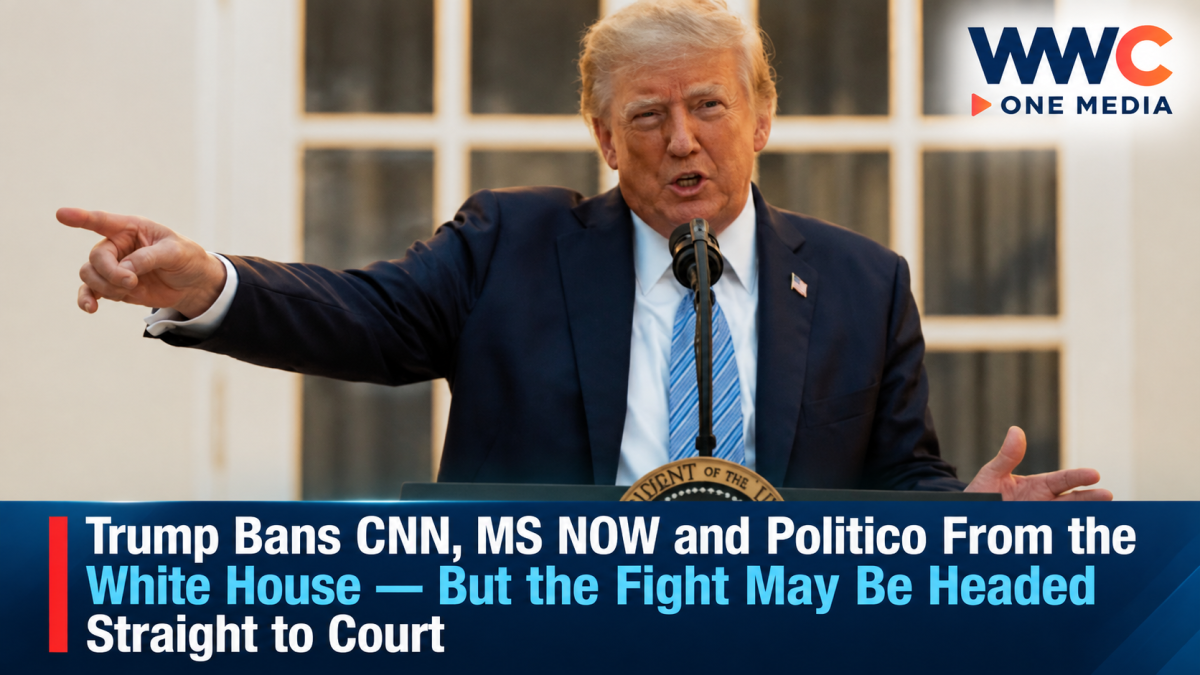
WASHINGTON — President Donald Trump has announced that CNN, MS NOW and Politico are being barred from the White House, escalating his long-running confrontation with major U.S. news organizations and immediately raising questions over how far the administration can legally restrict journalists’ access to the presidency.
Trump announced the move on September 18 through Truth Social, accusing the three outlets of publishing what he called “fake news” and saying the ban was effective immediately. He also warned that other media organizations could face similar treatment.
But the announcement left a crucial question unanswered: What exactly does “banning” the outlets mean in practice?
Trump did not initially specify whether reporters would have their White House credentials revoked, whether the organizations would be excluded from press briefings and events, or whether restrictions would apply only to certain presidential spaces.
Reports from the White House indicated that journalists from CNN, MS NOW and Politico were still present on the grounds shortly after Trump’s announcement, underscoring the uncertainty surrounding how the order would be implemented.
Trump threatens to target more media outlets
The president’s announcement did not appear to be limited to the three organizations.
Trump said other “Fake News Media Outlets” could follow, without identifying which organizations might be next. During remarks at the White House, he reiterated his criticism of news organizations whose coverage he considers unfair or inaccurate.
The move represents another escalation in Trump’s frequently combative relationship with the U.S. news media.
Reuters reported that Trump has repeatedly pressured broadcasters over programs and coverage he dislikes and has previously called on the Federal Communications Commission to take action against stations over programming he criticized.
Why the announcement could trigger a legal battle
The biggest question now may not be political but constitutional.
The First Amendment protects freedom of the press, while courts have previously examined whether government officials can selectively restrict journalists’ access to government facilities because of their reporting or viewpoint.
CNN said it stands behind its White House reporting and argued that journalists have a constitutional right to report without government interference. Politico similarly said it would continue covering the administration and defend its First Amendment rights. MS NOW did not immediately comment.
Legal experts and press-freedom organizations cited by several outlets have questioned whether the administration can lawfully exclude particular news organizations from generally available White House press access because of unfavorable coverage.
That does not mean the legal outcome is predetermined. The precise constitutional analysis can depend on the type of access involved, the rules governing the particular press facility and whether the administration is imposing a broad credentialing restriction or limiting access to more restricted presidential spaces.
The White House has already fought similar battles
This is not Trump’s first confrontation with the press over access.
In 2018, during his first presidency, the White House revoked CNN reporter Jim Acosta’s press credentials following a confrontation during a news conference. A federal judge subsequently ordered the credential restored.
More recently, the Trump administration restricted Associated Press access after the news organization continued using the term “Gulf of Mexico” rather than the administration’s preferred “Gulf of America.”
A federal judge ruled in 2025 that the White House had to restore AP access to presidential spaces, although subsequent litigation addressed the administration’s authority over more restricted areas.
The administration has also changed how the presidential press pool is selected, giving the White House a greater role in determining which journalists receive access to certain limited-capacity events.
CNN, MS NOW and Politico are now at the center of the dispute
The three targeted organizations occupy different parts of the American media landscape.
CNN is one of the country’s major television news networks. MS NOW is the network formerly known as MSNBC, while Politico is a major political news organization covering Washington and federal policy.
Trump’s announcement therefore affects television and digital political journalism rather than a single media company or platform.
The White House has not publicly identified specific reports that prompted the latest restrictions. Reuters reported that Trump’s announcement cited the outlets’ coverage generally rather than pointing to particular stories.
That absence of specific examples could become important if the dispute proceeds to court.
Press access is becoming a larger White House battle
The latest confrontation comes amid broader changes to how journalists interact with the Trump administration.
The Pentagon has imposed restrictions on reporters’ access, while the White House has taken greater control over portions of the presidential press pool. The administration has argued that it needs greater control over access and press operations, while news organizations and press-freedom groups have challenged some of those policies.
The resulting dispute goes beyond CNN, MS NOW and Politico.
At issue is whether a president can use access to the White House — a critical source of information about the executive branch — as leverage against news organizations whose coverage the administration dislikes.
What happens next?
For now, the immediate uncertainty is implementation.
Trump has announced the ban, but the administration has not publicly detailed a comprehensive mechanism explaining exactly which journalists would be excluded, from which areas and under what rules.
That leaves several possible flashpoints: press credentials, White House briefings, presidential travel pools, Oval Office events and access to other restricted presidential spaces.
If the administration formally excludes the three organizations from generally available press facilities, a court challenge could follow quickly.
And Trump’s warning that additional outlets may be targeted means the confrontation could expand beyond CNN, MS NOW and Politico.
For the U.S. media industry, the next step may therefore be more consequential than Friday’s announcement itself: whether the White House turns the declaration into a formal access policy — and whether the courts are asked to decide where presidential control of the press ends and constitutional protections begin.
The White House announcement and the reactions described above reflect events reported on September 18–19, 2026. The legal questions remain unresolved, and the precise scope of the announced restrictions had not been fully clarified at the time of publication.