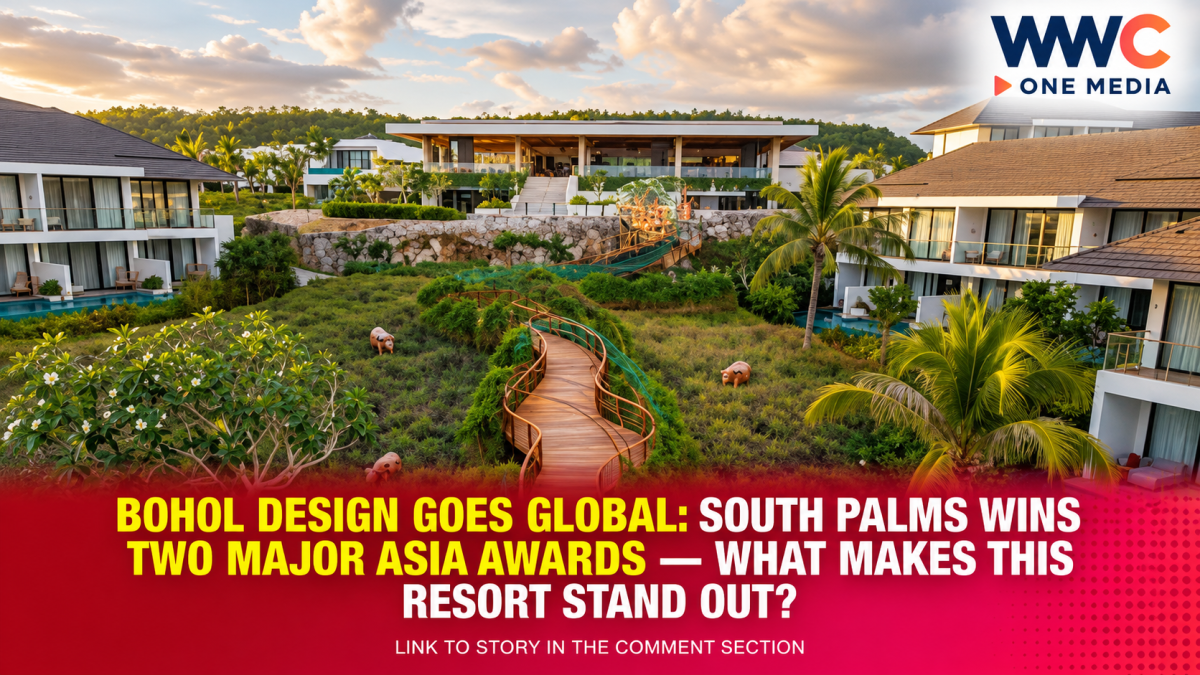
Bohol’s distinctive design language is gaining international attention after South Palms Resort & Spa, MGallery Collection in Panglao captured two major honors at the AHEAD Asia 2026 awards in Singapore.
The resort won the Sustainability and Spa & Wellness categories during the September 11 ceremony at Pan Pacific Orchard, putting a distinctly Boholano approach to hospitality design in the spotlight across Asia.
The recognition goes beyond luxury interiors.
South Palms’ design incorporates reclaimed materials, local craftsmanship, passive environmental strategies and resource-recovery systems, creating a resort concept that is closely tied to the island where it stands.
The Bohol story is built into the resort
Rather than relying primarily on generic tropical-resort aesthetics, South Palms draws directly from Bohol’s landscape, communities and traditional materials.
Among the most distinctive elements is reclaimed timber sourced from fishing boats and structures damaged by typhoons.
Limestone excavated during construction was also reused as architectural cladding rather than treated simply as construction waste.
The approach was recognized by the AHEAD Asia judging panel, which praised the project for its strong storytelling and locally driven narrative.
The resort’s developers and designers say the objective was not simply to make the property “look Filipino,” but to express Bohol through its materials, artisans, culture and local way of life.
Nearly 5,000 square meters of reclaimed timber
The scale of the material reuse is substantial.
Tatler Asia reported that nearly 5,000 square meters of reclaimed timber sourced from typhoon-damaged boats and houses were incorporated into the resort’s walls and sliding screens.
Buri palm raffia, traditionally woven into Saguran cloth by Boholano artisans, was also integrated into ceilings and joinery.
The result is a design vocabulary that connects the guest experience to the island’s traditional crafts while giving discarded or damaged materials another life.
This strategy also demonstrates how local materials can become part of a contemporary luxury environment without abandoning their original cultural context.
Sustainability goes beyond the materials
The environmental strategy at South Palms extends beyond reclaimed wood and stone.
The resort incorporates passive design, solar energy, greywater reuse, on-site water bottling, glass recycling and composting as part of its approach to reducing resource consumption and waste.
Its buildings were also designed to respond to local environmental conditions.
Tatler Asia reported that the development’s sustainability consultants used environmental modeling to improve building orientation, natural ventilation, daylight access, glazing, insulation, lighting, cooling systems and solar-thermal generation.
That makes the project an example of sustainability being incorporated into the design process rather than added merely as a finishing feature.
The resort turns Bohol culture into a guest journey
The property’s design is also structured around movement through the landscape.
Tatler Asia described the lobby as being positioned at the site’s highest point, giving guests expansive views toward the sea before they move through a village-like arrangement of bungalow-style buildings and landscaped paths.
Local artists also contributed hand-painted murals along the corridors.
The murals draw on themes including Harvest, Nature and Culture, with visual references to traditional tattoos associated with Bohol’s indigenous communities.
The result is intended to make the architecture feel connected to the destination rather than simply placed on it.
AHEAD judges praised the local narrative
The AHEAD Awards’ official profile describes South Palms as taking a holistic approach to wellbeing and responsible development.
Judges highlighted the project’s relationship with its site and community, as well as its use of Boholano traditions and local sourcing.
They specifically praised what they described as the project’s “great storytelling and locally driven narrative.”
The award therefore recognizes more than the resort’s appearance.
It reflects how architecture, interiors, operations, wellness and environmental considerations were brought together around a common sense of place.
The design team spent months immersed in Bohol
The designers say achieving that connection required more than studying the island from afar.
Patricia Ho Douven, founder of White Jacket, said the team sought to understand Bohol’s materials, craftsmanship and local way of life rather than simply applying Filipino-inspired decorative elements.
Phillip Pond, founder of Atelier Pond, similarly described spending months with local craftsmen and experiencing the island’s materials and rhythms before the design was finalized.
That process helped shape a project intended to feel distinctly Boholano while still functioning as a contemporary international hospitality property.
South Palms has another major design award this year
The AHEAD Asia recognition is not the resort’s only major design achievement in 2026.
South Palms Resort & Spa also won Best Innovative Design at the Tatler Homes Design Awards 2026 Philippines.
Tatler Asia identified SCSY and Rchitects Inc. as the design team behind the award-winning project and highlighted its climate-responsive approach, reclaimed materials and integration of local craftsmanship.
That recognition adds another dimension to the resort’s growing design profile.
Instead of a single award for one aspect of the property, South Palms has now received recognition across sustainability, wellness and innovation.
Local craftsmanship becomes part of the luxury experience
The resort’s design also extends local sourcing into the guest experience.
Philippine-made furniture, handwoven raffia, locally produced earthenware and ingredients sourced from nearby communities are incorporated into different parts of the property.
This approach creates a direct link between the resort and the local economy.
It also demonstrates how luxury hospitality can use local materials and craftsmanship without treating them as merely decorative souvenirs.
Why the recognition matters for Bohol
Bohol is already one of the Philippines’ most recognizable tourism destinations, but the South Palms recognition highlights another aspect of the island’s appeal: design rooted in place.
The AHEAD awards place the project alongside other hospitality developments competing for attention in one of Asia’s most active luxury-tourism markets.
For Bohol, that provides international visibility not only for a resort but also for the island’s artisans, materials, architecture and cultural identity.
The recognition comes as destinations across Asia increasingly compete on experiences rather than simply beaches, rooms and facilities.
A resort that can tell a convincing local story while addressing sustainability and wellness can offer a different proposition to travelers seeking more destination-specific experiences.
A model for a different kind of Philippine luxury
South Palms’ awards point to a broader evolution in Philippine hospitality design.
Instead of importing a standardized international luxury aesthetic, the project demonstrates how contemporary resorts can draw their identity from the places where they operate.
In Bohol’s case, that means reclaimed timber, limestone, buri, local craftsmanship, indigenous cultural references, tropical climate responses and connections to the surrounding land and sea.
The international recognition suggests that these local elements can compete on a regional design stage when they are combined with strong architecture, environmental planning and a carefully considered guest experience.
For Bohol, the significance may extend beyond one resort.
South Palms has shown that a luxury property does not have to look like it could be anywhere in Asia to compete across Asia. Its newest awards suggest that the strongest design advantage may be precisely what cannot be copied: the story, materials, craftsmanship and culture of the place itself.