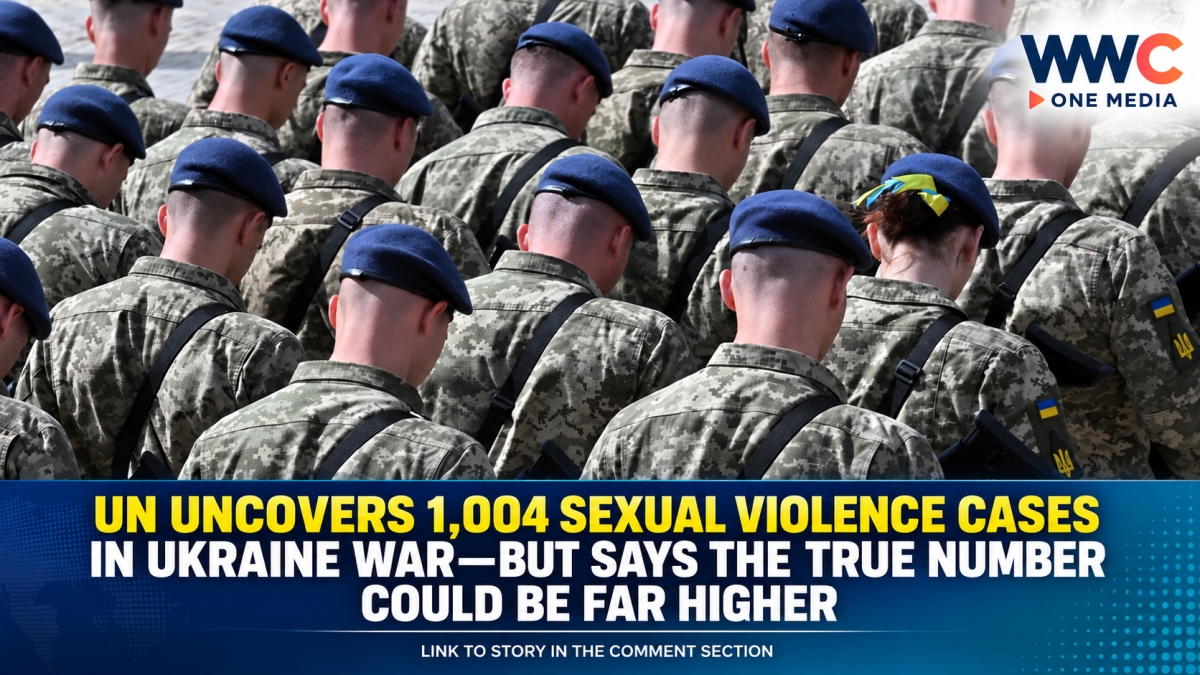
GENEVA — A new United Nations human rights report has documented 1,004 cases of conflict-related sexual violence in Ukraine between February 2022 and July 2026, with the overwhelming majority attributed to Russian authorities.
The report, released by the UN Human Rights Office on September 18, says 89% of the documented cases were attributed to Russian authorities, including members of the Russian armed forces, prison service and national security service. The remaining 11% were attributed to Ukrainian authorities, including members of the Ukrainian armed forces and security and penitentiary services.
The findings cover both detention and non-detention settings and are based on confidential interviews with hundreds of victims and survivors, along with court documents, official records and other evidence.
The UN stressed that the 1,004 cases do not represent the full scale of sexual violence during the war. Conflict-related sexual violence is frequently under-reported, while UN investigators have faced significant limitations in accessing occupied Ukrainian territory and detainees held by Russian authorities.
Most documented survivors were men
One of the report’s most notable findings is that men made up the majority of documented survivors, particularly among prisoners of war and detainees.
The UN documented sexual violence at multiple stages of detention, including during capture, transfers, interrogation, detention and immediately before release or exchange.
Reported abuses included rape, gang rape, genital mutilation, beatings to the genitals and electric shocks, as well as other acts of sexual humiliation and coercion. The UN said the pattern indicated that sexual violence was used as a method of torture, intimidation and coercion.
Women and children were also among the survivors, particularly in areas under Russian occupation.
The UN said the youngest documented rape survivor was a four-year-old girl, while the oldest was an 82-year-old woman. Both cases were attributed to Russian authorities.
Russian authorities linked to the vast majority of documented cases
According to the UN’s analysis, the 89% attributed to Russian authorities involved a range of state personnel, including military personnel, penitentiary officials and security-service members.
The report says sexual violence against Ukrainian prisoners of war and civilian detainees occurred in occupied Ukrainian territory and inside Russia, with violations documented throughout the detention process.
Reuters reported that the documented abuses included the use of electric shocks to the genitals and other forms of severe sexual violence. Russia’s permanent diplomatic mission in Geneva did not provide comment to Reuters on the findings.
The UN also said Russia had not engaged with requests for information and had not provided the access required for investigators to fully examine conditions in occupied areas and detention facilities.
UN also documents abuses by Ukrainian authorities
The report does not attribute all documented violations to Russia.
The UN attributed 11% of the 1,004 verified cases to Ukrainian authorities. These included allegations involving Ukrainian military personnel and other state authorities. The violations were described by UN officials as serious and requiring accountability.
In Ukrainian government-controlled territory, nearly half of the documented violations attributed to Ukrainian authorities involving Russian and other prisoners of war and detainees included threats of sexual violence and beatings to the genitals.
The UN said it did not document any cases of rape of Russian prisoners of war by Ukrainian forces during the reporting period. Russian and third-country prisoners reported sexual violence at 10 official detention facilities and 55 unofficial or transit locations.
The UN also noted that Ukraine had permitted its monitoring mission access to detention facilities and had cooperated with requests for information, although accountability efforts remained limited.
Why the UN says the real figure may be much higher
The 1,004 cases should therefore be understood as verified and documented cases, rather than an estimate of every incident that occurred.
During a UN Geneva briefing, Danielle Bell, head of the UN Human Rights Monitoring Mission in Ukraine, said the documented cases represented only a fraction of the overall number. The mission had interviewed approximately 10% of released Ukrainian prisoners of war and 10% of detained Russian prisoners of war, while access to civilian detainees was also constrained.
Russia’s lack of access for UN investigators to occupied territory and detention sites further limits the ability to establish the full scale of the abuse.
That makes the report’s 1,004 figure a measure of what investigators were able to verify—not a ceiling on the number of victims.
UN warns the abuse may still be continuing
UN High Commissioner for Human Rights Volker Türk said he was deeply alarmed by the prevalence of the violations documented in the report and warned that sexual violence could still be occurring as the war continues.
The UN is calling for stronger prevention, investigation and accountability measures and says survivors need support tailored to their experiences, including approaches that recognize the significant number of male survivors.
The report also underscores a broader problem facing investigators: sexual violence during war is often hidden, under-reported and difficult to document, particularly when victims remain in detention or live in areas inaccessible to international monitors.
The bigger picture
The UN findings add another dimension to the continuing human-rights documentation surrounding Russia’s full-scale invasion of Ukraine.
The evidence gathered so far points to sexual violence affecting civilians and prisoners of war on both sides, but with a substantially larger share of the verified cases attributed to Russian authorities. At the same time, the UN cautions that its data cannot provide a complete accounting of the conflict’s sexual-violence toll.
For survivors, the central issue now extends beyond documentation: whether the allegations can be investigated, perpetrators identified and victims provided with meaningful protection, justice and long-term support.
The UN’s 1,004 documented cases are therefore not the end of the story—they are the cases investigators were able to verify amid a conflict where much remains hidden.