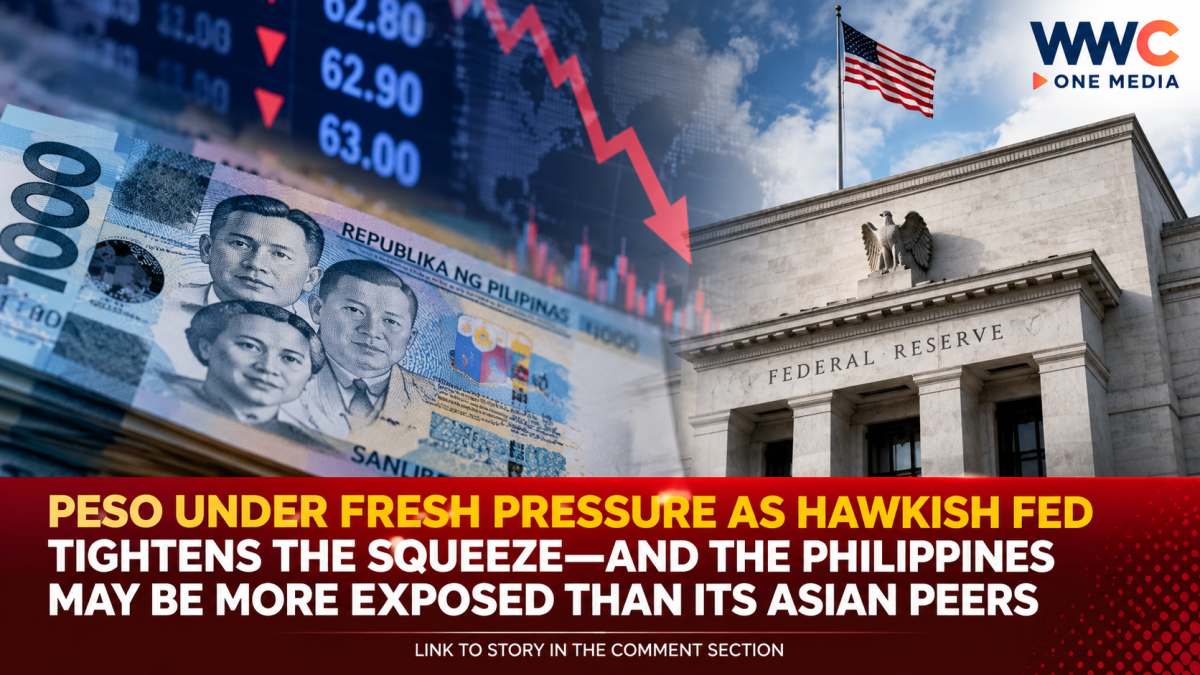
MANILA, Philippines — The Philippine peso is facing another difficult stretch after the US Federal Reserve’s renewed tightening pushed the dollar higher, while elevated oil prices and the Philippines’ external deficit add another layer of pressure on the local currency.
The warning comes from Australia and New Zealand Banking Group (ANZ), which said Asian economies with relatively wide current-account deficits and limited exposure to the artificial-intelligence investment boom could be more vulnerable when expectations for higher US interest rates rise. The Philippines is among the economies identified as particularly sensitive to that combination.
The timing is significant: the peso has already been trading at record lows against the US dollar.
On Sept. 14, the currency closed at ₱62.86 to the dollar, after touching an intraday record low of ₱62.875. Just a day earlier, the peso was already approaching the ₱63 threshold as traders reacted to expectations of tighter US monetary policy, higher oil prices and continued demand for dollars.
Fed tightening puts another weight on the peso
The Federal Reserve subsequently raised its benchmark interest rate by 25 basis points, bringing the target range to 3.75%–4%—its first rate increase in three years.
The move strengthened the appeal of dollar-denominated assets and pushed US Treasury yields higher, creating another challenge for emerging-market currencies such as the peso.
Reuters reported on Sept. 17 that bearish positioning against emerging Asian currencies had intensified amid higher US Treasury yields and escalating Middle East tensions. The Philippine peso was the most shorted currency in the Reuters survey, with bearish bets reaching their highest level in more than four months.
However, Reuters also reported an important counterpoint: analysts at MUFG said the risk-reward of betting on further dollar strength against the peso had become less attractive because of the peso’s valuation and improving domestic fundamentals.
Why the Philippines is particularly vulnerable
The Philippines’ exposure goes beyond interest-rate differentials.
Higher US rates can encourage investors to favor dollar assets, increasing demand for the greenback and putting pressure on emerging-market currencies.
At the same time, the Philippines is a major energy importer. When oil prices rise, importers need more dollars to pay for fuel, increasing demand for foreign currency and potentially widening trade pressures.
That risk has become more pronounced amid renewed Middle East tensions. Reuters reported that oil prices moved above $100 a barrel following attacks affecting Saudi Arabia’s East-West pipeline, while higher Treasury yields simultaneously strengthened the dollar.
Philstar likewise reported that the peso’s record-low moves in September were being driven by a combination of higher US yields, expectations of tighter Fed policy and elevated oil prices.
The speed of the peso’s decline is also drawing attention
Economists have pointed to the pace of depreciation as an important issue.
BusinessMirror reported that the peso moved from around ₱60.93 per dollar in early August to nearly ₱62.80 by Sept. 7, representing roughly a 3% decline over a relatively short period. Analysts said a rapid adjustment can have implications for market sentiment and inflation expectations.
The concern is not simply the exchange-rate level. A weaker peso raises the local-currency cost of imported goods, particularly fuel and other commodities priced in US dollars.
That can eventually feed into consumer prices, although the impact generally occurs with a lag and depends on global commodity prices and domestic demand conditions.
BSP faces a more complicated policy environment
The Bangko Sentral ng Pilipinas is also navigating the pressure.
The BSP raised its Target Reverse Repurchase Rate by 25 basis points to 5% on Aug. 27, 2026, while maintaining its focus on price stability.
But the renewed Fed tightening creates a more complicated environment for the Philippine central bank. Analysts cited by BusinessMirror said further domestic rate adjustments could remain an option if inflation risks and external pressures persist.
Higher Philippine interest rates can help support the currency by making peso assets relatively more attractive, but they can also weigh on domestic borrowing and economic activity.
What happens next?
The peso’s trajectory will depend on several forces moving at the same time: US interest rates, Treasury yields, global oil prices, Middle East developments, Philippine inflation, dollar demand and the country’s external accounts.
Reuters’ latest currency survey shows that investors remain heavily positioned against the peso, but the same report notes that some analysts see less room for additional dollar gains against the Philippine currency because of valuation and domestic fundamentals.
For Filipino consumers and businesses, the key issue is not simply whether the peso reaches another record low. The more important question is whether depreciation remains orderly or begins feeding more persistently into fuel costs, imported goods, inflation expectations and borrowing conditions.
With the Federal Reserve now back in tightening mode and oil prices elevated, the pressure on the peso is coming from several directions at once.
And with ₱63 per dollar now within striking distance, markets will be watching closely to see whether the latest record becomes a temporary milestone—or the beginning of a new trading range.