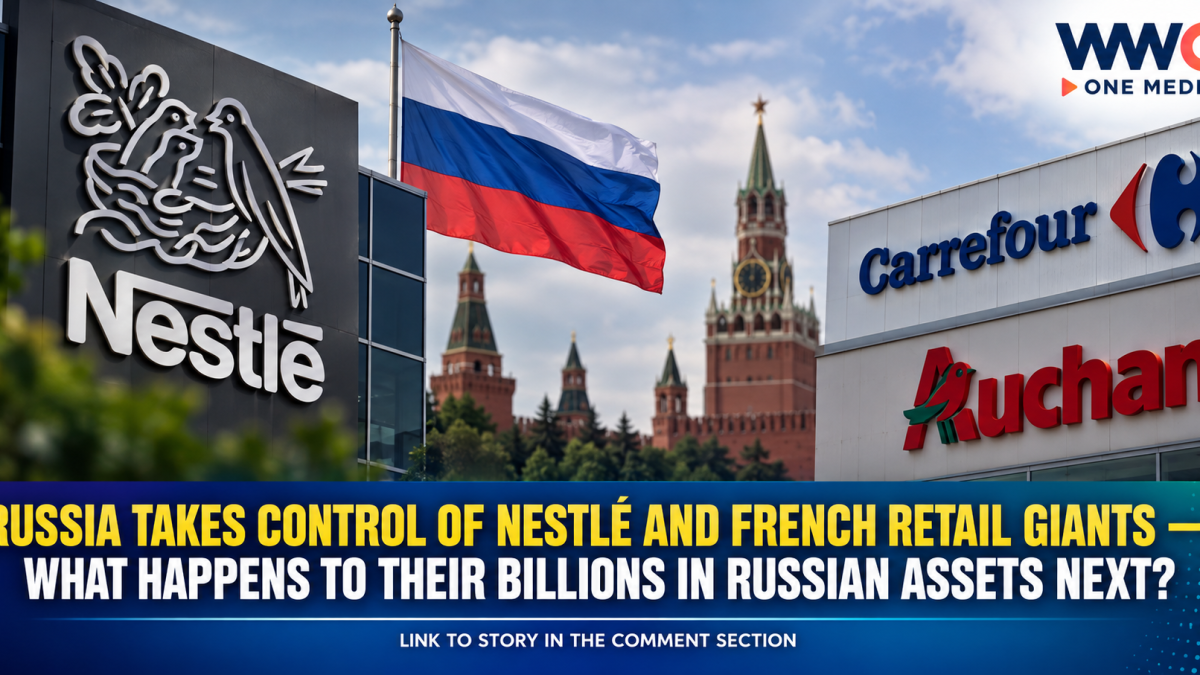
MOSCOW/WARSAW — Russia has placed the Russian operations of Swiss food giant Nestlé and several major French companies under temporary administration, escalating Moscow’s confrontation with Western businesses that have remained in the country since the invasion of Ukraine.
The measure, ordered in a decree signed by Russian President Vladimir Putin on September 17, transfers control of Russian operations linked to Nestlé, French supermarket group Auchan, former Leroy Merlin operations now operating as Lemana Pro, and French logistics company FM Logistic to a little-known Russian company, L.E.V. Management.
The Kremlin has described the affected companies as belonging to countries it considers “unfriendly.” Kremlin spokesman Dmitry Peskov said European countries’ involvement in supporting Ukraine was among the factors considered in the decision.
The action does not formally amount to a final transfer of ownership at this stage. Russian authorities have described the arrangement as temporary administration, although previous cases have shown that such measures can eventually lead to changes in ownership.
Why Nestlé has been caught in the crossfire
Nestlé has not completely withdrawn from Russia following the full-scale invasion of Ukraine in 2022, but it has significantly reduced its business there.
The Swiss company says it has six factories and about 7,000 employees in Russia, with operations focused on products including coffee, pet care, infant nutrition and confectionery. Nestlé has suspended most non-essential sales, imports, advertising and capital investment while continuing to supply products it considers essential.
Nestlé said on September 18 that it had taken note of the presidential decree and was “assessing the situation and its options.” The company added that it would take necessary steps to protect its rights and maintain business continuity, particularly for its employees.
The financial exposure is considerably smaller than it was before the war. Analyst Jean-Philippe Bertschy of Vontobel estimated that Russia now represents slightly more than 1% of Nestlé’s group sales, compared with roughly 2% before the invasion.
However, the value of the assets and cash that could potentially be lost remains significant. Jefferies analysts estimated that a write-off involving Nestlé’s Russian business and trapped funds could reach approximately 1 billion Swiss francs, although the eventual financial impact remains uncertain.
Auchan and Lemana Pro also affected
The decree also covers the Russian operations of Auchan, one of the country’s major supermarket chains.
Auchan Retail Russia said it had asked Russian authorities for clarification regarding the decree and would provide further comment once it received additional information. Reports say the Russian business operates hundreds of stores and employs tens of thousands of people.
The former Russian Leroy Merlin business is also affected. Leroy Merlin’s owner transferred control of its Russian operation to local management in 2023, after which the business was rebranded as Lemana Pro. Euronews reported that the Russian chain now operates more than 100 stores.
The decree additionally covers Russian subsidiaries connected to FM Logistic, a French logistics group.
France demands reversal
France has condemned the Russian move.
The French foreign and economy ministries called on Moscow to reverse the decision, according to reporting by The Straits Times and AFP.
The dispute adds another layer to the increasingly strained economic relationship between Russia and Western countries over sanctions and support for Ukraine.
Moscow, meanwhile, argues that companies from countries supporting Ukraine should not be treated like ordinary foreign businesses.
The mysterious company now controlling the assets
One of the most closely watched aspects of the decree is the identity of the company receiving temporary control.
L.E.V. Management is a relatively obscure Moscow-based company with limited public business activity. Euronews reported that its ownership is not publicly disclosed and that Andrei Krayushkin was appointed its general director shortly before the decree. Independent Russian reporting has linked the director’s identity to a former senior Interior Ministry official, although some details surrounding that identification have not been independently confirmed.
The company therefore became the immediate vehicle through which Moscow assumed control of assets belonging to several internationally known Western businesses.
A familiar Russian playbook
The move follows a pattern that has emerged since Russia introduced its temporary-administration mechanism for assets connected to companies from countries Moscow considers hostile.
In 2023, Russia seized control of the Russian operations of French food company Danone and Danish brewer Carlsberg. Those businesses were subsequently sold to Russian buyers, after periods of state-appointed management.
That history is why analysts and investors are watching the Nestlé and Auchan cases closely.
The immediate legal status is temporary administration, but previous cases demonstrate that temporary control can ultimately be followed by a sale or permanent change in ownership. Reuters reported that Russia has taken control of more than $50 billion in private property, according to a 2025 estimate from Moscow law firm NSP, although estimates of the total vary depending on what assets are counted.
What happens next?
For Nestlé, the immediate question is whether the company can challenge the measure and protect its remaining Russian assets.
For Auchan, Lemana Pro and FM Logistic, the situation raises similar questions over who will ultimately control their Russian businesses, how operations will be managed and whether temporary administration could eventually become a permanent ownership change.
For Western companies still operating in Russia, the latest decree is another warning that maintaining a reduced presence does not necessarily eliminate the risk of government intervention.
The bigger question now is whether the Nestlé and French-company seizures remain temporary — or become another chapter in Russia’s increasingly far-reaching transfer of Western corporate assets.
For Nestlé and the other companies involved, the battle may now move from the Russian marketplace to the legal and diplomatic arena.