
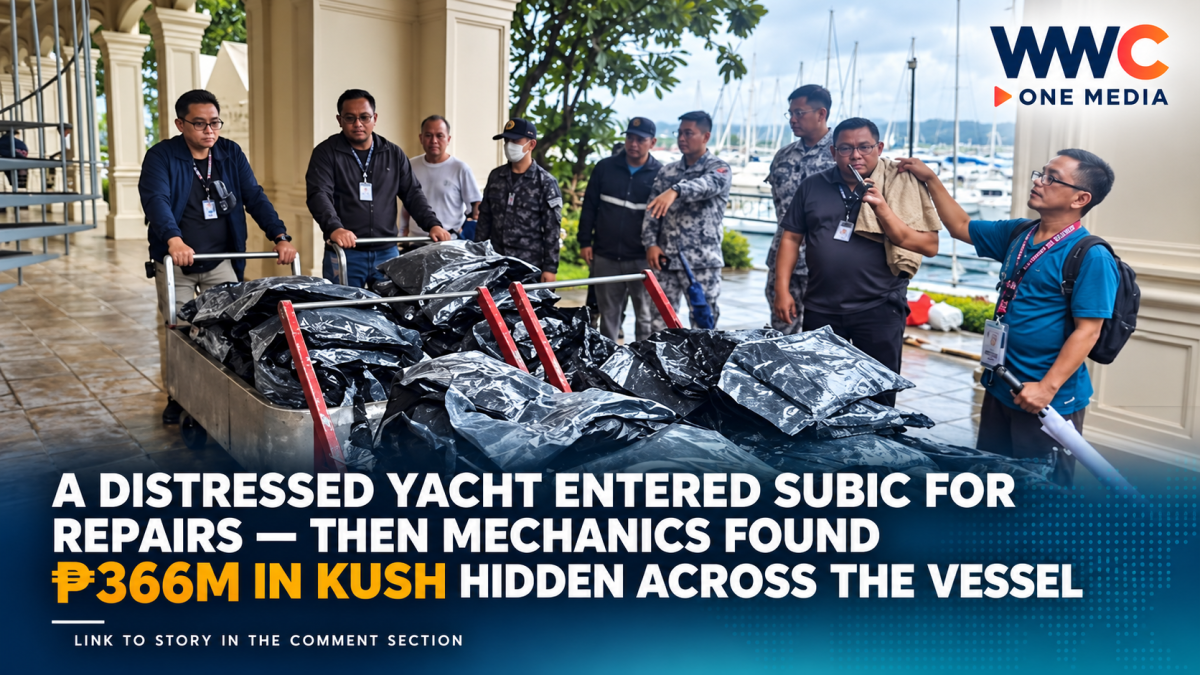
SUBIC BAY FREEPORT, Philippines — A sailing yacht that reportedly entered Subic only because it needed emergency shelter and repairs has now become the center of a potentially international drug-trafficking investigation after authorities discovered more than ₱366 million worth of suspected high-grade marijuana hidden aboard the vessel.
The latest breakthrough came when authorities conducting a deeper stripping and inspection found 109 additional packages weighing approximately 123.91 kilograms, with an estimated street value of ₱204.44 million. The Bureau of Customs confirmed the discovery on Sept. 5.
Bombo Radyo, citing Philippine Coast Guard spokesperson Commodore Noemie Cayabyab, reported that the new packages were discovered during a Sept. 4 re-inspection and were concealed in the yacht’s forward hatch. They were subsequently brought to the BOC’s Port of Subic for inventory and disposition.
But that was not the first hiding place authorities had uncovered.
Days earlier, mechanics working on the vessel reportedly found suspicious packages concealed around its engine-room compartment.
And that discovery is what transformed an apparently routine repair stop into a major narcotics operation.
The yacht wasn’t originally headed for the Philippines
According to the BOC and SBMA, the vessel had reportedly departed Kota Kinabalu, Sabah, Malaysia, and was supposed to be heading toward Taiwan.
It encountered engine trouble and adverse conditions at sea, however, forcing it to seek assistance.
SBMA said the yacht was brought to the Subic Bay Yacht Club on Aug. 28 after issuing a distress signal. Four crew members were aboard. The vessel was described by SBMA as Malaysian-flagged, while other government reporting said its crew included Thai and Malaysian nationals.
That detail now sits at the center of investigators’ questions.
Was Subic genuinely only an emergency stop?
Where exactly did the vessel travel before the engine problem?
And where was the cargo ultimately supposed to go?
Authorities have not publicly answered those questions.
Then the mechanics opened up the yacht
The investigation began not with a sophisticated maritime interception but with repair work.
According to SBMA, mechanics repairing the vessel’s generator and engine discovered plastic bags hidden in a compartment and alerted yacht-club management. That report triggered coordination among customs, anti-drug, coast guard, police and Subic authorities.
The Bureau of Customs said its Port of Subic office subsequently acted on derogatory information indicating that the vessel might contain prohibited goods.
District Collector Geniefelle Lagmay issued a mission order authorizing a formal inspection.
On Sept. 2, authorities searched the yacht.
The result was substantial.
BOC’s official tally put the first recovery at 98.332 kilograms of marijuana valued at approximately ₱162.2 million.
The Philippine Daily Inquirer and GMA Regional TV also reported the ₱162.2-million valuation.
But inspectors were not finished.
A second search found more than the first
Authorities continued dismantling and examining the yacht after the initial seizure.
The second operation uncovered an even larger quantity by weight: 123.91 kilograms packed into 109 packages, valued at about ₱204.44 million.
That brought the BOC’s official combined tally to:
198 packages worth approximately ₱366.65 million.
Combining the BOC’s two published weight figures gives approximately 222.24 kilograms of marijuana recovered from the yacht.
The scale of the second discovery is particularly significant because it demonstrates that the first search had not exhausted the vessel’s possible concealment areas.
Lagmay said that was precisely why authorities continued stripping the boat after the original haul.
She said enforcement efforts could not end at the first discovery and that vessels would be thoroughly examined when circumstances warranted it.
An accuracy problem in early reports
There is one discrepancy responsible newsrooms should disclose rather than quietly ignore.
The SBMA’s Sept. 3 account said authorities initially found 89 bags or packages weighing roughly 89 kilograms and valued at ₱106.8 million. Bombo Radyo repeated essentially the same figures.
But the Bureau of Customs’ official Sept. 3 release recorded the initial seizure as 98.332 kilograms worth ₱162.2 million.
BOC’s subsequent Sept. 5 release used the ₱162.2-million first seizure when calculating the combined ₱366.65-million haul.
The agencies have not publicly explained in the material reviewed here why those early figures differ.
For publication, I would therefore use the latest BOC consolidated figures and describe the earlier 89-kilogram/₱106.8-million number as a preliminary account rather than presenting both as simultaneously final.
Now the Coast Guard wants the yacht’s digital history
The physical drugs are only one part of the investigation.
The Philippine Coast Guard is now trying to reconstruct the yacht’s movements.
Bombo Radyo reported that Cayabyab said the PCG is coordinating with the BOC to examine the vessel’s records and navigation systems, with the goal of establishing its point of origin, previous voyages and possible routes used in transporting the suspected drugs.
The Inquirer separately reported that PCG Zambales commander Cmdr. Euphraim Jayson Diciano sought access to the yacht, which remains under BOC custody, so investigators could examine its route history.
That could become one of the most important parts of the case.
Modern vessel-navigation equipment can potentially help investigators reconstruct previous movements, ports visited and other voyage information—depending on what data remain available.
But authorities have not yet publicly identified an international trafficking organization, confirmed a Philippine consignee or established that the Philippines was the intended destination of the drugs.
Those possibilities remain under investigation.
Investigators are looking at owners, recipients and possible syndicate links
Philstar reported that BOC investigators are trying to identify the owners and intended recipients of the contraband and determine whether there are links to local or international drug syndicates.
That wording is important.
No publicly released evidence reviewed for this article establishes who owned the drugs.
The fact that the yacht reportedly traveled from Malaysia toward Taiwan does not, by itself, prove where the marijuana originated or where it was ultimately supposed to be delivered.
Those are precisely the questions investigators are now attempting to resolve.
Authorities are also examining the status and whereabouts of the vessel’s crew.
Philstar reported that the Olongapo City Police Office, assisted by intelligence units, was conducting efforts to locate the crew members.
That does not automatically mean all four have been formally charged, declared fugitives or proven to have known about the drugs. Any such conclusion would require evidence from investigators or prosecutors that has not yet been publicly established.
The seized drugs are now with PDEA
After documentation, the seized material was turned over to the Philippine Drug Enforcement Agency for custody and disposition under existing procedures.
BOC Commissioner Ariel Nepomuceno said the operation illustrated why inspections should continue even after an initial seizure.
The agency says the case is part of broader border-security efforts against illegal drug trafficking.
But the Subic incident also exposes an unusual maritime-security scenario.
This was not a container shipment identified by an X-ray scanner.
It was not baggage intercepted at an airport.
And according to the government’s account, it was not even a vessel intentionally entering Subic as part of its original route.
It was a distressed yacht that reportedly came in for shelter and repairs.
That may be the strangest part of the story
Had the vessel not developed problems at sea, it might never have entered Subic Bay.
Had mechanics not opened the relevant compartment while carrying out repairs, the first stash might not have been discovered when it was.
And had authorities stopped after that initial seizure, another ₱204.44 million worth of suspected kush might have remained concealed elsewhere inside the yacht.
That sequence is now likely to draw intense attention from investigators.
Because the biggest unanswered question is no longer simply how much marijuana was on board.
It is how long the yacht had allegedly been carrying it, where the shipment really came from, who expected to receive it—and whether the vessel had successfully made similar voyages before its engine trouble unexpectedly brought it into Philippine waters.
WWC ONE MEDIA M.J.E




Leave a Reply