
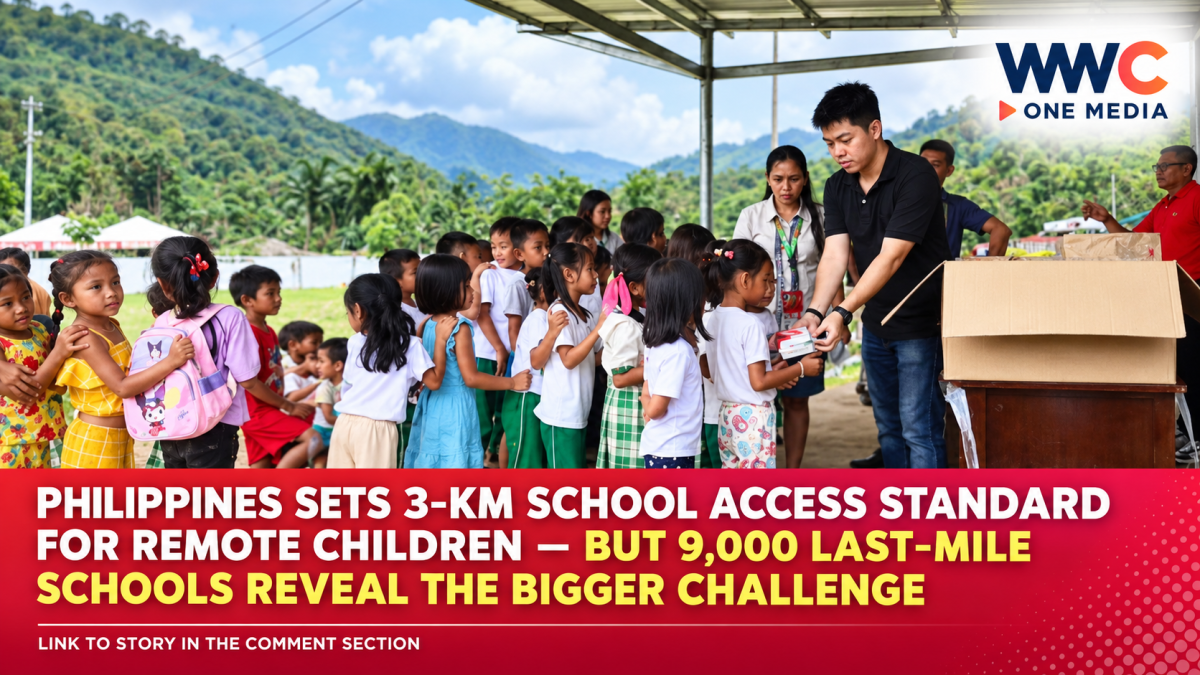
MANILA — For generations of Filipino children living in mountains, islands and isolated rural communities, getting an education has sometimes begun with a journey measured not in minutes — but in kilometers.
A new Philippine law is attempting to change that.
Republic Act No. 12321, or the Last Mile and GIDA Schools Act, establishes a national standard under which students should have access to a basic education school within a walkable distance of three kilometers from their homes.
Senator Christopher “Bong” Go highlighted the provision this weekend, arguing that the distance between a child’s home and the nearest school should not become the reason that child loses access to education. Bombo Radyo reported his remarks on Sept. 6.
But the new law goes much further than drawing a three-kilometer circle around communities.
It requires the government to confront the things that often make those three kilometers extraordinarily difficult:
No road. No public transport. No electricity. Weak or nonexistent internet. Too few classrooms. Difficult terrain. Security threats. And teachers who themselves struggle to reach the schools where they work.
That is why the biggest question surrounding RA 12321 is no longer whether the Philippines has a law for its hardest-to-reach learners.
It is whether the government can actually build everything the law now demands.
The 3-kilometer provision is real — but it has an important exception
Section 5 of RA 12321 directs the Department of Education to adopt a national school-accessibility standard for planning public schools.
The law says students should have access to a basic education school within a walkable three-kilometer distance from their residence.
The Department of Public Works and Highways must also ensure that access roads leading to schools are built and maintained according to accessibility requirements.
But lawmakers recognized that three kilometers on a paved road is very different from three kilometers across a river, steep mountain trail, island crossing or conflict-affected community.
So where physical access is not feasible because of terrain, geography or safety, DepEd must provide alternative delivery modes while local governments are tasked with supporting transportation.
That distinction is crucial.
An accurate headline can say the Philippines has adopted a 3-kilometer school-access standard.
It would be misleading to suggest that the law guarantees an immediately constructed school exactly three kilometers from every household.
Around 9,000 schools show how large the problem already is
The scale of the challenge is enormous.
Before the law was enacted, EDCOM II data cited by Inquirer put the number of Philippine last-mile schools at approximately 9,000, serving around 2.5 million learners. Roughly half were reported to be in the Bangsamoro Autonomous Region in Muslim Mindanao.
Those numbers help explain why Congress moved to institutionalize support instead of continuing to rely primarily on individual programs and annual initiatives.
DepEd’s own earlier field assessments had already identified 9,225 Last Mile Schools, equivalent at the time to 19.4 percent of the country’s public schools.
The exact number can change as DepEd updates classifications.
RA 12321 therefore requires the department to create something more systematic.
DepEd now has to build a national map
Within one year of the law’s effectivity, DepEd must develop and publish a National Last Mile and GIDA Schools Map.
That map will be used for:
planning,
resource allocation,
identifying communities that require intervention,
and determining where government programs should be concentrated.
It cannot simply be published once and forgotten.
The law requires it to be reviewed and updated at least every three years as local conditions and education needs change.
DepEd must also publish a list of Last Mile and GIDA schools every year and submit an annual implementation report to Congress. After the program has operated for three years, the department must conduct a formal review, with additional reviews every three years thereafter.
In other words, Congress has attempted to turn remote-school policy into a measurable national system rather than a collection of isolated projects.
A GIDA school is not defined by distance alone
The law’s scope is broader than simply identifying schools far from cities.
It defines Last Mile and GIDA schools as public schools in remote, hard-to-reach, underserved or economically disadvantaged communities where access to safe and adequate basic education is constrained by infrastructure, personnel, resources or social and environmental conditions.
Possible indicators include schools where more than 75 percent of learners are Indigenous Peoples, as well as schools serving communities affected by conflict, insecurity or disaster vulnerability.
That means an isolated island school can qualify.
So can a mountain community.
A conflict-affected barangay may qualify.
And so may an Indigenous community where access to conventional school infrastructure remains severely limited.
The law doesn’t stop at classrooms
This is one area where the Bombo report deserves emphasis.
RA 12321 recognizes that building a classroom does little good if the school has no water, electricity, communications or usable route to reach it.
The law assigns different parts of that problem to multiple government agencies.
DPWH is tasked with access roads.
The Department of Energy and National Electrification Administration are brought in for electricity.
The Department of Information and Communications Technology is responsible for ICT and connectivity support.
Government water agencies and LGUs are expected to address safe water.
And the Department of Transportation, working with LGUs, must help ensure safe, reliable and accessible transportation to and from Last Mile and GIDA schools.
DepEd itself must develop programs covering learning equipment, alternative delivery methods, water and sanitation, computerization, feeding and other health and nutrition interventions, tutoring and socio-emotional support.
That makes RA 12321 as much an infrastructure-and-public-services law as an education law.
Teachers are part of the “last mile” problem too
One of the most significant provisions concerns the people expected to teach in these communities.
Remote schools frequently struggle not only to attract teachers but also to retain them.
RA 12321 allows qualified teaching and non-teaching personnel assigned to Last Mile and GIDA schools to receive support beyond existing benefits.
That may include special hardship allowances, mobility assistance and transportation support for deployment and periodic travel.
Accommodation assistance may also be provided.
The law allows arrangements including teacher quarters, rental or housing subsidies and partnerships with local governments and communities to provide safe accommodation.
It also calls for scholarships, specialized training and career-progression mechanisms designed specifically around the difficulties of staffing isolated schools.
That could prove just as important as new construction.
A school building without enough teachers remains an education-access problem.
The government also wants more teachers recruited locally
RA 12321 encourages community-based hiring.
It gives importance to recruiting qualified teachers and essential personnel who already live near the community, are willing to live there or have cultural and linguistic connections to the area.
For some communities, that could reduce one of the biggest sources of instability in remote-school staffing: teachers being assigned far from their homes and eventually requesting transfers.
The law also establishes pathways for teacher-education scholarships for students originating from GIDA and Indigenous communities, linked in some cases to return-to-service obligations.
The strategy is effectively to create a local teacher pipeline:
train people from the community, then create a pathway for them to teach the next generation in that community.
Indigenous communities get specific protections
The law goes beyond physical access for Indigenous Peoples.
For Last Mile and GIDA schools within ancestral domains, curricula must integrate Indigenous Knowledge Systems and Practices, indigenous languages and community-validated cultural narratives, in coordination with the National Commission on Indigenous Peoples.
School and road projects within ancestral domains are also subject to requirements under the Indigenous Peoples’ Rights Act, including Free, Prior and Informed Consent where applicable.
The law further recognizes Indigenous knowledge educators, culture-bearers and tradition-keepers as potential partners in contextualized education.
That means the objective is not simply to export an urban-style school model into a remote Indigenous community.
The law requires the education delivered there to reflect the community’s linguistic and cultural context as well.
The digital divide is already being attacked from another direction
The Last Mile law does not begin from zero.
DepEd and DICT have already been rolling out connectivity programs targeting schools in difficult-to-reach communities.
In June, the Philippine Information Agency reported that the government was expanding internet connectivity in remote and geographically isolated schools through joint DepEd-DICT efforts.
DICT’s Bayanihan SIM Project has also distributed data-enabled SIM cards to learners and schools in underserved communities.
In Soccsksargen alone, PIA reported that DICT distributed 49,179 SIM cards in 2026 and was preparing another 50,040 for unserved areas.
In Mountain Province, another 7,130 SIM cards were distributed to 70 schools, with the program particularly aimed at remote schools and areas lacking telecommunications towers.
But a SIM card only works where infrastructure can support it.
That is why the new law formally gives DICT a role in providing Last Mile schools with actual connectivity infrastructure.
The Philippines is already spending billions on Last Mile schools
Another important piece of context missing from a simple reading of the new law is that government spending on these schools predates RA 12321.
For 2026, the government allocated ₱3 billion to the Last Mile Schools Program.
DBM said the allocation was intended to address infrastructure and resource gaps in at least 200 geographically isolated and disadvantaged schools.
DepEd says that figure is double the ₱1.5-billion allocation in 2022.
That demonstrates increased investment.
It also reveals the scale problem.
If approximately 9,000 last-mile schools require varying levels of assistance, reaching a few hundred schools at a time means the work cannot be completed quickly.
And many of the most isolated projects are also the most expensive and difficult to build.
Getting construction materials there can be harder than funding the classroom
EDCOM II has previously documented the infrastructure bottlenecks affecting Last Mile schools.
Its education review identified obstacles including inadequate road networks, security risks, difficulties transporting materials, challenging site conditions, right-of-way problems and permits.
Costs are also higher in isolated areas.
EDCOM II found discrepancies between classroom costing assumptions used by agencies, partly because transporting construction materials and machinery to difficult sites substantially increases expenses.
That is one reason a three-kilometer standard looks simple on paper but becomes vastly more complicated in implementation.
A school cannot simply be placed wherever a map says it should go.
Land must be available.
The site must be safe.
Roads may have to be built.
Materials must reach it.
Water and electricity must follow.
Teachers must be hired.
And the building must survive floods, earthquakes, typhoons or landslides depending on its location.
RA 12321 actually recognizes that problem
The law specifically requires school buildings in these areas to be safe, durable, accessible and climate- and disaster-resilient.
It also allows DepEd to develop context-responsive standards when conventional school-building specifications are impractical in difficult locations.
Where practical, bamboo, engineered bamboo and other locally sourced materials may be incorporated, provided they meet structural and safety requirements.
The Armed Forces may also be engaged in infrastructure construction in priority locations that are conflict-affected, disaster-prone or especially difficult to reach.
That is an unusual provision, but it reflects the realities of building schools in some of the country’s most inaccessible communities.
The law was not simply a Bong Go measure
Another accuracy point is important when packaging this story politically.
Senator Go supported the GIDA schools initiative and publicly advocated expanding educational access in remote areas. His office said in March that he backed and co-sponsored the measure.
But RA 12321 should not be presented as though it were solely authored by Go.
The final law consolidated Senate Bill No. 1937 and House Bill No. 4745. The official Senate record lists a broad group of senators behind SB 1937, while EDCOM II identifies Sen. Bam Aquino as the measure’s Senate sponsor.
The House version similarly had multiple authors.
President Ferdinand Marcos Jr. signed the consolidated bill into law on July 22, 2026.
So the strongest factual framing is:
Go is now calling attention to and urging effective implementation of a law that emerged from a broader congressional effort.
The next test is implementation
DepEd said after the law was signed that it was preparing the implementing rules and technical guidelines needed for full implementation.
RA 12321 requires those rules to be developed in consultation with a long list of agencies, including DPWH, DICT, DOTr, DBM, DILG, DOE, NCIP and others, within 90 days of the law’s effectivity.
Funding, meanwhile, is not provided through a single permanent blank check.
The law says the amounts necessary for implementation must be incorporated into the annual budgets of the agencies responsible for carrying it out.
That means Congress and the executive branch will still have to translate the law’s promises into annual appropriations for roads, classrooms, transportation, internet, electricity, teachers and support programs.
This is where the political promise becomes measurable.
Three kilometers may become the easiest number to remember
The 3-kilometer standard will probably become the most recognizable feature of RA 12321.
But it may not ultimately be the provision that determines whether the law succeeds.
A student could technically live within three kilometers of a school and still face an impossible journey if the route involves a dangerous river crossing.
A classroom could be built nearby and still struggle if there is no teacher.
A teacher could be assigned and still leave if housing and transportation are impossible.
A school could receive computers and still have no reliable electricity or internet.
That is why the law attempts to address all of those problems simultaneously.
And it is also why implementation will be difficult.
The promise is simple. Delivering it isn’t.
Senator Go’s message — that distance should not prevent a child from studying — is difficult to dispute as a policy objective.
RA 12321 now gives that principle statutory force.
It establishes a national accessibility standard.
It requires mapping.
It assigns responsibilities for roads, transportation, power, internet and water.
It creates teacher incentives.
It recognizes the particular needs of Indigenous communities.
And it requires government to measure whether students actually stay in school and improve academically.
But the Philippines has approximately 9,000 schools already identified with last-mile conditions and about 2.5 million learners associated with them.
That is the number policymakers now have to confront.
The Philippines has finally put the “last mile” of education into law.
The harder question is how long it will take before children in the last village can actually feel the difference.
WWC ONE MEDIA M.J.E

Leave a Reply