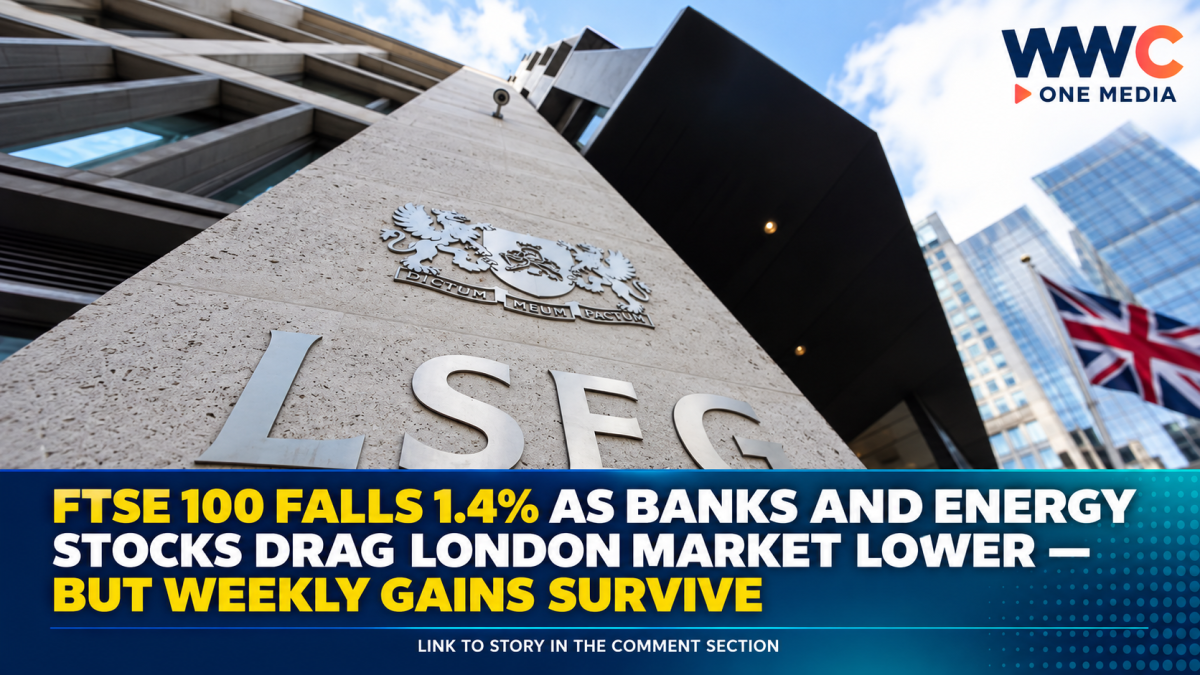
LONDON — London’s stock market ended the week with a sharp Friday sell-off, as falling bank and energy shares dragged the FTSE 100 down 1.4%.
The blue-chip index closed at 10,659.13 points on September 18, its biggest one-day decline since July, according to Reuters. Despite the drop, the FTSE 100 still recorded a small weekly gain, highlighting just how volatile a week it had been for global markets.
The decline came after a week dominated by inflation concerns, energy-market disruption and major central-bank decisions in the United States and United Kingdom.
The FTSE 250, meanwhile, fell 0.6% on Friday but posted its strongest weekly rise since early August.
Banks become the biggest drag
Financial stocks were among the biggest sources of pressure on London’s benchmark index.
The banking sector fell 2.1%, with Lloyds dropping 2.9% and HSBC losing 1.6%, according to Reuters.
The weakness came after investors spent much of the week reassessing the outlook for UK interest rates.
The Bank of England kept its benchmark rate at 3.75% on Thursday in a 6-3 vote, but the central bank warned that prolonged energy-price volatility could increase inflationary pressure and eventually require tighter monetary policy.
That combination—rates remaining high while inflation risks increase—created an uncertain backdrop for investors.
Energy stocks also retreat
Energy shares were another major weight on the FTSE 100.
The sector declined as crude prices fell for a third consecutive session, easing some concerns over disruptions to Saudi Arabian oil supplies.
Oil had previously climbed above $100 a barrel, adding to concerns that higher energy costs could keep inflation elevated and complicate the decisions facing central banks.
The Bank of England has specifically warned that a prolonged Middle East conflict could feed into UK inflation through energy prices.
For investors, that creates a difficult balancing act: falling oil prices can ease inflation pressure, but energy companies can also lose some of the earnings support provided by elevated crude prices.
Airtel Africa suffers a major sell-off
One of the day’s biggest individual-stock moves came from Airtel Africa.
Shares plunged 11.3% after a report said its Airtel Money business was considering downsizing its planned London initial public offering.
The decline made Airtel Africa the FTSE 100’s biggest faller and contributed to the broader weakness in the telecommunications sector.
Telecom stocks fell 4.8% overall, according to Reuters.
Gold miners provide a bright spot
Not every sector fell.
Precious-metal miners gained as gold prices extended their rally, providing some support for the broader market. Reuters reported that construction and materials stocks also advanced, rising 1.3%, led by Galliford Try.
The divergence between commodity-related sectors reflects the complicated environment facing investors.
Gold has benefited from demand for assets traditionally viewed as defensive during periods of geopolitical and financial uncertainty, while movements in oil and other commodities have been closely tied to concerns over supply disruptions.
British shoppers spend more despite higher fuel costs
Friday’s market decline came alongside economic data showing that British consumers unexpectedly increased their shopping in August.
However, consumers reduced fuel purchases as petrol prices climbed.
The data offered a mixed picture of the UK economy.
Stronger consumer spending can suggest resilience in household demand, but higher fuel costs can squeeze household budgets and contribute to inflation.
That tension is especially important for the Bank of England as it attempts to bring inflation back toward its 2% target without unnecessarily weakening economic activity.
Bank of England keeps rates unchanged—but the message gets tougher
The FTSE’s volatile week was closely linked to the Bank of England’s latest policy decision.
The central bank held its key interest rate at 3.75%, with six policymakers voting to keep rates unchanged and three voting for a quarter-point increase to 4%.
The Bank also warned that UK inflation could rise above 4% early next year, largely because of higher energy costs linked to the Middle East conflict.
Governor Andrew Bailey said that while higher global energy costs had so far had limited effects on UK wage and price-setting, the longer the volatility persists, the greater the inflation risk becomes.
That warning changed the tone of the rate decision.
Even though rates were left unchanged, investors were forced to consider the possibility that borrowing costs could rise again if inflation pressures become more persistent.
The Fed adds another layer of pressure
The Bank of England’s decision came just one day after the U.S. Federal Reserve raised interest rates by 25 basis points, taking its benchmark rate to a range of 3.75% to 4%.
It was the Fed’s first rate increase in three years. Policymakers also signaled that further increases could be necessary as the central bank continues its fight against inflation.
The Fed’s move added to concerns across global markets that interest rates in major economies could remain elevated for longer than investors had previously anticipated.
Higher rates can increase borrowing costs for businesses and consumers while also affecting the relative attractiveness of equities and bonds.
A week of gains despite Friday’s shock
The striking feature of the latest FTSE performance is the contrast between Friday’s decline and the overall weekly result.
The FTSE 100 lost 1.4% on Friday but still finished the week with a small gain.
The index had climbed 1.2% on Thursday after the Bank of England’s decision to leave rates unchanged and announce changes to its gilt-selling program. The FTSE 100 closed Thursday at 10,816.14.
That rally was not enough to prevent Friday’s reversal.
The week’s performance therefore reflects a market being pulled in different directions by interest rates, inflation, oil prices, geopolitical developments and individual corporate news.
Why investors are watching oil so closely
Oil remains one of the most important variables for the market.
Higher crude prices can raise transportation and production costs, potentially pushing inflation higher. That can make central banks more cautious about cutting rates—or, in extreme circumstances, encourage them to raise rates.
The opposite is also true.
If supply disruptions prove less severe and oil prices continue to fall, some of the immediate inflation pressure could ease.
Reuters reported that oil prices had declined for a third straight session by Friday as concerns about Saudi supply disruptions eased.
That leaves investors watching both the physical oil market and developments in the Middle East.
What comes next for London’s market?
The FTSE 100 enters the next trading week after an unusually eventful stretch.
Investors have already absorbed:
- A 25-basis-point U.S. Federal Reserve rate hike
- A Bank of England decision to hold rates at 3.75%
- Renewed concerns about UK inflation
- Significant oil-price volatility
- Weakness in major UK banks
- A sharp decline in Airtel Africa
- Continued strength in precious metals
The next challenge is determining whether Friday’s sell-off represents a temporary pullback after a strong week or a sign that investors are becoming more cautious about the inflation and interest-rate outlook.
The available data do not yet provide a definitive answer.
For now, the numbers tell a more nuanced story than Friday’s headline decline suggests.
The FTSE 100 fell sharply—but it did not erase its weekly gain.
And with oil prices, inflation and central-bank policy still moving markets, London’s next move could depend heavily on which of those forces takes control.