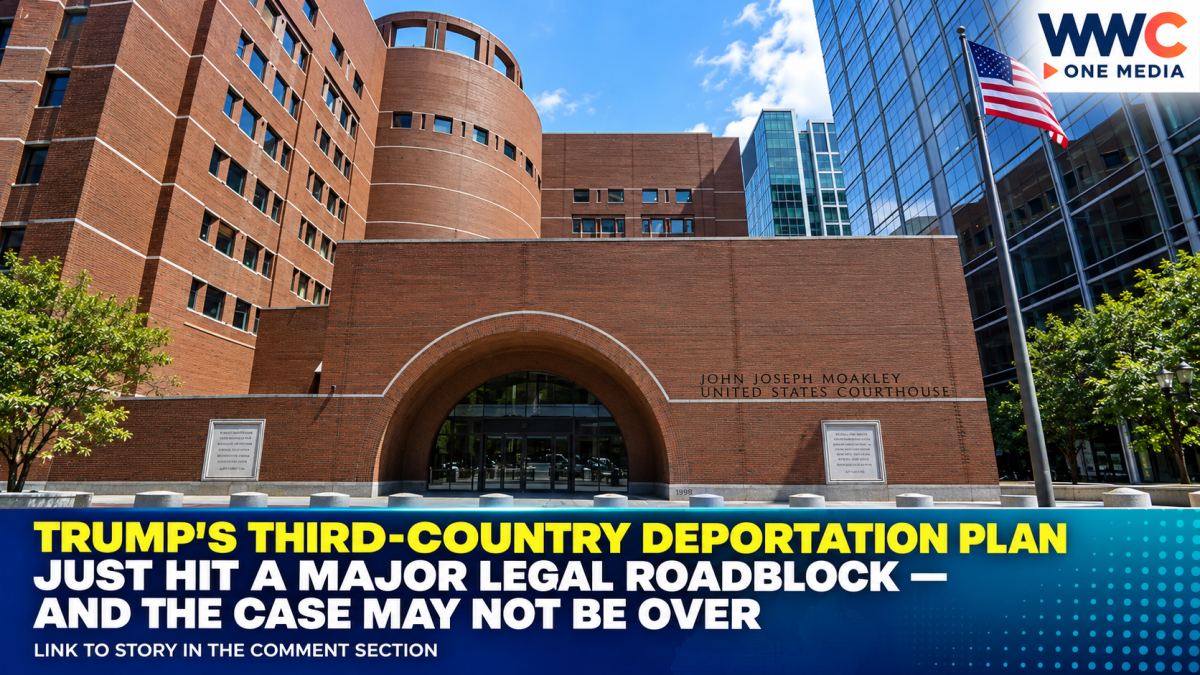
BOSTON — A major legal setback has hit the Trump administration’s immigration enforcement strategy after a US federal appeals court ruled that migrants cannot be rapidly deported to third countries without meaningful notice and an opportunity to raise concerns about persecution or torture.
The Boston-based 1st US Circuit Court of Appeals on Friday, Sept. 18, largely upheld a lower-court ruling that found a Department of Homeland Security policy governing third-country deportations unlawful.
The case could now move to the US Supreme Court, putting the administration’s broader use of third-country deportation agreements under renewed legal scrutiny.
What the court ruled
The dispute centers on a DHS policy adopted in March 2025 that allowed immigration authorities to send certain migrants to countries other than their own when the government had obtained, or believed it could obtain, diplomatic assurances concerning their treatment.
The policy provided for limited notice in some circumstances.
The appeals court concluded that migrants must have a meaningful opportunity to challenge their removal to a third country, particularly when they fear persecution or torture there.
Judge Seth Aframe, writing for the three-judge panel, rejected the government’s interpretation of immigration law that would have allowed the streamlined procedure to operate without the protections required under existing statutes and regulations.
The ruling largely affirmed the February decision by US District Judge Brian Murphy, who had found the policy unlawful because migrants could potentially be sent to unfamiliar countries without adequate warning or a meaningful chance to raise safety concerns.
More than 25,000 migrants sent to third countries
The ruling comes after the Trump administration dramatically expanded the use of agreements allowing migrants to be transferred to countries where they are not citizens.
According to Third Country Deportation Watch, a project operated by Refugees International and Human Rights First, more than 25,000 people had been sent to at least 29 third countries by early September 2026. The project says agreements or arrangements have involved more than 30 countries.
Mexico has accounted for a large share of those transfers.
Separate reporting by The Washington Post and AP has documented the expansion of the practice, including the transfer of Mexican nationals to Guatemala and Honduras. The Post reported in August that nearly 2,300 Mexicans had been deported to Guatemala during 2026, along with at least dozens sent to Honduras.
CBS News also reported in August that the administration had expanded third-country deportation flights to several African nations, including Burundi, Cameroon, the Central African Republic, Equatorial Guinea, Eswatini, Liberia, Rwanda and Sierra Leone.
Why the decision matters
Third-country deportation allows the US government to remove a migrant to a country that is neither the person’s country of citizenship nor necessarily a country where the person has previously lived.
The legal question is not simply whether the United States can deport someone. It is whether the government must provide an adequate opportunity for that person to object to the destination country when there is a credible fear of persecution or torture there.
The First Circuit said those protections cannot become meaningless simply because the government chooses a different country for removal.
The court’s decision therefore focuses heavily on due process and statutory protections against persecution and torture, rather than eliminating the government’s general authority to deport people with final removal orders.
The court did not reject every part of the lower-court ruling
One important detail could easily get lost in the headline.
Although the appeals court largely sided with the migrants challenging the DHS policy, it reversed one portion of the lower court’s ruling.
That portion concerned whether immigration authorities were required to prioritize removal to countries with which migrants had connections or to their countries of nationality before considering third-country destinations.
The First Circuit concluded that the plaintiffs could not litigate that particular statutory-sequencing issue through the class-wide relief imposed by the lower court.
In other words, Friday’s ruling was not a blanket judicial prohibition on every form of third-country deportation.
Instead, it struck at the streamlined process that the administration used to remove migrants to third countries without adequate notice and a meaningful opportunity to raise destination-specific fears.
The legal battle has already reached the Supreme Court
The case, D.V.D. v. US Department of Homeland Security, has already produced multiple emergency interventions from the Supreme Court.
Earlier in the litigation, the Trump administration persuaded the Supreme Court twice to lift a preliminary injunction that had protected migrants from certain third-country removals, allowing eight men to be deported to South Sudan.
The First Circuit’s latest ruling could therefore set the stage for another Supreme Court fight over the government’s authority and the procedural protections owed to migrants facing removal to countries unrelated to their original deportation proceedings.
The First Circuit docket identifies the case as No. 26-1212, with the appeal argued before Judges Lara Montecalvo, Jeffrey Howard and Seth Aframe.
The human-rights controversy is also growing
The court battle comes as reports emerge about conditions faced by some people transferred under third-country arrangements.
On Sept. 18, AP reported that two men deported from the United States to Equatorial Guinea — an Egyptian national and an Eritrean national — were allegedly arrested and beaten by local police, according to their lawyers and human-rights organizations.
The men were being held at a hotel converted into a detention facility under a US agreement with Equatorial Guinea. AP reported that lawyers and advocates alleged broader problems involving detention conditions and access to legal representation. Those allegations remain claims made by the detainees’ representatives and rights organizations.
Such reports help explain why the legal question over advance notice and the ability to raise country-specific safety concerns has become central to the litigation.
What happens next?
The Trump administration is expected to challenge the First Circuit’s ruling, potentially taking the dispute back to the Supreme Court.
For now, however, the appeals court’s decision leaves the administration facing a significant restriction on the expedited procedure it adopted for third-country removals.
The broader third-country deportation campaign is not necessarily over. The ruling instead establishes that, under the laws at issue in this case, migrants facing removal to an unfamiliar country must receive meaningful notice and an opportunity to raise applicable fears of persecution or torture before the government sends them there.
And that leaves the next question hanging over the case:
Will the Supreme Court have the final word on how far the administration can go in using third countries to carry out deportations?