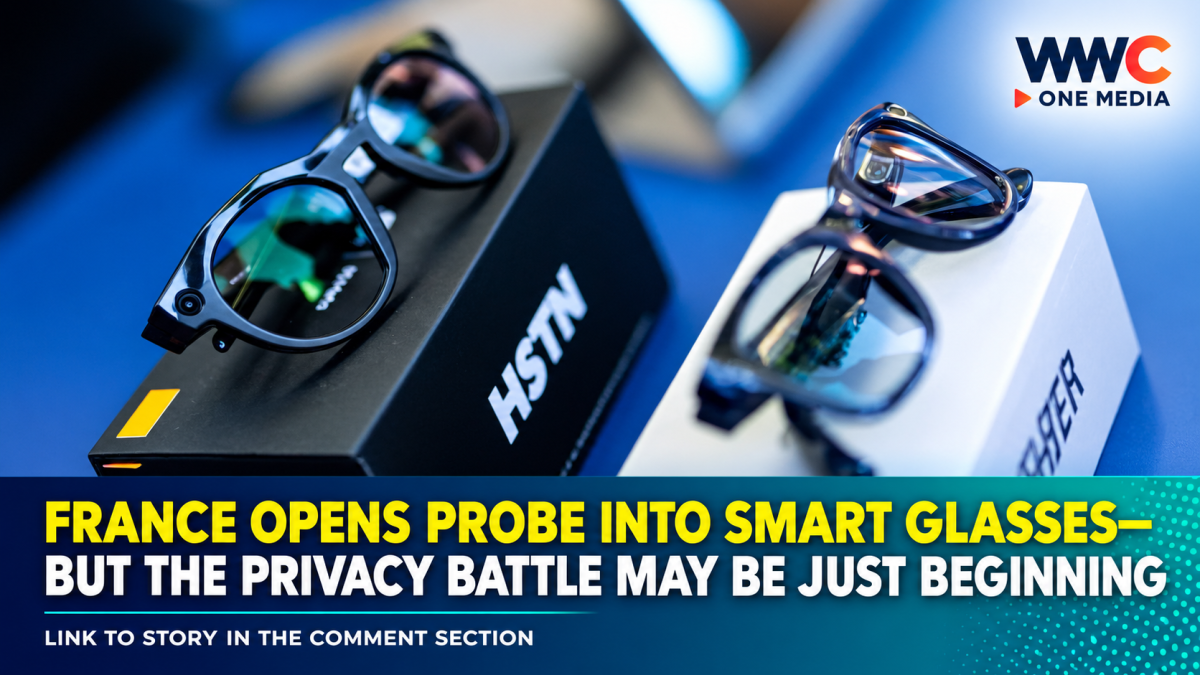
PARIS — Smart glasses are facing a new wave of scrutiny in France after prosecutors opened a criminal investigation linked to alleged sexual harassment involving camera-equipped eyewear, while the country’s data-protection regulator deals with complaints from businesses concerned about privacy and workplace surveillance.
The development adds to growing international concern over smart glasses, particularly devices that combine cameras, microphones and artificial intelligence in eyewear that can look almost indistinguishable from ordinary glasses.
According to Reuters, the Paris prosecutor’s office said it had opened at least one criminal investigation after receiving complaints connected to a social-media trend in which women were allegedly filmed on the street without their knowledge and the footage later posted online. Prosecutors have not identified the brand of glasses involved.
The investigation comes as France’s data-protection authority, the CNIL, receives complaints involving smart glasses in workplaces and fields questions from employers about whether they can prohibit their use.
Why Meta’s Ray-Ban glasses are at the center of the debate
Several companies manufacture smart glasses, but Meta’s AI-enabled eyewear, developed with EssilorLuxottica, has become the dominant product in the market.
Reuters reported that Meta’s glasses accounted for roughly 76% of the global market and that about 7 million units were sold in 2025. EssilorLuxottica has also reported rapid growth in the category during 2026.
The devices can take photographs and record video, make calls, play audio and interact with AI services. Some functions can also be activated through voice commands.
That convenience is precisely what has complicated the privacy debate.
Unlike a smartphone, a pair of glasses does not have to be visibly raised toward another person before recording begins. A wearer can potentially capture what is directly in front of them while appearing to simply look around.
France’s CNIL has already warned that smart glasses create a particular privacy challenge because cameras and microphones can capture information about people nearby without those individuals necessarily realizing that recording or processing is taking place.
CNIL had already sounded the alarm
The latest criminal investigation did not come out of nowhere.
In June, CNIL launched an action plan on smart glasses and called for greater vigilance over their use. The regulator said the devices can process substantial amounts of personal data and may capture images, video and audio in circumstances where people nearby are unaware.
CNIL’s research found that 67% of respondents in a January 2026 survey believed smart glasses posed a risk to privacy.
The regulator said the technology raises questions involving consent, image rights, the handling of collected data and possible misuse of captured information, including AI-related risks.
CNIL has recommended that users inform people nearby when smart glasses are being used, disable functions when they are no longer necessary, avoid using the devices in places where people would not expect them and obtain consent when photos or videos are to be shared.
Reports involving women are adding pressure
The issue has also drawn attention from French online-safety organizations.
The e-Enfance/3018 association said in September that it had received around 20 reports since the beginning of 2026 involving women allegedly filmed without their knowledge using camera-equipped glasses. The organization said most of the cases specifically involved Meta smart glasses.
According to e-Enfance, some recordings were subsequently uploaded to TikTok and other social platforms, with victims facing insults, harassment and threats after the footage spread online.
Le Monde separately reported that e-Enfance had recorded more than 20 such reports and said the number of reports had increased significantly between 2025 and 2026. The publication also reported that IDC data indicated Meta’s Ray-Ban and Oakley smart-glasses lines represented a large majority of connected glasses sold in France this year.
Importantly, these reports concern alleged misuse of the technology; they do not establish that ordinary smart-glasses users are engaging in such behavior.
The flashing light may not settle the consent question
Meta’s smart glasses include a small indicator light designed to signal when the camera is recording. Meta has also said it has implemented measures intended to prevent users from disabling or covering the recording indicator.
Meta told Reuters that it had “built privacy into” its AI glasses and would continue strengthening protections as the products become more capable. EssilorLuxottica declined to comment to Reuters about the French investigation.
But privacy advocates argue that an indicator light does not necessarily establish consent.
Their concern is straightforward: a person who notices a light may understand that a camera is operating, but that does not automatically mean they agreed to be recorded or to have the resulting footage distributed online.
That distinction could become increasingly important as wearable cameras become smaller, more capable and more difficult for bystanders to distinguish from ordinary eyewear.
What does French law say?
France already has privacy protections that can apply to unauthorized recording.
CNIL says Article 226-1 of the French Penal Code can punish violations involving the recording or transmission of a person’s image in a private place without consent, with penalties of up to one year in prison and a €45,000 fine under the circumstances covered by the provision.
The challenge is not simply whether laws exist. Authorities and privacy advocates are also confronting how existing rules should apply to technology capable of continuously capturing information in public, workplaces and other environments.
At the European level, smart glasses can also fall within the framework of the General Data Protection Regulation (GDPR), depending on how personal data is collected and processed. Reuters reported that the EU’s AI Act and GDPR form part of the regulatory landscape surrounding AI-enabled wearable technology.
France is not alone
The debate is rapidly spreading beyond France.
In Australia, the government is considering whether camera-equipped smart glasses should be prohibited in federal government workplaces because of privacy and security concerns. Public Service Minister Katy Gallagher has requested advice on possible restrictions.
In the United Kingdom, the UK Cinema Association said many cinema operators were introducing or considering policies restricting camera-enabled smart glasses because of privacy and film-piracy concerns.
Reuters has also reported legal pressure involving smart glasses in Germany, while other jurisdictions and institutions are examining restrictions in schools, courts and workplaces.
The pattern suggests that the debate is moving beyond individual privacy complaints toward a broader question: where should camera-equipped AI eyewear be allowed, and under what conditions?
A technology caught between convenience and privacy
Smart glasses offer legitimate applications, including hands-free communication, navigation, translation and accessibility features. CNIL itself acknowledges potential benefits, including assistance for people with visual or hearing impairments.
But the same hardware that makes those features possible can also capture people and surroundings without the clear physical signals associated with traditional cameras.
That is why the French investigation could become significant beyond the specific complaints that prompted it.
The immediate issue is whether alleged misuse of smart glasses has crossed legal boundaries. The bigger question is whether existing privacy protections are sufficient for a technology designed to place cameras and AI directly in the user’s field of vision.
As smart glasses become more widespread, France’s latest investigation may therefore be an early test of how governments, regulators, technology companies and the public intend to draw that line.