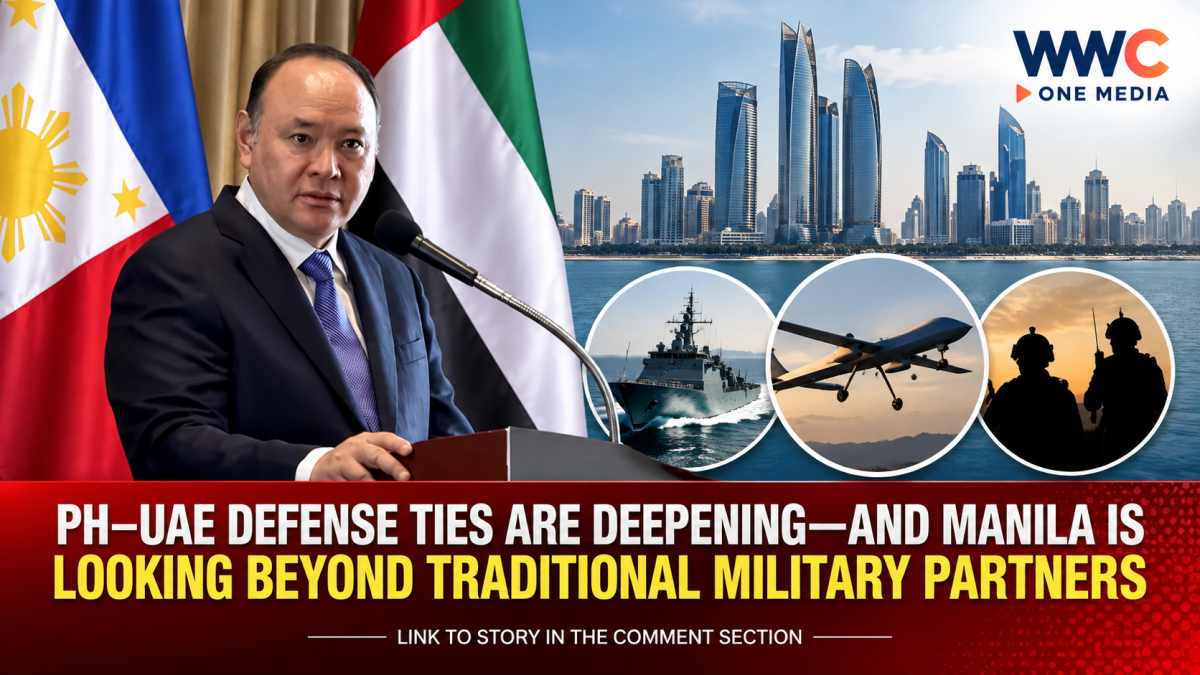
MANILA — The Philippines and the United Arab Emirates are looking to take their growing defense relationship to a deeper level, with military training and possible coproduction of defense equipment emerging as areas for expanded cooperation.
For more Philippines defense and foreign-policy briefs, see our Philippines hub and Politics desk.
The latest development builds on a landmark Philippines-UAE Memorandum of Understanding on Defense Cooperation signed in January 2026 during President Ferdinand Marcos Jr.’s working visit to Abu Dhabi.
The agreement was described by the Philippine Department of National Defense as the country’s first formal defense agreement with a Gulf country, creating a framework for cooperation in advanced defense technologies, military education and training, intelligence and security sharing, maritime security, counterterrorism and peacekeeping.
The new push comes as Manila continues to broaden its network of defense partners and accelerate the modernization of the Armed Forces of the Philippines.
From training to defense production
The potential expansion is significant because the relationship is moving beyond traditional military exchanges toward possible defense-industrial cooperation.
Under the January agreement, the Philippines and UAE identified advanced capabilities—including unmanned aerial systems, electronic warfare and naval systems—as areas where the two countries could cooperate.
Possible coproduction arrangements could eventually provide another avenue for Manila to strengthen domestic defense-industrial capabilities, although any specific equipment, production arrangements or contracts would still require separate negotiations and government approvals.
The UAE has increasingly developed its own defense-industrial sector and has pursued international partnerships involving technology, manufacturing and defense systems. An IISS assessment has documented UAE defense-industry partnerships in Asia involving areas such as licensed production, research and development and co-production.
A defense relationship that took years to develop
The latest move did not happen overnight.
Philippine Ambassador to the UAE Alfonso Ver said in April 2025 that Manila and Abu Dhabi had already been discussing a defense agreement covering areas such as traditional military equipment, cybersecurity, training and information exchange.
By January 2026, those discussions resulted in the formal defense cooperation MOU.
Before the signing, Ver also said the proposed arrangement would include joint training, exchanges of officers and information sharing, while noting that the UAE has advanced defense capabilities that could provide opportunities for Philippine cooperation.
What the agreement actually means
The defense MOU should not be confused with a mutual-defense treaty or military alliance.
Instead, it establishes a framework through which the two countries can develop practical cooperation in areas including:
- Military education and training
- Intelligence and security information sharing
- Counterterrorism
- Maritime security
- Peacekeeping
- Advanced defense technologies
- Unmanned aerial systems
- Electronic warfare
- Naval systems
That distinction is important. The agreement provides a foundation for cooperation, but does not automatically mean UAE forces are committed to defend the Philippines or that Manila has entered a mutual-defense alliance with Abu Dhabi.
The bigger picture for Philippine defense modernization
The Philippines has been pursuing a broader strategy of expanding defense partnerships while upgrading its military capabilities.
The UAE agreement came just one day before the Philippines and Japan signed an Acquisition and Cross-Servicing Agreement, designed to facilitate reciprocal logistical support between their armed forces during activities such as exercises and other agreed engagements.
The Department of National Defense has also emphasized that Philippine defense partnerships increasingly involve more than military-to-military relations, extending into industrial, technological and economic cooperation.
This broader approach gives Manila additional channels for training, technology cooperation, logistics, procurement and defense-industrial development.
Why the UAE matters
The UAE occupies a strategically important position linking the Middle East, Asia and global trade routes. Its growing defense-industrial sector also gives the Philippines another potential partner outside its traditional security relationships.
The relationship also extends beyond defense. During Marcos’ January visit, the two countries signed the Philippines-UAE Comprehensive Economic Partnership Agreement, the Philippines’ first free-trade agreement with a Middle Eastern country.
The two governments have also discussed cooperation in technology, security, health, education and investment.
And the relationship has continued to develop on the security side. In September 2026, two Philippine police officers began a five-month exchange program at the UAE Ministry of Interior Police Academy in Abu Dhabi, illustrating that security cooperation is expanding beyond traditional military channels.
What comes next?
The key question is whether the new defense framework will eventually translate into concrete training programs, technology partnerships and defense-production arrangements.
For now, the publicly documented framework establishes areas for cooperation rather than announcing a finalized coproduction contract.
What is clear is that Manila and Abu Dhabi are moving from a relationship historically centered heavily on economic and people-to-people ties toward a broader partnership that includes defense technology, military training, security cooperation and potentially defense industry.
That could give the Philippines another avenue to pursue its military modernization goals while strengthening its network of international defense partnerships.
The next stage—whether it produces specific training programs, technology transfers or actual coproduction projects—will depend on the agreements and negotiations that follow.