
MANILA — The most consequential dispute in Vice President Sara Duterte’s impeachment trial may now come down to a denominator.
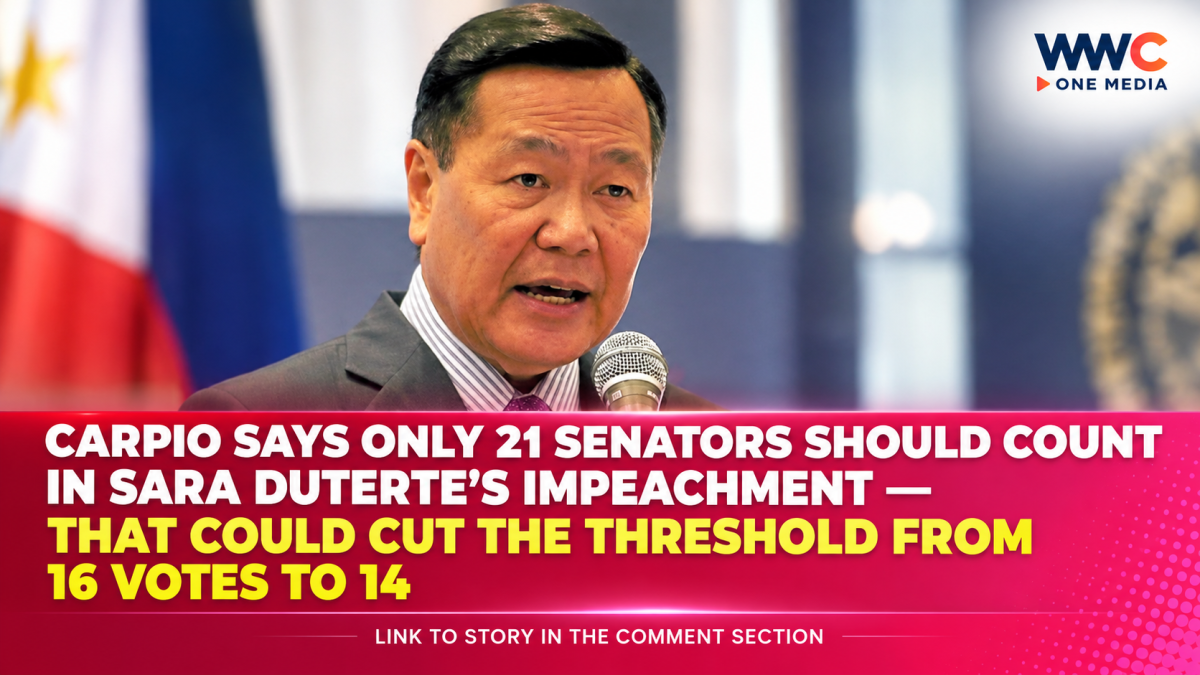
Retired Supreme Court Associate Justice Antonio Carpio said Thursday that only 21 of the Senate’s 24 members should presently be considered qualified senator-judges for purposes of an eventual impeachment vote, arguing that two detained senators and Senator Ronald “Bato” dela Rosa should not be counted in the constitutional base.
If the Senate impeachment court accepted Carpio’s position, the arithmetic would change immediately:
two-thirds of 21 is 14.
That would reduce the number required for conviction from the 16 votes currently prescribed under Senate impeachment court presiding officer Francis “Chiz” Escudero’s July 6 ruling.
But Carpio’s interpretation is not yet the rule.
The Senate impeachment court is scheduled to hear arguments from the prosecution and defense on September 23, after which senator-judges are expected to decide whether Escudero’s existing 16-vote ruling should stand.
The Constitution says “two-thirds of all the Members of the Senate”
The dispute begins with a single sentence in Article XI, Section 3(6) of the 1987 Constitution:
No person shall be convicted without the concurrence of two-thirds of all the Members of the Senate.
The Senate is constitutionally composed of 24 members.
A straightforward calculation using all 24 produces the familiar threshold of 16 votes. That was the position Escudero adopted when the trial formally proceeded in July.
But the Constitution does not expressly say what happens when some members cannot legally or practically sit and vote as senator-judges.
That is the unresolved question now confronting the impeachment court.
Carpio says the denominator should contain only senators qualified to vote
Carpio told Super Radyo dzBB that the relevant denominator should be based on senators who are actually legally qualified to exercise the function.
His proposed count excludes three senators:
Jinggoy Estrada, Rodante Marcoleta and Ronald “Bato” dela Rosa.
Carpio cited the legal consequences of suspension or detention in explaining his position on Estrada and Marcoleta and pointed separately to the impeachment oath requirement in dela Rosa’s case.
Under that approach, 24 becomes 21.
And 16 becomes 14.
Again, that is Carpio’s interpretation, not a final constitutional determination.
Jinggoy Estrada is both detained and under preventive suspension
Estrada is detained while facing a ₱573-million plunder case involving alleged irregularities connected with flood-control projects.
He has denied wrongdoing and is contesting the charges.
Separately, the Sandiganbayan ordered him preventively suspended from office for 90 days in connection with a pending graft case.
Senate President Sherwin Gatchalian previously said the suspension from his position as senator also covers Estrada’s functions as a senator-judge in Duterte’s impeachment trial.
That makes Estrada the clearest example in the current debate of a senator whose formal ability to perform senatorial functions has been directly affected by a court order.
Marcoleta presents a somewhat different situation
Senator Rodante Marcoleta is also detained while facing a ₱75-million plunder case connected with allegedly undeclared campaign contributions.
The charges remain pending, and Marcoleta has not been convicted.
Carpio argued that the legal principles governing officials facing such proceedings should also remove Marcoleta from the denominator.
But Marcoleta himself rejects the premise that the constitutional threshold should be recalculated.
He said Thursday that the threshold is already written into the Constitution and that he would not seek temporary release merely to participate in a vote on changing it.
That disagreement illustrates why the issue cannot simply be described as settled law.
Dela Rosa never took the impeachment oath
The third senator in Carpio’s calculation is Ronald “Bato” dela Rosa.
When senators formally convened as an impeachment court on May 18, dela Rosa was absent and therefore did not take the oath administered to the senator-judges.
Article XI expressly says that when the Senate sits for an impeachment trial, senators “shall be on oath or affirmation.”
Carpio therefore argues that dela Rosa is currently not qualified to vote as a senator-judge because he never took that oath.
Dela Rosa has also remained out of public view amid an International Criminal Court arrest warrant connected with the Duterte administration’s anti-drug campaign.
But even on the oath question, the legal answer is not universally accepted.
Former Chief Justice Reynato Puno told the impeachment court that whether a senator who has not taken the oath should be counted cannot necessarily be answered categorically without examining the circumstances, including why the oath was not taken and the stage of proceedings.
Loren Legarda is absent — but Carpio’s 21 appears to keep her in the count
A fourth senator, Loren Legarda, has also missed the impeachment proceedings for several weeks while on extended medical leave abroad.
But Carpio’s figure of 21 excludes only three of the 24 senators.
That indicates his current calculation does not automatically remove Legarda merely because she is physically absent.
This highlights an important distinction running through the debate:
absence is not necessarily the same thing as legal incapacity.
The Senate impeachment court still has to decide how different situations — detention, suspension, medical absence, failure to take the oath or voluntary inhibition — affect the constitutional denominator.
Three former chief justices also said 16 is not necessarily fixed
Carpio’s comments came one day after the Senate impeachment court heard from four retired Supreme Court magistrates serving as amici curiae, or friends of the court.
Former Chief Justices Hilario Davide Jr., Artemio Panganiban and Reynato Puno all took the position that the constitutional requirement does not necessarily mean the denominator must remain permanently fixed at 24 regardless of circumstances.
Davide argued specifically that the two-thirds computation should be based on senators who are legally and physically qualified to vote.
He said that public officers who are legally incapable of holding or exercising office should not automatically remain in the denominator.
Puno took a more contextual approach, saying the number required for conviction could move depending on circumstances and warning that a rigid interpretation might produce results inconsistent with the purpose of the constitutional process.
Panganiban similarly emphasised meaningful participation and suggested that senator-judges who cannot fairly decide the case because they have not participated should consider inhibiting themselves.
But Azcuna says all 24 still count
The fourth amicus, retired Supreme Court Associate Justice Adolfo Azcuna, disagreed.
His interpretation is far closer to Escudero’s original ruling.
Azcuna said that as long as a senator legally remains a member of the Senate, that senator should remain part of the denominator.
He identified only three clear circumstances that would remove someone from that membership count:
death, resignation or removal from office.
Under Azcuna’s view, detention or inability to participate would not by itself shrink the constitutional denominator.
The required conviction vote would therefore remain 16.
That difference is fundamental.
The Senate is not choosing between a legal position and no legal position.
It is confronting competing constitutional interpretations advanced by experienced former justices.
So the dispute currently looks like this
| Interpretation | Denominator | Votes needed for conviction |
|---|---|---|
| Escudero’s existing ruling | 24 senators | 16 |
| Azcuna’s interpretation | 24 senators | 16 |
| Carpio’s current view | 21 qualified senators | 14 |
The table does not mean the Senate has chosen the 14-vote interpretation.
It has not.
It simply shows the practical consequence of Carpio’s argument compared with the existing rule.
Why the debate matters even before anyone votes on guilt
Changing the denominator does not determine whether Duterte should be convicted or acquitted.
It determines only how many affirmative votes would be required if and when the impeachment court reaches final judgment.
That distinction is essential.
The trial concerns allegations including culpable violation of the Constitution, graft and corruption, betrayal of public trust and other high crimes contained in the articles approved by the House.
Duterte has contested the impeachment case and is represented by a defense team in the Senate proceedings.
The threshold dispute is procedural and constitutional.
It should not be reported as evidence for or against any of the impeachment charges themselves.
Senator Erwin Tulfo forced the issue back onto the floor
The immediate reconsideration arose after Senator-Judge Erwin Tulfo asked the impeachment court for clarification on September 8.
He pointed out that four senators were not currently participating:
Estrada and Marcoleta were detained;
dela Rosa was absent and beyond the Senate’s immediate reach;
and Legarda remained abroad on medical leave.
Tulfo asked who would actually be legally capable of voting if judgment were required under those circumstances.
That pushed the impeachment court to schedule testimony from the four former magistrates on September 16 and oral arguments from both sides for September 23.
There is another issue: does mere absence effectively become a “no” vote?
This is one reason some senator-judges have questioned the fixed-24 interpretation.
If 16 votes are always required regardless of how many senator-judges are legally or physically capable of voting, then every unavailable senator effectively makes conviction mathematically harder even without casting a vote.
Tulfo has publicly raised precisely that concern.
Supporters of the fixed denominator answer that the Constitution deliberately uses the words “all the Members of the Senate”, establishing a high and stable bar for removing an impeachable official.
Azcuna’s argument reflects that reading.
Both considerations are now before the impeachment court.
The Avelino case has repeatedly been cited — but the former justices say it is not a perfect match
Much of the debate initially centred on the 1949 Supreme Court case Avelino v. Cuenco.
That case involved the calculation of a Senate quorum and the treatment of members who were beyond the chamber’s coercive jurisdiction.
Some impeachment participants have suggested the principle could support reducing the denominator when senators cannot participate.
But Davide, Puno and Panganiban told the impeachment court that Avelino does not directly decide the present question.
Their reason is straightforward:
Avelino was about a quorum.
The Duterte dispute concerns the constitutional number required for conviction in an impeachment trial.
So Avelino may provide an analogy, but the former justices said it is not a controlling answer.
The Supreme Court itself has repeatedly quoted the two-thirds requirement
Recent Supreme Court decisions involving Duterte’s impeachment have repeated the constitutional language requiring concurrence by two-thirds of all Senate members.
But those decisions were not resolving the precise factual situation now before the impeachment court — namely how the denominator should be calculated when individual senators are detained, suspended, absent or never took the impeachment oath.
That distinction is why the Senate is debating the issue rather than simply pointing to a definitive Supreme Court ruling that already answers it.
Who has the final say is itself disputed
Puno and Panganiban emphasised that the Constitution grants the Senate the “sole power to try and decide all cases of impeachment” and argued that the Senate impeachment court therefore has authority to determine the applicable threshold in the first instance.
But Duterte’s defense team has said going to the Supreme Court remains an option after the impeachment court resolves the question.
Some House prosecutors have likewise previously expressed the view that an eventual constitutional dispute could reach the Supreme Court, although they said the prosecution was not necessarily the party that needed to raise it at that stage.
That means the September 23 vote might settle the rule inside the Senate impeachment court without necessarily ending the constitutional debate outside it.
Escudero will not vote on whether his own 16-vote ruling survives
Another procedural wrinkle is that presiding officer Francis Escudero is not expected to participate in the September 23 vote reconsidering his ruling.
Impeachment court spokesperson Regie Tongol said Escudero’s July decision effectively represents his position already.
The remaining senator-judges will therefore decide whether to overturn or sustain it.
If a motion to overturn the ruling fails, the existing 16-vote threshold remains in force.
The threshold debate is not the impeachment verdict
That point deserves emphasis because the numbers can easily overtake the substance of the trial.
Whether the required vote is eventually 16, 14 or another constitutionally determined number does not tell senator-judges how to vote.
Each article of impeachment still has to be evaluated based on the case presented in the Senate proceedings.
A conviction on an article would require the applicable two-thirds concurrence and would result in removal from office; impeachment judgment can also include disqualification from future public office. Criminal or civil liability is separate from the impeachment judgment.
What happens September 23
The next major procedural date is now Wednesday, September 23.
The prosecution and defense are scheduled to present oral arguments on the threshold question.
Each side was allotted time to explain how it interprets “two-thirds of all the Members of the Senate.”
Afterward, the senator-judges are expected to vote on whether Escudero’s existing interpretation should remain.
That vote could settle whether the eventual conviction threshold remains 16 or moves lower based on a different definition of which senators belong in the constitutional denominator.
And that is why Carpio’s “21” matters
Carpio did not decide the impeachment case Thursday.
He did not issue a Supreme Court judgment.
And his interpretation does not automatically replace Escudero’s ruling.
What he did was convert an abstract constitutional debate into a concrete mathematical consequence.
If all 24 senators count:
16 votes are required.
If only the 21 senators Carpio regards as currently qualified count:
14 votes are required.
Azcuna says the first calculation is correct.
Carpio, Davide and other former jurists have advanced arguments supporting a more flexible denominator, though their precise reasoning is not identical.
The Senate impeachment court now has to decide which interpretation governs its own judgment.
And before senators determine whether the evidence warrants conviction or acquittal, they first have to answer an unusually consequential question:
How many senator-judges legally count?




Leave a Reply