
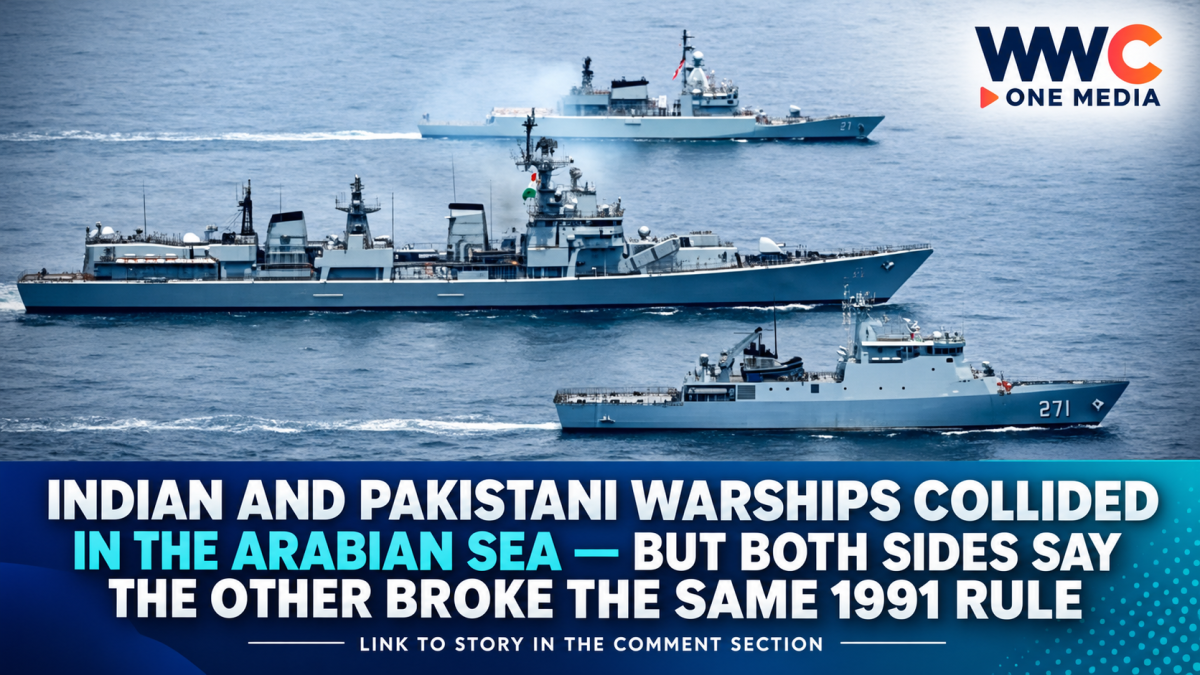
A physical collision between Indian and Pakistani naval vessels in the North Arabian Sea has opened a new and potentially dangerous front in the already strained relationship between the two nuclear-armed neighbours.
The encounter happened on September 15, 2026, and by the following day both New Delhi and Islamabad had summoned the other country’s senior diplomatic representative and lodged formal protests.
Both governments agree on the most basic fact:
Their naval vessels came into contact at sea.
Almost everything about how that happened is disputed.
India says a Pakistani naval vessel approached one of its frontline warships at high speed while the Indian ship was conducting routine surveillance, accusing the Pakistani crew of unsafe and unprofessional manoeuvring.
Pakistan says the opposite.
Islamabad says its navy was conducting the biennial SEASPARK-26 exercise when an Indian naval vessel carried out what it described as aggressive manoeuvres dangerously close to a Pakistani ship, causing the vessels to make contact.
Both sides say the other violated the same bilateral agreement designed specifically to stop dangerous military encounters from turning into something much worse.
And that may be the most important part of the story.
India Says the Pakistani Ship Came in at High Speed
According to India’s Ministry of External Affairs and Indian officials cited by multiple outlets, an Indian Navy warship was conducting a routine surveillance operation in the northern Arabian Sea on Tuesday evening when the Pakistani vessel approached rapidly.
Indian officials described the Pakistani ship’s manoeuvring as unsafe and said it resulted in the collision. New Delhi said the incident caused no major damage.
India then summoned Pakistan’s Charge d’Affaires in New Delhi and lodged what it described as a strong protest over the conduct of Pakistani naval units.
New Delhi also instructed its own Charge d’Affaires in Islamabad to raise the matter formally with Pakistan’s Foreign Ministry.
Indian reporting has identified the Pakistani vessel as PNS Hunain, a relatively new offshore patrol vessel delivered to the Pakistan Navy in 2024.
Indian Express reported that the encounter occurred roughly 120 nautical miles from the Gulf of Oman, while Indian media reports said PNS Hunain later returned to port after sustaining damage.
That last point requires caution.
Pakistan’s official statement did not publicly identify its vessel as PNS Hunain or confirm the Indian reports about the extent of damage.
So while PNS Hunain has been widely identified by Indian sources, the damage claims should not be treated as independently verified.
Pakistan Says the Indian Vessel Was the Aggressor
Hours after India’s protest, Pakistan presented a substantially different account.
Pakistan’s Foreign Ministry said the encounter took place while its navy was carrying out SEASPARK-26, which it described as a biennial exercise.
Islamabad accused the Indian vessel of conducting aggressive manoeuvres in dangerously close proximity to the Pakistani ship and said that action resulted in contact between them.
Pakistan summoned India’s Charge d’Affaires in Islamabad and lodged its own protest, describing the Indian action as highly provocative and unacceptable.
It also accused India of violating international law and the same 1991 bilateral military agreement invoked by New Delhi.
Pakistan urged India to comply with international law and agreements intended to prevent dangerous encounters at sea.
In other words, both governments are not merely disputing the facts.
They are accusing each other of violating the same safety mechanism.
The 1991 Agreement Contains a Very Specific Rule: Stay Three Nautical Miles Apart
At the centre of the dispute is the Agreement Between India and Pakistan on Advance Notice on Military Exercises, Manoeuvres and Troops Movements, signed on April 6, 1991.
The agreement was created as a confidence-building measure intended to reduce the risk that military activities by either country would be mistaken for preparations for an attack.
Most of the document concerns advance notification of military exercises.
But Article 10 contains a strikingly specific rule for naval forces.
It states that Indian and Pakistani naval ships and submarines should not close to less than three nautical miles of one another while operating in international waters, specifically to reduce the risk of accidents.
Three nautical miles is approximately 5.6 kilometres.
India says the Pakistani ship breached that requirement.
Pakistan says the Indian vessel violated the bilateral agreement through its own manoeuvring.
No publicly released independent navigation data has yet established which version is correct.
Even the Location Sounds Disputed — But There Is an Important Legal Nuance
India describes the incident as occurring in international waters.
Pakistan says it happened within Pakistan’s exclusive economic zone, or EEZ.
At first glance those claims may appear completely contradictory.
Legally, however, the situation is more complicated.
An EEZ can extend as far as 200 nautical miles from a country’s coastline, but it is not the same thing as territorial waters.
Under the United Nations Convention on the Law of the Sea, a coastal state has special rights over resources and certain economic activities within its EEZ, while vessels from other countries retain freedom of navigation there.
So if the phrase “international waters” is being used broadly to mean waters outside Pakistan’s territorial sea, it is possible for an area to fall within Pakistan’s EEZ while still allowing international navigation.
If India is using “international waters” to mean the legal high seas, however, the descriptions would be different because UNCLOS treats the high seas and EEZ as separate maritime zones.
Neither government has publicly released precise coordinates that would allow outsiders to settle that question.
The collision itself — and the three-nautical-mile bilateral safety rule — therefore matters more than simply whether the encounter occurred inside an EEZ.
PNS Hunain Is One of Pakistan’s Newer Naval Ships
Indian reports have identified the Pakistani vessel involved as PNS Hunain.
The shipbuilder Damen says PNS Hunain is an OPV 2600 offshore patrol vessel built for the Pakistan Navy and delivered in the summer of 2024.
The approximately 98-metre, 2,600-tonne class is designed for maritime-security operations and sustained deployments.
That makes the reported involvement of Hunain notable because it is not an ageing ship operating at the end of its service life.
It is part of Pakistan’s relatively modern surface fleet.
Again, Pakistan’s Foreign Ministry did not identify the vessel in its September 16 statement, so its involvement rests on Indian reporting rather than confirmation from both sides.
Why SEASPARK Matters
Pakistan says its naval forces were conducting SEASPARK-26 when the encounter happened.
SEASPARK is not a newly invented exercise.
Pakistan Navy historical material says the first exercise in the SEASPARK series took place in the North Arabian Sea in 1979, making it a longstanding part of the navy’s training programme.
That matters because military exercises routinely involve increased ship movements, surveillance and observation by neighbouring forces.
None of that automatically means a confrontation is intended.
But when two rival navies operate in proximity — particularly ones belonging to states with a history of war — the risk of a miscalculation becomes significantly more serious.
That is precisely why the 1991 rules exist.
This Is Not the First Time the Two Navies Have Had a Dangerous Encounter
The three-nautical-mile provision has surfaced before.
Indian reporting points to a 2011 encounter involving the Indian frigate INS Godavari and Pakistan Navy ship PNS Babur as another episode in which New Delhi accused a Pakistani vessel of operating dangerously close to an Indian warship.
The broader principle behind the agreement is straightforward.
Even if neither side intends to open fire, an unsafe manoeuvre by a large naval vessel can cause a collision.
A collision can injure sailors.
Damage to a warship can be interpreted as hostile action.
Radio warnings can be misunderstood.
Other ships or aircraft can move into the area.
And what begins as a navigational incident can become a political or military crisis remarkably quickly.
That danger is considerably higher when the countries involved have recently fought each other.
India and Pakistan Were in Their Worst Fighting in Decades Just Last Year
The timing makes the collision especially sensitive.
In May 2025, India and Pakistan fought their most intense military confrontation in nearly three decades after an April 22 attack in Indian-administered Kashmir killed 26 people, mostly tourists.
India blamed Pakistan-linked militants and launched strikes on what it described as militant infrastructure inside Pakistan and Pakistan-administered Kashmir.
Pakistan denied involvement in the tourist attack and said Indian strikes had hit civilian locations.
Four days of fighting involved missiles, drones, aircraft and artillery, leaving dozens dead before a ceasefire was reached on May 10.
India and Pakistan have disagreed over the diplomatic role played by Washington in reaching that ceasefire: Pakistan has credited U.S. mediation, while India has maintained that the halt in fighting was arranged bilaterally.
Those disagreements remain politically important, but the larger point is undisputed:
The two countries entered the latest naval incident with the memory of a recent armed clash still fresh.
Kashmir Remains the Central Fault Line
India and Pakistan have fought three full-scale wars since independence in 1947, with two centred on the disputed Kashmir region.
Both administer parts of Kashmir, while each claims the territory in full.
The April 2025 Pahalgam attack sharply intensified those tensions.
India has maintained that Pakistani links were behind the assault.
Pakistan has denied involvement and called for an independent investigation.
That history means even an encounter far away from Kashmir — this time hundreds of kilometres out in the Arabian Sea — inevitably carries wider strategic significance.
Why the Arabian Sea Matters Even More Right Now
The waters where the collision occurred are strategically critical.
The northern Arabian Sea connects South Asian ports with the approaches to the Gulf of Oman and Strait of Hormuz, placing it on one of the world’s most important maritime energy and commercial routes.
The Japan Times/Bloomberg noted that the encounter comes during a period of severe disruption around the Strait of Hormuz linked to the wider U.S.-Iran conflict, making security and freedom of navigation around the Arabian Sea even more sensitive.
That does not mean the India-Pakistan collision was directly connected to the Middle East conflict.
There is no evidence establishing such a link.
But it does mean the incident happened in waters already experiencing unusually high geopolitical tension.
What Has Actually Been Confirmed?
Strip away the competing accusations and several facts are solid.
An Indian and Pakistani naval vessel made physical contact in the North Arabian Sea on September 15.
India and Pakistan both formally protested the incident the following day.
Both invoked bilateral rules designed to prevent military accidents.
India says no major damage occurred.
Pakistan says the encounter took place during SEASPARK-26.
And each government says the other side was responsible.
What remains unresolved is crucial:
Which ship closed the distance?
Which vessel altered course?
How fast were they travelling?
What warnings were exchanged?
What do their bridge logs and radar tracks show?
And exactly where did the contact occur?
Until navigation records, an investigation or mutually verifiable evidence emerges, those questions should not be answered by simply adopting either government’s version.
The Collision Was Minor. The Risk Behind It Was Not.
There are no reports of the two navies exchanging fire.
India says there was no major damage.
No casualties have been publicly reported.
That makes this incident dramatically different from the missile and drone exchanges of May 2025.
But it may also demonstrate why military confidence-building agreements matter.
The 1991 pact was written precisely because leaders in New Delhi and Islamabad understood that a crisis does not always begin with a deliberate decision to start one.
Sometimes it begins when ships get too close.
For 35 years, India and Pakistan have had a written rule telling their naval vessels to remain three nautical miles apart.
On September 15, two ships ended up close enough to physically collide.
Now both countries are saying the other side broke the rule designed to stop exactly that from happening




Leave a Reply