
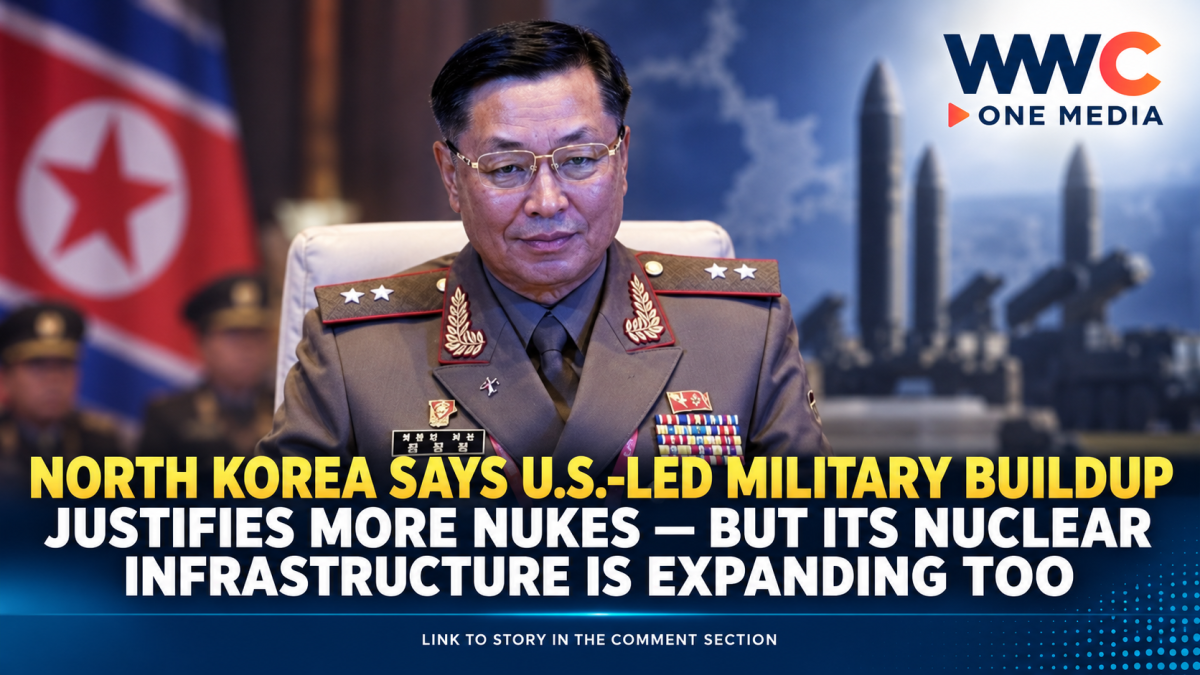
BEIJING / SEOUL — September 17, 2026 — North Korea has delivered one of its clearest warnings yet that it intends to keep expanding its nuclear forces, arguing that deeper military cooperation among the United States, South Korea and Japan has eliminated any reason for Pyongyang to reverse course.
Speaking at the Beijing Xiangshan Forum on Thursday, North Korean Vice Defense Minister Kim Kang Il said what Pyongyang views as a growing U.S.-led military buildup justified strengthening the country’s nuclear deterrent. He also described North Korea’s nuclear status as effectively irreversible.
But one crucial distinction sits at the center of the dispute: North Korea characterizes Washington-Seoul-Tokyo security cooperation as an expanding “nuclear alliance.” The three governments describe their cooperation as defensive, while publicly documented U.S. nuclear-deterrence arrangements with Japan and South Korea operate through separate alliance mechanisms rather than a formally declared three-country nuclear alliance. Japan and the U.S., for example, held a bilateral Extended Deterrence Dialogue as recently as June, when Washington reaffirmed that its defense commitment to Japan includes nuclear capabilities.
That difference in interpretation is now becoming increasingly important as military exercises, missile launches and nuclear expansion feed a cycle in which each side cites the other’s actions as justification for strengthening its own forces.
North Korea: Our Nuclear Program Is Now a ‘Line of No Retreat’
Kim Kang Il told delegates at China’s flagship international defense gathering that North Korea would continue expanding what it describes as its self-defensive nuclear deterrent as long as the military threat it perceives from the United States and its allies continues.
He blamed tensions on Washington’s longstanding policy toward Pyongyang and called North Korea’s constitutional nuclear status a “line of no retreat.” He also rejected the objective of denuclearization.
His appearance itself was notable.
Reuters reported that it represented a relatively rare high-level North Korean presence at a major international security conference, coming as Pyongyang has been strengthening political and military relations with both China and Russia.
Kim was also asked whether another summit between U.S. President Donald Trump and North Korean leader Kim Jong Un could take place. He said he was not in a position to address the possibility.
That leaves an unusual diplomatic situation: Trump has shown interest in reopening direct engagement, while Pyongyang is simultaneously insisting that giving up its nuclear arsenal cannot be the starting point.
Kim Yo Jong Sent Almost the Same Message Hours Earlier
Kim Kang Il’s remarks did not come in isolation.
Earlier Thursday, Kim Yo Jong, Kim Jong Un’s influential sister and a senior North Korean official, rejected fresh calls for denuclearization emerging from the International Atomic Energy Agency’s General Conference in Vienna.
She described North Korea’s nuclear status as “absolute” and argued that it could no longer be reversed.
South Korea’s Unification Ministry said it was taking note of her statement and assessed it as an attempt by Pyongyang to signal to Washington that denuclearization should not be expected to form the basis of any future summit negotiations. That is Seoul’s interpretation of North Korean messaging, rather than a confirmed statement of negotiating terms from Pyongyang.
Together, Kim Yo Jong’s statement and Kim Kang Il’s Beijing speech suggest that North Korea is trying to establish one principle before any renewed diplomacy begins:
its nuclear arsenal is not something it considers temporary.
The Timing Comes Days After a Major U.S.-Japan-South Korea Exercise
The rhetoric also follows the latest Freedom Edge exercise involving the United States, South Korea and Japan.
The five-day drill ended on September 11 and included maritime, aviation, air-defense, cyber, medical and command-and-control training. U.S. Pacific Command described the exercise as designed to strengthen interoperability and defensive cooperation among the three militaries.
South Korea’s Joint Chiefs of Staff likewise said the exercise was defensive and intended to improve responses to North Korean nuclear and missile threats.
Pyongyang sees it differently.
North Korea has repeatedly portrayed Freedom Edge and other multinational exercises as evidence that Washington, Seoul and Tokyo are moving toward an integrated military bloc directed against it.
That characterization is disputed by the participating governments.
The publicly released description of Freedom Edge calls it a trilateral multidomain military exercise involving increasingly integrated communications and operations, but it does not establish a formal three-country nuclear alliance.
But U.S. Nuclear Guarantees to Its Allies Are Real
That does not mean nuclear deterrence is absent from the security architecture.
The United States provides what is known as extended deterrence to allies including Japan and South Korea — effectively a commitment to use the full range of U.S. capabilities to deter or respond to attacks against them.
In June, Japan and the United States held another Extended Deterrence Dialogue in Tokyo. Washington reaffirmed its commitment to defend Japan using its full range of capabilities, including nuclear forces, while both governments discussed nuclear posture, crisis coordination and regional threats.
The same statement also reaffirmed Washington and Tokyo’s objective of the complete denuclearization of North Korea.
That exposes the fundamental collision between the two positions.
Pyongyang says its nuclear status is permanent. Washington and Tokyo continue officially to seek its denuclearization.
Neither position is currently showing signs of converging.
Then Came the Missiles
Just after Freedom Edge ended, North Korea launched several short-range ballistic missiles from the Wonsan area toward waters off its east coast.
South Korea’s military said the missiles flew about 250 kilometers, while Seoul’s National Security Council said ballistic missile launches by North Korea violate U.N. Security Council resolutions.
U.S. Pacific Command said the launches did not pose an immediate threat to U.S. territory or its allies but reaffirmed Washington’s defense commitments.
North Korea subsequently said the launches were part of a broader live-fire exercise involving missiles, artillery and drones.
The sequence highlights the escalating action-and-reaction dynamic:
Washington, Seoul and Tokyo conduct military exercises because they cite North Korea’s nuclear and missile capabilities as a security threat.
North Korea then cites those exercises as evidence that it needs more nuclear weapons and stronger delivery systems.
The Nuclear Program Is Expanding on the Ground, Not Just in Speeches
There is another reason Thursday’s warning carries weight: outside monitoring indicates that North Korea is physically expanding its capacity to produce nuclear material.
The International Atomic Energy Agency reported this month that Pyongyang constructed another uranium-enrichment facility at its main Yongbyon nuclear complex.
According to the IAEA assessment, the new two-story facility could accommodate up to 28 centrifuge cascades. The agency also detected indications that an expanded annex at the Kangson enrichment facility near Pyongyang began operating in January.
Because the IAEA has not had inspectors inside North Korea since 2009, its assessments rely on satellite imagery, open-source intelligence and North Korean state-media material. That limitation is important: the agency can monitor visible activity but cannot directly inspect the facilities or independently inventory North Korea’s nuclear material.
IAEA Director General Rafael Grossi said the continuing enrichment activity and reported expansion of weapons-grade material production were a serious concern. The agency says the activities conflict with U.N. Security Council resolutions.
North Korea rejects the IAEA’s authority over its program.
Another Dispute Is Developing Over WMD Planning
The rhetoric intensified further after South Korea and the United States held talks on responding to North Korean weapons of mass destruction.
Seoul and Washington agreed during their Combined WMD Countermeasures Committee meeting to strengthen information sharing and joint response capabilities.
North Korea’s defense ministry condemned those discussions as confrontation and warned that such planning could trigger provisions of its own nuclear-force policy.
Again, the two sides describe the same activity in opposite terms.
Seoul and Washington characterize WMD planning as preparation for responding to a potential North Korean attack.
Pyongyang portrays it as evidence of preparations directed against the North.
Trump Has Already Scaled Back One Major Exercise
The confrontation is unfolding even as the Trump administration has attempted limited steps toward reopening diplomacy.
AP reported that Trump ordered the annual Ulchi Freedom Shield exercise between the United States and South Korea to be substantially reduced, citing his relationship with Kim Jong Un and concerns that large exercises could send a hostile signal.
But North Korea did not respond by suspending its weapons activity.
Kim Yo Jong argued that reducing the exercise did not fundamentally change what Pyongyang views as its hostile character, while North Korea subsequently conducted additional missile launches.
That raises one of the biggest questions surrounding any possible Trump-Kim reopening:
What exactly would the two sides negotiate?
Previous diplomacy was centered largely on denuclearization and sanctions relief.
North Korea is now publicly insisting that its nuclear status itself is non-negotiable.
The Real Battle May Be Over the Starting Point of Any Future Talks
The latest statements do not mean diplomacy is impossible.
They do, however, expose an increasingly difficult gap over what negotiations would even be designed to achieve.
Washington and its allies continue to publicly support North Korean denuclearization. Japan and the United States explicitly reaffirmed that objective during their June 2026 deterrence talks.
North Korea, by contrast, is increasingly demanding that other governments accept nuclear possession as a settled reality before meaningful relations can move forward. Kim Kang Il’s Beijing speech and Kim Yo Jong’s IAEA statement both reinforced that position this week.
Meanwhile, the physical infrastructure behind the nuclear program continues to expand, military exercises continue around the peninsula and ballistic missile testing continues.
That makes Thursday’s speech more than another round of hostile rhetoric.
It highlights the central strategic problem now confronting the Korean Peninsula:
the United States and its allies are strengthening deterrence because North Korea is expanding its nuclear forces — while North Korea says it is expanding those forces precisely because U.S.-led deterrence is getting stronger.
Neither side currently accepts the other’s explanation for why that cycle began.




Leave a Reply