
TOKYO — More than half a century after nine young Japanese radicals seized a domestic passenger jet and forced it toward North Korea, one of the remaining internationally wanted suspects is reportedly dead.
Shiro Akagi, 78, is believed to have died on September 12 at a hospital in Pyongyang, according to information passed from North Korea to supporters and family members in Japan.
Akagi had reportedly suffered from chronic heart problems and had been repeatedly hospitalised in recent years. Japanese police have received information about his death but, as of September 17, were still attempting to verify it independently.
That distinction matters.
Akagi was not a former suspect whose case had long ago been formally closed.
He remained internationally wanted 56 years after the hijacking.
Japan’s National Police Agency was still displaying Akagi among wanted members of the so-called Yodogo group in its most recent security material.
His reported death therefore marks another disappearing link to one of the strangest episodes in Japanese aviation history—a hijacking involving swords, a fake Pyongyang airport in Seoul, a politician volunteering to become a hostage and a group of radicals who ultimately spent decades living in North Korea.
It began with an ordinary Tokyo-to-Fukuoka flight
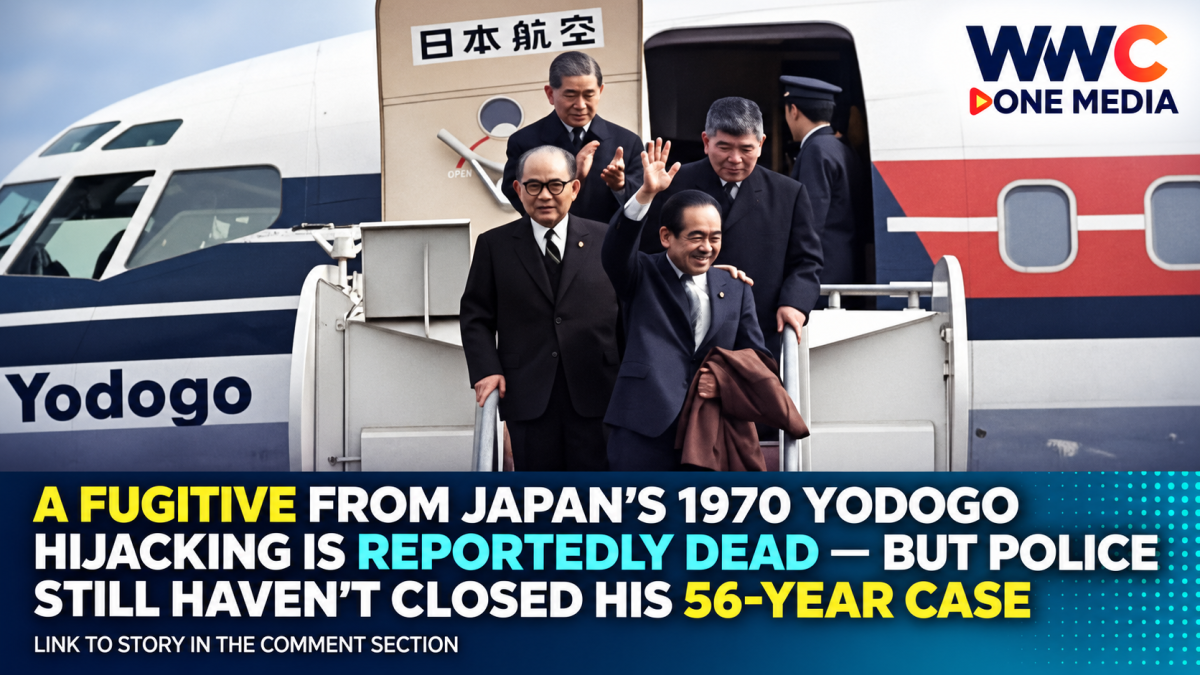
On March 31, 1970, Japan Airlines Flight 351 departed Tokyo’s Haneda Airport for Fukuoka.
The Boeing 727 was nicknamed Yodo, after Japan’s Yodo River.
Nine members of the Communist League’s Red Army Faction, a militant far-left group, were aboard.
They seized control of the aircraft using weapons that included Japanese swords and other weapons or purported explosives, taking the passengers and crew hostage. Japanese police records identify Takamaro Tamiya as the leader of the group.
The aircraft carried 129 passengers and crew members apart from the hijackers, according to Japanese court and contemporary reporting.
Their stated objective went far beyond taking an aircraft.
The group wanted to leave Japan and establish an overseas revolutionary base from which it could pursue its vision of international revolution.
North Korea became the destination.
One important historical correction: they were not yet the Japanese Red Army
The terminology is often blurred in modern retellings.
The nine hijackers belonged to the Red Army Faction, or Sekigun-ha, which emerged from Japan’s radical student movement.
The better-known Japanese Red Army, associated with later international attacks in the 1970s, was a separate organisation formed afterward.
Japan Times’ reporting on convicted Yodogo hijacker Yoshimi Tanaka notes that the Red Army Faction was formed in 1969 and advocated global revolution through armed struggle; the Japanese Red Army broke away later.
Calling Akagi simply a “Japanese Red Army hijacker” therefore risks compressing two related but distinct organisations into one.
The hijackers first stopped at Fukuoka
The Yodo could not simply fly from Japan to whatever destination its captors demanded.
After the takeover, the aircraft landed in Fukuoka, where negotiations began and 23 passengers were released.
The plane then headed toward the Korean Peninsula.
What happened next became the most cinematic episode of the entire crisis.
South Korean authorities tried to convince the hijackers that they had arrived in North Korea.
They had actually landed at Gimpo Airport in Seoul.
South Korea tried to turn Gimpo into fake Pyongyang
Officials hurriedly disguised the airport.
North Korean flags were displayed.
South Korean identification was concealed.
Personnel were dressed to support the deception.
The idea was to persuade the hijackers that the aircraft had already reached Pyongyang and end the crisis without allowing them into North Korea.
It did not work.
The hijackers eventually realised they were still in South Korea.
That led to another extraordinary negotiation.
A Japanese politician volunteered to replace the hostages
Japan’s parliamentary vice minister for transport, Shinjiro Yamamura, offered himself as a substitute hostage.
After prolonged talks, the remaining passengers were released.
Yamamura boarded the aircraft in their place, allowing the Yodo to continue with the hijackers, flight crew and the Japanese official to North Korea. Historical photo archives and contemporary accounts record Yamamura’s exchange for the passengers after the standoff at Gimpo.
The hijackers finally reached Pyongyang.
North Korea accepted them.
Yamamura and the aircraft crew were ultimately able to return to Japan with the plane.
No hostage was killed during the hijacking, although a later Japanese court found that five people had suffered minor injuries during the incident.
Akagi never came back
For Shiro Akagi, the flight effectively became a one-way trip.
He remained in North Korea for the rest of his life—or, at least, until the reported death now being investigated by Japanese authorities.
Jiji reported that Akagi had been living in a suburb of Pyongyang with other members of the Yodogo circle, including Kimihiro Uomoto, and relatives of deceased members.
FNN says Akagi had suffered from heart disease for several years and repeatedly entered and left hospital.
According to information reaching Japan, he died at a Pyongyang hospital on September 12.
But because that information originates from inside North Korea rather than an independently accessible death record, Japanese authorities have not yet treated the matter as completely verified.
Why police confirmation matters
Death normally ends the possibility of prosecuting an individual.
But investigators first have to establish that the person is genuinely dead.
That is particularly difficult in a case involving a fugitive who has lived for decades inside North Korea, where Japanese investigators cannot simply obtain hospital records, examine remains or independently question witnesses.
Japan’s National Police Agency has encountered this problem before.
Its official publications have repeatedly noted that some Yodogo members were reported to have died but that those deaths could not always be independently verified.
That explains the careful wording surrounding Akagi today.
Information says he is dead.
Police are checking.
Until that process is complete, his death is reported rather than officially established.
Reports even differ slightly on how he died
Jiji Press and FNN say the reported cause was heart failure.
NTV reported myocardial infarction.
Those descriptions can overlap medically but should not be presented as though Japanese authorities have issued a certified cause of death.
FNN also reported information that Akagi was cremated in North Korea on September 13, one day after his reported death.
If accurate, that could make physical verification even more difficult.
Only three original hijackers are now believed to remain in North Korea
Akagi’s reported death further shrinks the surviving core of the 1970 group.
Japanese reports now identify Takahiro Konishi, Moriaki Wakabayashi and Kimihiro Uomoto as the three Yodogo hijackers believed to remain in North Korea.
Others followed very different paths.
Group leader Takamaro Tamiya was reported to have died in North Korea in 1995.
Yoshimi Tanaka eventually left North Korea, was arrested in Southeast Asia and was extradited to Japan in 2000. He admitted his role in the hijacking and was sentenced by the Tokyo District Court in 2002 to 12 years in prison.
Tanaka died in 2007, according to Japan’s police records.
What started as a group of nine young militants has therefore been reduced by deaths, arrests and the passage of more than half a century.
But the Yodogo story did not end when the aircraft returned
This is where the case becomes far larger than a 1970 aviation crime.
Japanese authorities have long investigated allegations connecting members of the Yodogo circle and their wives with later cases involving Japanese citizens taken to North Korea.
The National Police Agency says it has an international arrest warrant for Kimihiro Uomoto over the suspected abduction of Keiko Arimoto, a Japanese woman who was studying in Europe before disappearing in 1983.
Police also identify Yoriko Mori and Sakiko Wakabayashi, wives of Yodogo hijackers, as wanted suspects in connection with the alleged abductions of Toru Ishioka and Kaoru Matsuki.
These are separate alleged crimes from the 1970 aircraft hijacking.
And they should not be automatically attributed to every individual Yodogo member.
That distinction is particularly important for Akagi.
Public evidence cited by Japan’s NPA specifically identifies Uomoto and two hijackers’ wives in those named abduction cases; it does not establish that Akagi personally carried out those particular abductions.
The Yodogo fugitives became part of the wider North Korea dispute
For decades, Tokyo has requested that North Korea hand over surviving Yodogo suspects.
The National Police Agency says police have continued international wanted notices while the Foreign Ministry has sought extradition through diplomatic channels.
Those requests sit within a far bigger and more difficult Japan-North Korea relationship dominated by:
North Korea’s nuclear and missile programmes,
the unresolved Japanese abduction issue,
the absence of normal diplomatic relations,
and repeated attempts—largely unsuccessful—to reopen sustained negotiations.
That is one reason a criminal case dating from 1970 has remained on Japan’s active security agenda for so long.
The suspects were not hiding under assumed names somewhere investigators might easily arrest them.
They were believed to be living openly in one of the world’s most diplomatically isolated states.
The original hijacking also changed Japan’s understanding of aviation security
The Yodogo incident is widely remembered as Japan’s first aircraft hijacking.
It shocked a country where domestic air travel was rapidly expanding and forced attention onto weaknesses in airport and aircraft security. Kyodo’s current reporting again describes it as Japan’s first hijacking incident.
The mechanics of air travel in 1970 looked radically different from today.
Modern passengers pass through layers of passenger screening, luggage inspection, restricted-access zones and reinforced security procedures that did not exist in comparable form at the time.
The fact that a group carrying swords and other weapons could board a domestic commercial flight illustrates just how different that era was.
And the bizarre story has recently returned to popular culture
The case has also attracted renewed attention beyond Japan.
South Korean film and television productions have recently drawn on the Yodogo hijacking—particularly the extraordinary attempt to disguise Gimpo Airport as Pyongyang.
Yonhap noted in its current report on Akagi that the incident inspired both Netflix’s Good News and the Disney+ series Made in Korea.
That pop-cultural revival has introduced the case to viewers born decades after the actual events.
But dramatic adaptations can blur fact and fiction.
The fake-airport plan was real.
The hostage exchange was real.
The hijackers really did reach North Korea.
Individual characters, conversations and some operational details in dramatizations are not necessarily historical records.
The real story is stranger enough
Nine militants boarded a morning domestic flight.
They seized it with swords and other weapons.
They demanded an international revolutionary escape.
A South Korean airport was dressed up to impersonate the capital of North Korea.
A Japanese politician offered himself as a replacement hostage.
The passengers were freed.
The hijackers reached Pyongyang.
And several members then remained outside Japanese custody for more than half a century.
That is why Akagi’s reported death resonates beyond the ordinary death of an elderly fugitive.
It represents the gradual closing of a case that technically never fully closed.
Fifty-six years later, there may still be no courtroom ending
If police confirm Akagi’s death, Japan will lose another possibility—however remote—of ever bringing one of the original participants before a court.
Tanaka’s case showed what such a prosecution could look like.
After returning to Japanese custody, he admitted the hijacking.
The Tokyo District Court sentenced him to 12 years and explicitly cited the physical and psychological harm inflicted on passengers, crew and their families.
Akagi never underwent such a proceeding.
He was never convicted in a Japanese court over the Yodogo hijacking.
That legal distinction matters.
He remained an accused fugitive, not someone whose guilt had been established through a completed Japanese trial.
That is why “presumed dead” is the real headline
The story is tempting to frame as closure.
It is not quite that.
Japanese authorities still have to authenticate the death.
Three original hijackers are still believed to remain in North Korea.
Separate allegations surrounding parts of the wider Yodogo network remain entangled with Japan’s unresolved North Korea abduction cases.
And surviving suspects have not been returned to Japan.
So 56 years after Flight 351 left Haneda for what should have been an ordinary domestic journey, the Yodogo case remains partly unresolved.
The aircraft came home in 1970.
Many of the men who took it never did.
And if the report of Shiro Akagi’s death is confirmed, another of those fugitives may have died before Japan could ever put him on trial.




Leave a Reply