
SINGAPORE — A severely cluttered flat can sometimes be emptied in a matter of days.
Stopping it from filling up again may take months — or years.
That is the difficult lesson emerging from charities, social workers and mental-health professionals working on Singapore’s growing hoarding problem, where simply removing newspapers, plastic bags, furniture and other accumulated possessions can leave the underlying reasons for the behaviour untouched.
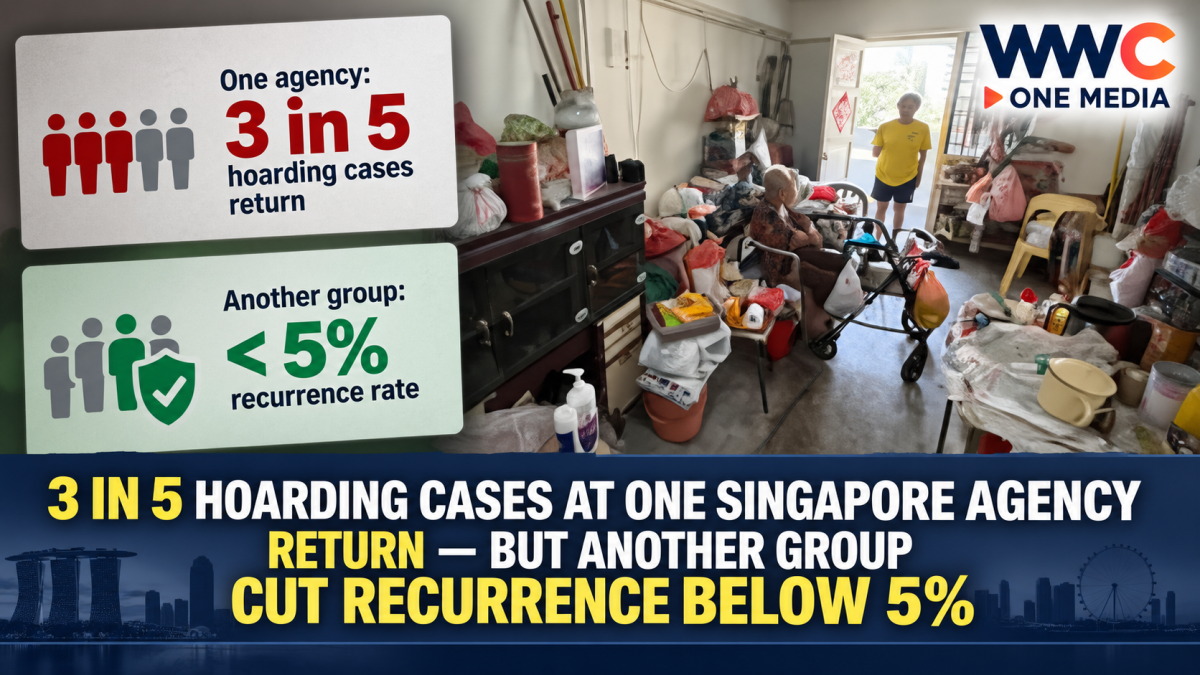
Montfort Care says about 60% of hoarding cases handled by three of its family service centres experience re-hoarding, according to CNA.
Yet another organisation, Ang Mo Kio Secondary School Social Move, or AMKSS Social Move, says it has pushed its recurrence rate from roughly 50% six years ago to less than 5% today.
The difference, its founder says, came after the organisation stopped treating decluttering as the end of the job.
Instead, volunteers began returning every week.
They checked on residents.
They involved neighbours and community partners.
And they spent more time building relationships before — and after — possessions were removed.
That experience is increasingly reshaping how Singapore responds to hoarding.
Because the problem is becoming harder to ignore.
Singapore’s active hoarding caseload nearly doubled in less than four years
The number of active cases handled by Singapore’s hoarding intervention groups rose to 450 by June 2025, up from 253 in December 2021.
That is an increase of almost 78% in less than four years.
At the same time, authorities had reduced the severity of another 308 severe hoarding cases and continued monitoring them to prevent recurrence.
The Ministry of National Development and Ministry of Social and Family Development have cautioned that the increase does not necessarily mean hoarding behaviour suddenly became dramatically more common.
Greater public awareness and improved identification after Singapore created a coordinated national response may also be bringing more previously hidden cases to attention.
But the ministries have also warned that Singapore’s ageing population could contribute to higher numbers over time.
That demographic pressure makes prevention increasingly important.
Cleaning the same home repeatedly is expensive, labour-intensive and emotionally exhausting for everyone involved.
One 88-year-old woman initially refused almost everyone who tried to help
CNA highlighted the case of 88-year-old Mdm Lee Poh Chen, whose home had become severely cluttered and was also suffering from a bedbug infestation.
Officials and community representatives had tried to approach her.
She repeatedly declined assistance.
When AMKSS Social Move eventually became involved, volunteers did not immediately arrive with rubbish bags and start throwing things away.
They spent three days simply befriending her.
Only after that did she agree to let them help with the home.
That sequence may sound inefficient if the goal is viewed purely as clearing a dangerous flat.
But charities say it can be crucial.
A person’s home is intensely private, and possessions that look worthless to an outsider may carry emotional meaning, memories or a sense of security to the person keeping them.
Walking inside and removing everything without consent can therefore feel less like cleaning and more like losing control.
The charity now has 20 active cases — and another 30 waiting
AMKSS Social Move currently has around 600 volunteers and is dealing with about 20 active hoarding cases, while at least another 30 cases are on its waiting list.
Founder Michael Sim told CNA that requests for help have been growing by as much as 30% year on year, which he attributes partly to increased public awareness.
Many calls come not from the people who hoard, but from relatives and friends worried about them.
That creates another complication.
The person seeking help may desperately want a flat cleared.
The person living inside it may not.
Without immediate danger crossing a legal or public-safety threshold, charities often have to spend considerable time securing cooperation rather than simply forcing entry.
Why throwing everything away overnight can make things worse
Institute of Mental Health senior consultant Dr Chris Tan Ze Jia warned that abruptly transforming a heavily cluttered home can produce an intense emotional reaction.
Someone may wake up to find a familiar environment almost completely gone.
That sudden absence can trigger an urge to accumulate possessions again — sometimes rapidly — as the person tries to replace what was removed.
That helps explain why a visually spectacular “before and after” clean-up is not necessarily a successful intervention.
The floor may be visible.
The exits may be clear.
Pests may be removed.
But the behaviour that produced the clutter may remain.
Singapore mental-health professionals have long described hoarding as involving persistent difficulty discarding possessions regardless of their practical value, to the point that living spaces can no longer function normally. IMH has also stressed that hoarding behaviour is different from organised collecting.
It is not simply about being messy
That distinction matters because people who hoard are often dismissed as lazy, unhygienic or unwilling to clean.
The reality can be substantially more complicated.
Clinical psychologist Sarah Ann Lee told CNA that possessions may give some people a sense of permanence or safety.
Objects do not leave.
They do not reject someone.
They may become associated with memories, future usefulness or emotional security.
Keeping them may therefore become a way of regulating anxiety, grief, loneliness or loss.
IMH has similarly said hoarding behaviour can occur in people with or without other mental-health conditions.
Some people may have experienced bereavement, stress or past deprivation and develop a powerful reluctance to waste anything.
In other cases, hoarding can occur alongside conditions such as schizophrenia or obsessive-compulsive disorder, which may require appropriate psychiatric assessment and treatment.
That is why treating every case as though it has the same cause can fail.
Singapore’s solution is increasingly “one corner at a time”
Montfort Care assistant director Jeannie Teo said confrontational or highly forceful interventions can make residents resistant or anxious.
Her agency instead tries to understand what possessions mean to a person and negotiate manageable steps.
Rather than saying, “Everything has to go,” workers might begin with one part of one room.
Clear this walkway.
Sort this table.
Decide together what can leave.
Then return later.
The process is slower.
But it gives residents some control over the outcome and may reduce the feeling that outsiders are invading their home.
It also creates opportunities to build the kind of trust that charities say is essential for long-term change.
One charity learned the hard way that cleaning alone did not work
AMKSS Social Move’s experience is particularly striking.
Six years ago, roughly half of the hoarding cases it handled eventually recurred.
Volunteers would clean a home.
Months later, they could return to what was effectively the same situation again.
The organisation changed its model.
Instead of considering the intervention finished when the rubbish truck left, volunteers began conducting weekly follow-ups and bringing a wider network of neighbours and community groups into the resident’s life.
According to Sim, the recurrence rate among its cases has since fallen to below 5%.
That is a dramatic result.
But it needs one important qualification: it is the charity’s own reported outcome for the cases it handles, not Singapore’s national re-hoarding rate.
The different figures from AMKSS Social Move and Montfort Care also should not be interpreted as a direct head-to-head comparison. Their client populations, case severity, intervention methods and definitions of recurrence may differ.
What the numbers collectively show is that hoarding frequently returns — but sustained intervention can matter.
Singapore created a national alliance because no single agency could handle the entire problem
The government launched the New Environment Action Team, or NEAT, in January 2025.
It began as a 28-member alliance combining social service organisations, community groups, trade associations and government agencies.
Its purpose was to move Singapore away from fragmented interventions where one group handled cleaning, another dealt with mental health, another dealt with pests and another dealt with public safety — sometimes with limited coordination.
By March 2026, CNA reported that organisations represented in NEAT had expanded to 31.
Members have included groups such as Montfort Care, Habitat for Humanity Singapore, Tzu-Chi Foundation, Care Corner, TOUCH Community Services and the Singapore Association for Mental Health, alongside agencies including HDB, MSF, NEA, NParks, SCDF and the Agency for Integrated Care.
IMH provides the specialist mental-health dimension.
Trade groups can help source contractors for repairs.
Volunteer organisations can declutter.
Social agencies can continue follow-up.
That distribution of work matters because severe hoarding rarely creates just one problem.
A cluttered flat can become a fire, pest and emergency-access risk
At the mild end, excessive possessions may primarily affect the resident.
At the severe end, they can affect an entire block.
Accumulated combustible material can increase fire risks.
Blocked walkways can interfere with escape routes.
Food and waste can contribute to pest infestations.
Objects may spill into shared corridors.
In serious emergencies, clutter can make it harder for rescuers or medical crews to enter and move through a home.
HDB’s own neighbourhood education materials stress the importance of keeping common corridors clear because obstructions can delay emergency access.
That is why government involvement cannot always depend indefinitely on voluntary cooperation.
Authorities now have stronger powers — but forced clearing is meant to be a last resort
Singapore’s Community Relations Unit, or CRU, began a pilot in Tampines in April 2025.
The unit was given stronger powers to address severe neighbour disputes and, under certain circumstances, pursue compulsory decluttering where persistent hoarding creates serious problems and other interventions have failed.
The legal pathway strengthened authorities’ ability to intervene when a resident repeatedly refuses to address dangerous conditions.
But officials have stressed that forced decluttering is a last resort, after efforts by frontline agencies to secure cooperation have been exhausted.
That limitation reflects exactly what charities are now warning about.
There are situations where public safety requires immediate action.
But forcing a clean-up and walking away may solve the physical hazard without reducing the chance that possessions accumulate again.
Singapore’s old system often treated pieces of the problem separately
Before NEAT, individual organisations were already doing large amounts of work.
The problem was coordination.
Habitat for Humanity Singapore national director Francis Foo told CNA that agencies and charities historically did their respective jobs, but there was no single coordinating structure tying those services together.
One organisation might remove clutter.
Another might provide counselling.
Another might repair wiring or plumbing.
A government agency might become involved over fire or health risks.
But the handoff between those interventions could be difficult.
NEAT attempts to turn those separate efforts into one longer process.
That process may begin with befriending and engagement, move to decluttering, involve mental-health or medical support where necessary, include repairs to the flat and continue with regular monitoring.
The key word is continue.
IMH says many people learn to manage hoarding rather than simply “overcome” it
CNA’s earlier reporting cited Dr Tan as saying many patients do not simply stop hoarding forever.
Some learn to keep the behaviour at a more manageable level.
Others move through cycles where possessions begin accumulating again and require smaller, repeated decluttering interventions.
That makes hoarding look less like a one-off housekeeping crisis and more like a condition that may require ongoing management.
It also changes what success looks like.
Success may not mean an empty minimalist apartment.
It may mean keeping the kitchen usable.
Keeping exits unobstructed.
Preventing infestation.
Ensuring possessions remain at a level that does not endanger the resident or neighbours.
And maintaining enough trust that the resident accepts help before the home reaches crisis point again.
Singapore’s ageing population could make this more urgent
Both MND and MSF have identified demographic change, including population ageing, as one reason hoarding cases could increase.
Older residents may be living alone.
Some may have lost spouses or close relatives.
Mobility issues can make household management more difficult.
Social isolation can mean fewer friends or relatives notice accumulating clutter early.
And possessions gathered over decades may carry strong emotional significance.
None of those factors means older people inevitably hoard.
But they help explain why Singapore is trying to shift intervention upstream rather than waiting until a home becomes a fire or health hazard.
Public awareness is already generating more referrals
AMKSS Social Move says many of its new referrals now come from relatives and friends.
Its reported increase of up to 30% in new requests each year may partly reflect people becoming more willing to recognise hoarding behaviour and seek assistance.
Government agencies have made the same point about national figures.
The increase in identified cases may partly reflect improved detection rather than only a rise in underlying prevalence.
That is an important accuracy distinction.
Singapore cannot simply look at 450 active cases and conclude that the prevalence of hoarding nearly doubled across the entire population.
What nearly doubled was the number of active cases being worked on by the relevant groups, compared with December 2021.
There is an older clue suggesting the hidden population may be much larger
An earlier Singapore Mental Health Study conducted by IMH found that about one in 50 people had displayed hoarding behaviour at some point in their lives.
That study dates back to 2010 and should not be treated as a current 2026 prevalence estimate.
It also does not mean one in 50 Singapore residents currently lives in a severely cluttered home.
There is a major difference between exhibiting hoarding behaviour and becoming one of the severe cases requiring multi-agency intervention.
Still, the research demonstrates that the behaviour exists on a spectrum and that the highly visible cases attracting complaints are only one part of the picture.
The most effective intervention may happen before a home becomes unlivable
That is one reason NEAT and community charities increasingly emphasise early identification.
Once possessions fill entire rooms, infestations have developed and relationships with neighbours have broken down, intervention becomes enormously difficult.
Months may be needed simply to gain entry.
Residents may already feel attacked or ashamed.
Family relationships may have deteriorated.
A sudden clean-up may feel traumatic.
Earlier intervention allows social workers to focus on smaller behavioural changes before the case becomes a crisis.
It is less dramatic.
But it may be more sustainable.
What families should understand before confronting someone who hoards
Experts quoted by CNA repeatedly return to one principle: do not begin by treating the person as the problem.
Someone who already expects criticism may become more defensive when relatives arrive demanding that possessions be discarded.
Building rapport can involve talking about the person’s life and understanding why particular items matter before discussing what should be removed.
That does not mean dangerous conditions should simply be accepted.
Severe infestations, blocked exits, fire hazards or risks to neighbours may require urgent intervention.
But outside emergencies, charities increasingly favour negotiated and gradual decluttering over an all-or-nothing confrontation.
The most viral “before-and-after” photo may actually show only half the work
Hoarding clean-ups naturally produce dramatic images.
One photograph shows mountains of boxes, old newspapers and plastic bags.
The next shows a clear floor and fresh walls.
But charities say the most important work often happens after the second photograph.
Someone has to return next week.
Someone has to notice whether bags are accumulating again.
Someone has to help with loneliness, grief, anxiety, healthcare or family conflict if those issues are contributing to the behaviour.
Someone may need to organise another small declutter before the home becomes dangerous again.
That is why AMKSS Social Move’s reported decline from around 50% recurrence to below 5% may be the most important number in CNA’s latest report.
The physical clean-up did not become radically easier.
The follow-up became much longer.
Singapore’s hoarding strategy is becoming less about rubbish — and more about relationships
Singapore now has more legal tools for the most severe cases.
It has a national multi-agency alliance.
It has volunteer groups capable of carrying out major clean-ups.
It has mental-health professionals assessing whether psychiatric conditions are involved.
But none of those tools eliminates the human problem at the centre.
A person has to eventually decide — or be helped — to live differently with their possessions.
For Mdm Lee, that process began not with throwing anything away.
It began with three days of conversation.
For AMKSS Social Move, long-term improvement came only after volunteers realised that returning to the same homes was not a failure of cleaning.
It was evidence that cleaning alone had never been enough.
Singapore can clear a dangerously cluttered flat in days.
The harder task is making sure volunteers do not have to clear exactly the same home again next year.
And the emerging evidence from charities suggests that the most powerful tool may not be a rubbish truck.
It may be somebody who keeps coming back.




Leave a Reply