
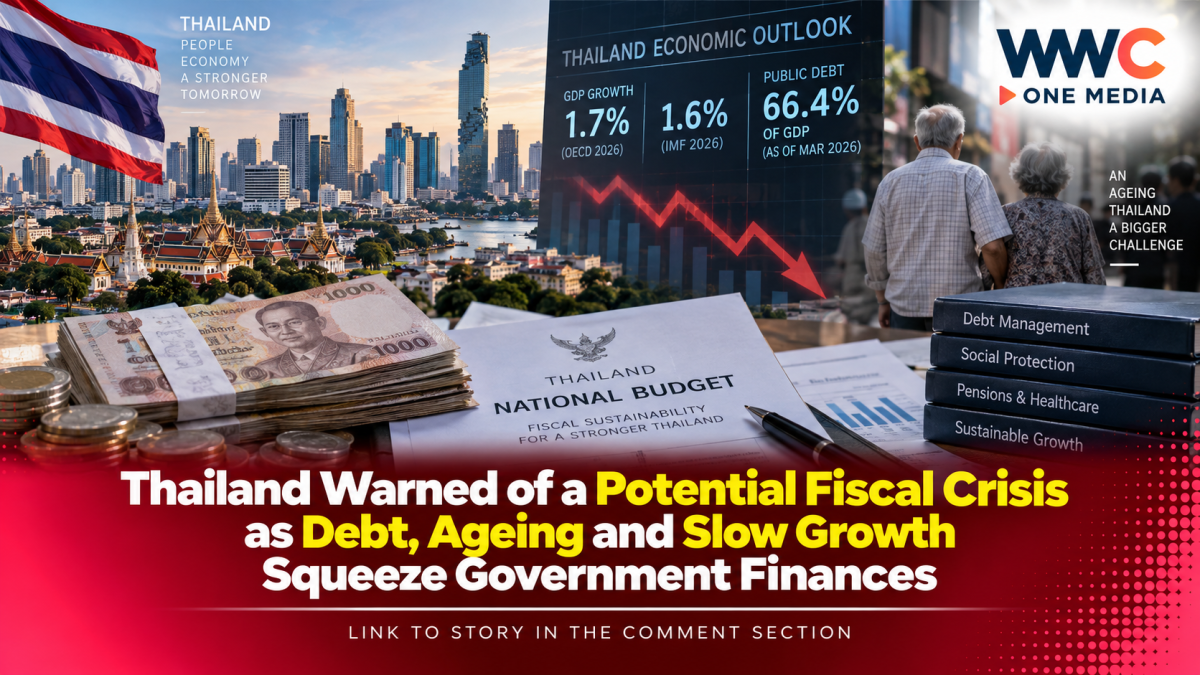
BANGKOK — Thailand faces a growing long-term fiscal challenge that could become a severe crisis within the next decade unless the government undertakes major reforms, according to a warning highlighted by Bangkok Post.
The concern is not that Thailand is on the verge of an immediate sovereign default. Rather, the warning focuses on a combination of rising public debt, persistent budget pressures, an ageing population and relatively weak economic growth that could progressively reduce the government’s room to respond to future shocks.
Thailand’s public debt is already around two-thirds of economic output, according to international institutions. The IMF estimated public debt at 64.8% of GDP at the end of fiscal 2025, while the World Bank put it at 65.1%, still below Thailand’s statutory ceiling of 70%.
The Warning Is About the Next Decade — Not an Immediate Collapse
The phrase “fiscal collapse” can sound like a prediction of an imminent financial breakdown.
That is not what the available evidence establishes.
The warning concerns the possibility that Thailand could face increasingly severe fiscal constraints if structural problems are left unresolved.
A government can continue borrowing while debt remains sustainable, but higher debt can gradually increase interest costs and reduce the money available for infrastructure, healthcare, education and other priorities.
That becomes more difficult when economic growth is weak.
Thailand’s Debt Has Climbed Since the Pandemic
Thailand entered the Covid-19 pandemic with substantially more fiscal space than it has today.
The World Bank reported that public debt had risen by more than 20 percentage points from pre-pandemic levels to 65.1% of GDP.
The IMF similarly estimated debt at 64.8% of GDP at the end of fiscal 2025 and projected a general-government deficit of 2.2% of GDP for that fiscal year.
The debt level remains below the government’s 70% ceiling, but the direction of travel has increased attention on fiscal sustainability.
Slow Growth Makes the Equation Harder
Thailand also faces a growth problem.
The World Bank’s 2026 assessment projected economic growth of around 1.6% in 2026, before a potential improvement in 2027. Other forecasts have similarly pointed to relatively subdued growth compared with the pace needed to rapidly improve living standards and government revenues.
Slower growth matters for public finances because tax revenues tend to grow more slowly when economic activity is weak.
At the same time, government spending does not automatically fall when growth slows.
This can leave policymakers with difficult choices involving taxes, spending, borrowing and economic reforms.
An Ageing Population Adds Another Layer of Pressure
Thailand’s demographic transition is becoming an increasingly important fiscal issue.
The country is ageing rapidly, meaning a larger share of the population will require pensions, healthcare and other forms of public support while the working-age population grows more slowly.
That can put pressure on government finances from both directions: spending needs increase while the potential growth of the tax base becomes more limited.
The issue is therefore not simply how much Thailand owes today, but whether future economic growth will be strong enough to support the obligations accumulating over time.
Fiscal Space Could Become the Real Problem
Thailand still has room to operate within its fiscal framework.
But fiscal space can disappear gradually.
If debt rises while growth remains weak, more government revenue may eventually have to be devoted to servicing existing obligations rather than financing new priorities.
That could make it harder for Thailand to respond to another pandemic, global recession, natural disaster or financial shock.
The IMF has likewise emphasized the importance of medium-term fiscal consolidation and structural reforms as countries around the world confront elevated debt levels.
Thailand Needs More Than Spending Cuts
Addressing fiscal pressure does not necessarily mean simply cutting government expenditure.
Long-term fiscal sustainability can involve several components:
- Improving tax collection and broadening the revenue base
- Increasing productivity and economic growth
- Reviewing inefficient spending
- Improving public-sector efficiency
- Managing social-security and healthcare costs
- Prioritizing productive public investment
- Maintaining credible medium-term debt management
The central challenge is finding a combination that improves the government’s finances without unnecessarily weakening economic growth.
Why Structural Reform Matters
Thailand’s fiscal challenge is closely connected to its broader economic structure.
The country is attempting to attract investment into higher-value industries while dealing with an ageing population, slower productivity growth and increasing competition from other Asian economies.
Stronger productivity and investment can expand the economy and, over time, improve the government’s revenue position.
The World Bank has identified areas including EVs, solar energy and energy-efficient manufacturing as potential sources of future growth, while stressing the importance of upgrading Thailand’s position in global value chains.
The 70% Debt Ceiling Is Not a Safety Guarantee
Thailand’s statutory public-debt ceiling is an important fiscal benchmark, but staying below it does not automatically mean fiscal risks have disappeared.
The IMF and World Bank figures show Thailand remains below the ceiling.
However, the OECD has previously warned that Thailand’s public debt could continue rising above 65% of GDP without stronger fiscal consolidation. Its analysis has argued that reforms are needed to contain the debt trajectory.
In other words, the question is not simply whether Thailand crosses 70%.
It is whether the government’s debt and deficit trajectory remains manageable over many years.
What Happens Next Could Define Thailand’s Fiscal Future
Thailand’s current position is therefore better described as a fiscal crossroads than an immediate collapse.
The country still has access to financing and remains below its statutory debt ceiling.
But the combination of high debt relative to pre-pandemic levels, slow growth and demographic pressures leaves policymakers with less room for error than before.
The longer structural reforms are delayed, the more difficult they could become.
For Thailand, the warning is ultimately about prevention: strengthening revenues, growth and spending efficiency before fiscal pressures become much harder to manage.
FACT-CHECK / EDITORIAL NOTE
Important clarification: “Fiscal collapse” in the Bangkok Post headline refers to a warning about Thailand’s future fiscal trajectory, not evidence that Thailand is currently bankrupt, insolvent or about to default.
Current debt position: The IMF estimated Thailand’s public debt at 64.8% of GDP at the end of FY2025. The World Bank estimated 65.1%, both below Thailand’s 70% debt ceiling.
Growth: The World Bank’s February 2026 assessment projected Thailand’s GDP growth at about 1.6% in 2026, highlighting the challenge posed by subdued economic expansion.
Broader warning: The IMF has emphasized the need for credible medium-term fiscal consolidation and structural reforms as elevated global debt increases fiscal risks.
WWC ONE MEDIA G,A


Leave a Reply