
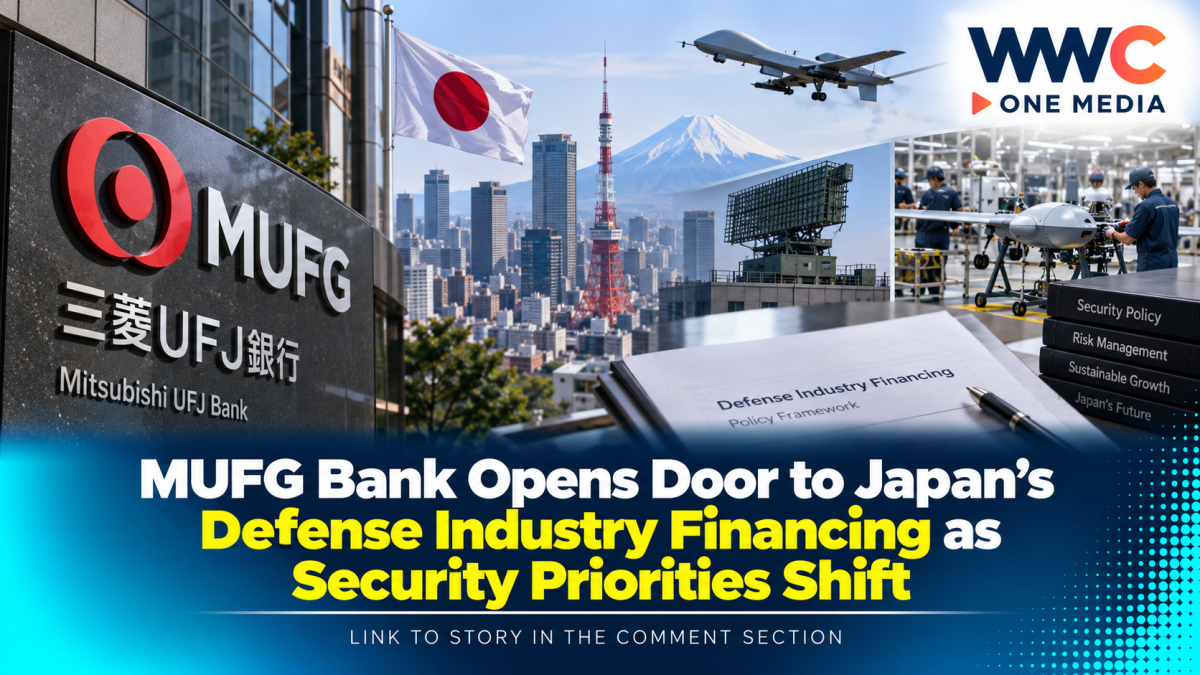
TOKYO — Japan’s biggest banking group is moving toward a more flexible approach to financing the country’s defense industry, marking a notable shift as Tokyo strengthens its security policy and calls for greater domestic defense-production capacity.
Mitsubishi UFJ Financial Group (MUFG) plans to consider financing defense-related companies, with screening based on Japan’s national-security policies, according to Nikkei Asia.
The move signals a change from the cautious position that has characterized major Japanese commercial banks’ approach to the defense sector.
MUFG Reconsiders Its Approach to Defense Companies
Commercial banks in Japan have historically approached defense-related financing cautiously, partly because of reputational concerns and the country’s postwar sensitivities surrounding the military industry.
That environment is changing.
Nikkei Asia reported that MUFG Bank intends to finance defense-industry companies while examining individual cases in line with Japan’s security policy.
The bank’s approach would therefore involve screening rather than an open-ended commitment to financing every defense-related business.
The development comes as Japan’s government increasingly emphasizes the need to strengthen domestic defense capabilities and supply chains.
Why Japanese Banks Are Changing Course
Japan’s security environment has changed considerably in recent years.
Tokyo has increased defense spending, strengthened security partnerships and placed greater emphasis on ensuring that critical industrial capabilities remain available domestically.
That has created a growing policy question: if the government wants Japan to expand its defense-industrial base, will private financial institutions also be willing to support companies operating in the sector?
Japanese banks have traditionally been cautious about that role.
The Japan Times reported earlier in September that commercial financial institutions remained wary of defense investments partly because of concerns about their corporate image.
MUFG’s reported policy shift illustrates how that debate is evolving.
The Development Bank of Japan Has Also Changed Its Rules
MUFG is not operating in isolation.
Japan’s government-backed Development Bank of Japan (DBJ) has already changed its operating rules concerning investments in arms manufacturers, removing previous restrictions, according to Nippon.com.
The change illustrates the broader policy environment surrounding defense-related finance in Japan.
The difference between a government-backed institution and a private commercial bank remains important, however.
For private banks, decisions also involve credit risk, reputational considerations, compliance requirements and shareholder expectations.
Japan Wants a Stronger Domestic Defense Industry
The financial shift comes as Japan seeks to strengthen its defense-industrial base.
The government has increasingly emphasized domestic production capacity, resilient supply chains and technological capabilities as part of its broader security policy.
That means defense companies may require access to conventional corporate finance, investment and other financial services as they expand.
For banks, the sector presents both a potential business opportunity and additional risks that must be assessed.
Screening Will Remain Important
The reported change does not mean MUFG will automatically finance any company connected with the defense industry.
Nikkei Asia reported that the lender will screen cases according to Japan’s security policy.
That distinction is significant because defense-related businesses can vary widely in their activities, customers, technologies and regulatory exposure.
Banks also need to comply with applicable laws, sanctions, export-control requirements and internal risk-management standards.
A Broader Shift Across Corporate Japan
The banking debate reflects a wider transformation in Japan’s relationship with the defense sector.
For decades after World War II, Japanese companies and financial institutions operated within a political and social environment that made defense-related business particularly sensitive.
Today, security concerns linked to developments in East Asia, supply-chain resilience and technological competition have increased attention on the sector.
The result is not simply a change in military policy. It is also affecting industries, investors and financial institutions.
What MUFG’s Move Could Mean
If implemented, greater willingness by major banks to provide financial services to defense companies could make it easier for eligible firms to obtain conventional corporate funding.
It could also encourage other financial institutions to reassess their own policies.
However, the extent of any broader change remains uncertain.
Banks must balance government policy priorities with their own risk assessments, regulatory obligations and business considerations.
That means MUFG’s reported shift should be viewed as part of an evolving financial-policy landscape, rather than evidence that Japan’s banking sector has completely abandoned its previous caution.
Japan’s Defense Push Meets the Banking Sector
The significance of MUFG’s reported policy change goes beyond one bank.
Japan’s effort to strengthen defense capabilities requires not only government budgets but also a functioning industrial ecosystem involving manufacturers, technology companies, suppliers and financial institutions.
Whether commercial banks become more comfortable serving that ecosystem could therefore influence how quickly Japanese defense-related companies can expand.
At the same time, the change raises questions about how financial institutions will define acceptable defense-related business and how they will manage reputational and regulatory risks.
FACT-CHECK / EDITORIAL NOTE
Confirmed: Nikkei Asia reported that MUFG Bank plans to finance defense-industry companies, with screening conducted in line with Japan’s security policy.
Broader context: Japanese commercial banks have generally remained cautious about defense-related investments, with concerns including corporate-image and reputational risks.
Related development: The government-backed Development Bank of Japan has removed restrictions on investments in arms manufacturers, according to Nippon.com.
Important clarification: MUFG’s reported policy does not mean unrestricted financing for all defense companies. Screening and applicable legal, regulatory and risk-management requirements remain relevant.
WWC ONE MEDIA G,A




Leave a Reply