
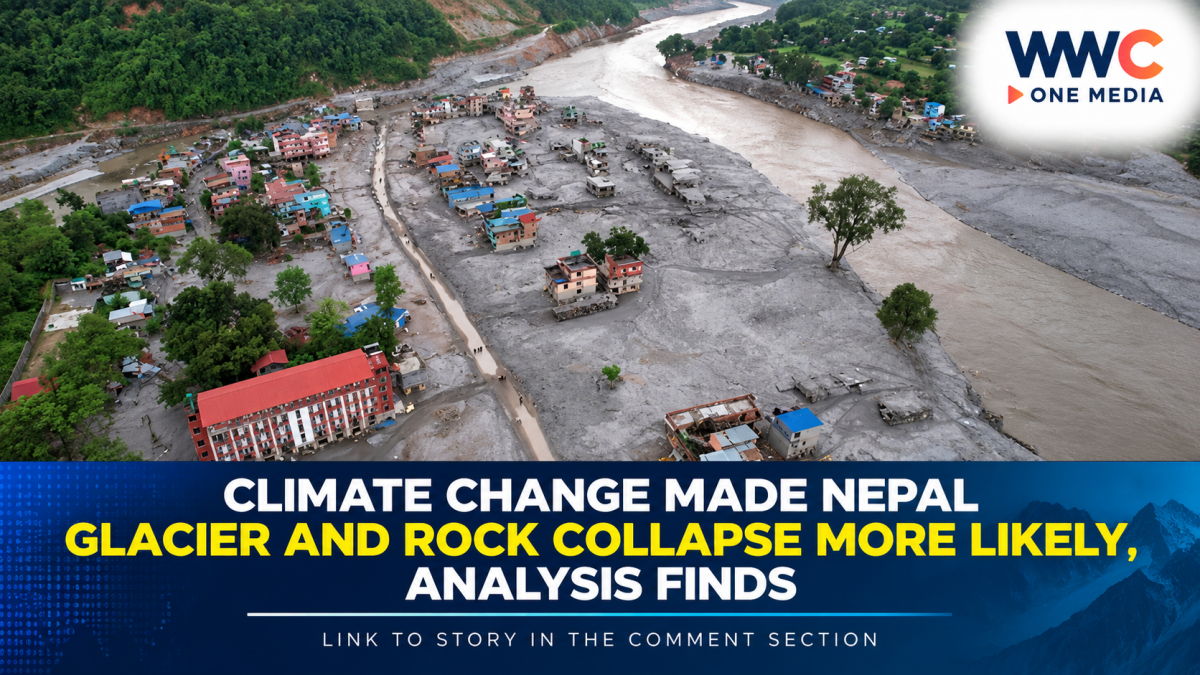
Human-caused climate change likely contributed to the instability of a Himalayan mountain slope that collapsed in Nepal last month, triggering catastrophic flooding that killed more than 1,300 people and left thousands missing, according to a new scientific analysis.
The World Weather Attribution report found that decades of warming had thinned glaciers and thawed permafrost in the region, weakening the mountain slope before the Aug 26 disaster.
Researchers stressed that climate change was not the sole cause. A major earthquake that struck Nepal in 2015 may have weakened the rock years before the collapse, while several geological and environmental factors acted together over time.
The collapse occurred near Nepal’s border with China when a massive section of rock and glacier broke away. The resulting torrent of water, ice, rocks and sediment swept through communities along the Trishuli River corridor, causing widespread destruction and billions of dollars in damage.
Scientists said one important effect of warming has been the rise in the elevation at which ground remains permanently frozen. The freezing threshold has moved upward by about 100 metres per decade, exposing higher sections of mountain rock to longer periods of thawing.
Permafrost can act as a natural binding material within mountain slopes. As it thaws, cracks can develop and previously frozen ground can become less stable.
Glacier retreat has also changed the landscape. Glaciers in the region have been losing mass for decades, with the analysis finding an average thinning rate of more than half a metre a year.
The Langtang Lirung glacier near the disaster site has retreated by about half a kilometre since the 1990s, exposing rock that was previously covered by ice.
Researchers also found that the weeks immediately before the collapse were unusually warm. July and August were the warmest such months recorded locally, adding to concerns about the effects of long-term warming on high-altitude terrain.
The analysis did not establish that the collapse would not have happened without climate change. Instead, researchers concluded that rising temperatures had intensified several processes that made the slope less stable over a period of decades.
The disaster has also highlighted the limits of early-warning systems in mountainous areas. Unlike rainfall-driven floods, large slope failures can occur suddenly and remain extremely difficult to predict, particularly in remote high-altitude locations.
Scientists said improved monitoring, satellite observations and warning systems could help reduce future risks. However, they cautioned that many communities, roads, hydropower facilities and other infrastructure remain concentrated in narrow Himalayan valleys vulnerable to landslides and floods.
The latest findings suggest that warming is changing not only glaciers and weather patterns but also the physical stability of mountain landscapes, creating additional risks for communities living downstream.




Leave a Reply