
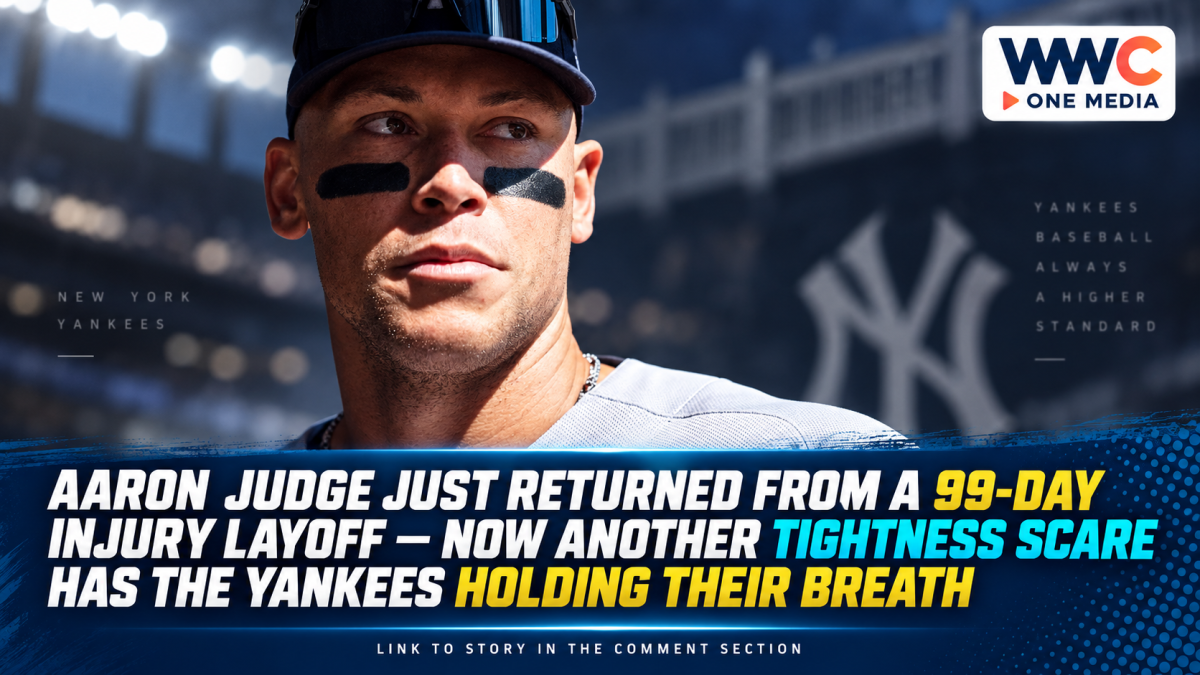
MINNEAPOLIS — Aaron Judge had waited more than three months to get back into a New York Yankees uniform. Seven games later, New York found itself watching its captain walk out of another game early.
Judge was removed in the sixth inning of Wednesday’s 5-4, 13-inning loss to the Minnesota Twins after experiencing tightness in his lower right leg.
The 34-year-old said he first felt the problem in the opening inning but initially tried to continue because of the importance of the Yankees’ remaining games. After talking with manager Aaron Boone, Judge decided staying in the game risked hurting the club defensively or on the bases.
For a player with an ordinary injury history, that might qualify as a routine precaution.
For Judge, it immediately becomes something more.
He had only returned on September 8 following a 99-day absence caused by a stress fracture in his right first rib. He missed 84 games and virtually the entire summer.
Now October is less than two weeks away.
The encouraging part: Judge does not expect scans
There is no indication yet that Judge has suffered a serious new injury.
After the game, he said he did not anticipate undergoing imaging and compared the stiffness to physical issues players can experience when ramping up after a long period without regular game action. Boone declined to speculate on whether Judge will miss additional games, saying the club wants to see how he responds after treatment.
That makes Thursday unusually well timed.
The Yankees do not play before beginning a three-game road series against the Arizona Diamondbacks on Friday, giving Judge roughly two days between his early exit and New York’s next game.
The cautious interpretation is therefore straightforward:
Judge left before the tightness had a chance to become something worse.
What remains unknown is whether treatment and an off-day are enough.
He felt it almost immediately
Judge started Wednesday in right field and struck out in both plate appearances against Minnesota starter Zebby Matthews.
Boone said Judge reported that the leg had begun to feel tight after the first inning.
Judge remained in the game through five innings before Heliot Ramos pinch-hit for him in the sixth with New York trailing 2-0. Ramos subsequently took over in right field.
Judge said he had attempted to play through it because of the Yankees’ situation in the standings.
That decision lasted only so long.
With the postseason already secured, protecting Judge for October now matters more than squeezing every possible inning out of him in September.
Which is ironic, because Judge had just reminded everyone why he matters
Only two nights earlier, Judge finally looked like Judge again.
Facing Twins reliever A.J. Minter in the eighth inning Monday, he launched a three-run, 415-foot home run into the second deck at Target Field.
It was his first homer since returning from the injured list and his first since May.
The blast helped turn a 2-1 deficit into an eventual 8-3 Yankees victory, on the same night New York secured its place in the 2026 postseason.
For the Yankees, it was the image they had been waiting all summer to see:
their captain healthy enough to change a game with one swing.
Less than 48 hours later, he was walking out early.
Judge’s comeback has not been easy at the plate
The home run was important partly because Judge had looked understandably rusty since returning.
Before Monday’s homer, he was 3-for-17 in his first five games back.
After going hitless with two strikeouts Wednesday, his season line stood at:
.241 batting average, .360 on-base percentage, .511 slugging percentage, 18 home runs and 41 RBIs in 66 games.
That is an excellent .871 OPS in ordinary terms.
It is not ordinary by Judge’s own standards.
He entered 2026 having won the American League MVP award three times—2022, 2024 and 2025—and is an eight-time All-Star.
His challenge now is not only staying healthy.
It is regaining elite timing before the games become elimination games.
His first injury started with a diving play months earlier
Judge’s strange 2026 season can be traced back to the outfield.
He believes the rib injury originated during a diving attempt in Houston in late April, when he awkwardly tried to avoid teammate Jazz Chisholm Jr. while pursuing a fly ball. Judge continued playing for more than a month as the pain worsened.
By mid-May, the effect on his performance was becoming visible.
MLB.com reported that from May 13 until he finally stopped playing, Judge hit only .180 with one home run in 61 at-bats.
The Yankees finally sent him for MRI, CT and X-ray examinations in early June.
The diagnosis was the one Judge said he had feared:
a stress fracture of the first rib on his right side.
He was initially expected to rest and then undergo additional imaging four to six weeks later.
Instead, recovery stretched through almost the entire summer.
At one point, even a 2026 return could not be guaranteed
The healing process moved slowly enough that general manager Brian Cashman acknowledged in early August that he could not completely rule out Judge missing the remainder of the season.
Judge had still not resumed full baseball activities more than two months after his last game.
Progress eventually accelerated.
He began throwing again.
Then swinging in a swimming pool.
Then hitting off a tee.
Then taking more advanced batting work.
Finally, on September 7, the Yankees activated him from the 60-day injured list. He returned to right field the following night.
That made Wednesday’s leg tightness especially frustrating.
The Yankees spent three months waiting for his rib to heal.
Now they have 10 regular-season games left to make sure the rest of his body is ready for October.
And he returned without a minor-league rehab assignment
That detail may help explain why Judge himself is not panicking.
Unlike many players returning from lengthy injuries, he did not spend a week or two playing minor-league games to rebuild his legs, timing and game-speed conditioning.
He went directly back into the Yankees lineup.
Boone had said before Judge returned that the most important issue was rebuilding durability and workload, not simply proving that he could swing a bat.
Judge then played six games in a week before receiving a planned rest Tuesday.
He returned Wednesday.
Then the leg tightened.
Judge’s explanation—that physical issues can emerge when a player suddenly ramps up again after months away—is therefore plausible.
It is not yet proof that the problem is harmless.
The Yankees were already trying to manage him carefully
Tuesday’s absence was deliberate.
Boone said he wanted to be intelligent about Judge’s workload after the captain had played four straight games, including a day game following a night game and then travel to Minnesota.
The plan was already to give him more recovery days down the stretch.
Wednesday’s exit may force the Yankees to become even more conservative.
That could mean designated-hitter appearances.
More planned rest.
Earlier defensive substitutions.
Or simply sitting him until the leg feels completely normal.
The club had not announced such a plan as of Thursday, so those remain possible workload strategies rather than confirmed decisions.
New York can afford to be cautious because it has already clinched
This is the biggest difference between Wednesday’s scare and an injury earlier in the year.
The Yankees already know they will be playing postseason baseball.
New York secured its berth earlier this week, marking its third consecutive playoff appearance and eighth in Boone’s nine seasons as manager.
The immediate objective is no longer survival.
It is positioning.
Following Wednesday’s results, the Yankees sit 88-64, second in the AL East, while Tampa Bay is 92-59.
That leaves New York 4½ games behind the Rays.
The division chase is difficult.
It is not mathematically over.
Why the AL East still matters
Finishing second does not keep New York out of October.
But it changes the route.
MLB’s postseason format sends the top two division winners in each league directly into the Division Series.
The remaining division champion and the three Wild Card clubs begin in a best-of-three Wild Card Series.
So catching Tampa Bay could potentially turn three dangerous first-round playoff games into several days of rest.
For a roster managing Judge’s health, that would have obvious value.
But pushing him aggressively in an attempt to chase that bye could also create the very injury problem the Yankees want to avoid.
That is the dilemma.
The upcoming Rays series suddenly matters even more
New York first heads to Arizona.
After that, the Yankees have a four-game series with Tampa Bay beginning Tuesday.
MLB.com noted after Judge’s exit that those games could still influence the AL East championship and potentially the first-round bye.
So the calendar creates a natural decision point.
If Judge is ready by Friday, the Yankees can resume building his rhythm.
If he needs extra time, they may prioritize having him available when the Rays series begins.
But the Yankees have not announced a timetable, and Boone explicitly refused to predict how quickly the tightness will disappear.
The Twins game showed what New York can do without him—and what it can waste
The Yankees did not collapse after Judge left Wednesday.
They nearly stole the game anyway.
Trailing 2-0 and down to their final out in the ninth, Anthony Volpe doubled home two runs to force extra innings.
New York then twice moved ahead during extras.
Minnesota answered both times.
The Yankees’ best chance came in the 12th, when they loaded the bases with nobody out.
They failed to score.
Ramos grounded into a double play in which Volpe was thrown out at home, then Ali Sánchez struck out.
One inning later, Victor Caratini delivered a pinch-hit walk-off single to give Minnesota the 5-4 victory.
It was a frustrating loss.
Judge’s exit was the much larger concern.
His absence earlier this season already showed the offensive cost
Judge missed 84 games.
The Yankees survived.
They even reached the postseason.
But the lineup was not the same.
During Judge’s absence, New York scored 341 runs in 84 games—about 4.06 per game, according to amNewYork’s review of the stretch.
Other players helped carry the offense, and the Yankees have enough pitching to remain dangerous regardless.
But there is no direct replacement for Judge.
Even in a season shortened by injury, opposing teams still have to plan around his power, patience and ability to change a game with one swing.
Monday’s homer was the perfect example.
New York’s pitching gives it another reason not to panic
The Yankees’ postseason hopes do not rest exclusively on Judge.
Their staff has been a major strength, and the roster now includes a potential October rotation built around pitchers such as Cam Schlittler, Gerrit Cole, Max Fried and Carlos Rodón.
Clarke Schmidt was also activated from the 60-day injured list Wednesday after returning from Tommy John surgery, giving New York another pitching option entering October.
That depth gives the Yankees another argument for patience.
They do not need Judge to carry them every single night over the remaining schedule.
They need him healthy enough to be Judge when postseason games begin.
The first Wild Card games begin September 29
The calendar is unforgiving.
MLB’s Wild Card Series begins September 29.
That gives New York less than two weeks between Wednesday’s injury scare and a possible first postseason game.
If Judge simply has short-term tightness, that is plenty of time.
If the leg becomes a genuine strain or another injury requiring a shutdown, everything changes.
At this stage there is no medical evidence supporting the more serious scenario.
That is why the next 48 hours matter more than speculation.
Judge’s own history explains the Yankees’ caution
There is another lesson hidden inside his rib injury.
Judge tried to play through it.
He has openly said he wants to be on the field and has described that as part of what the Yankees pay him to do.
But by the time the rib was finally diagnosed, he had spent weeks swinging through pain while his performance deteriorated.
Wednesday looked different.
He felt something.
He tried to continue.
Then he stopped before it became obvious that continuing was hurting the team.
That may be exactly the adjustment the Yankees need from their captain at this point in the season.
Playing through pain in April is one calculation.
Playing through an uncertain leg issue 13 days before the postseason is another.
For now, this is an injury scare—not another three-month absence
That distinction should remain central to the story.
The Yankees have not placed Judge back on the injured list.
They have not announced a strain, tear or structural injury.
Judge has not said he expects imaging.
Boone has not said Judge will miss the Arizona series.
The official description remains:
right lower-leg tightness.
Everything more serious than that remains speculation.
But the reason the baseball world reacted so quickly is obvious.
Judge had been back for only seven games.
He had finally homered.
The Yankees had finally secured their postseason place.
And just as their most important hitter appeared to be rebuilding momentum, he walked out of another game.
The Yankees have already proved they can survive months without Aaron Judge.
What they do not want to discover is whether they can win October without him.




Leave a Reply