
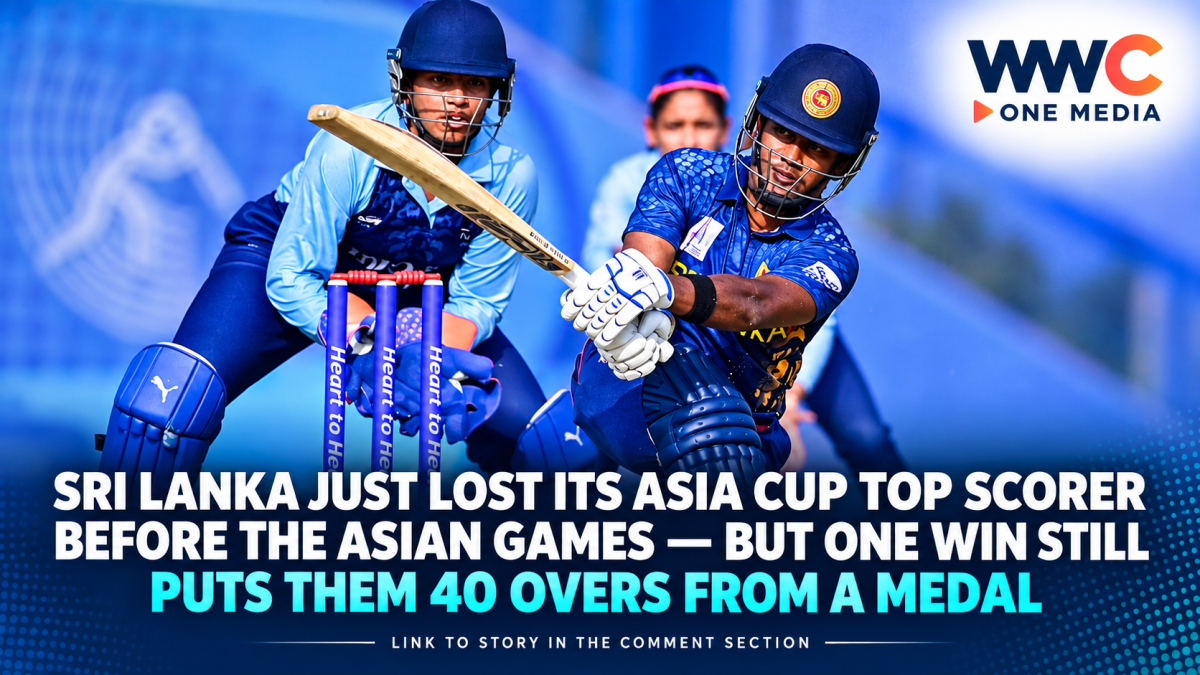
AICHI, Japan — Sri Lanka’s women arrived at the Asian Games with fresh evidence that they can reach a major continental final. Now they will have to chase another medal without the batter who scored more runs than any of their teammates on that run.
Middle-order batter Nilakshika Silva has been ruled out of the Aichi-Nagoya Asian Games with a fractured finger, Sri Lanka Cricket said, removing one of captain Chamari Athapaththu’s most productive batters just before Friday’s knockout opener against Malaysia.
The timing could hardly be worse.
Only four days earlier, Sri Lanka were playing India in the Women’s Asia Cup final in Dubai.
Silva ended that tournament with 108 runs from four innings, averaging 36 and striking at 128.57. No Sri Lankan scored more. Across the entire competition, only India’s Shafali Verma and Smriti Mandhana finished ahead of her.
And unlike in a league tournament, Sri Lanka have little time to compensate.
Lose once in Japan and their gold-medal campaign is over.
Silva was not just another middle-order option
The raw numbers explain why her absence matters.
Silva finished the Asia Cup with:
108 runs, a 36.00 average and a 128.57 strike rate.
Athapaththu was Sri Lanka’s next-highest run-scorer with 99, followed by Harshitha Samarawickrama with 98.
That means Sri Lanka are removing their most productive tournament batter from a lineup already heavily reliant on a relatively small group to build and finish innings.
Silva’s value was especially visible in the semifinal against Pakistan.
Sri Lanka were chasing 131 when she arrived late in the innings. She struck an unbeaten 18 from 10 balls, including three boundaries, helping complete a four-wicket victory with eight balls remaining.
Those are exactly the situations where experienced middle-order batting becomes difficult to replace.
When a chase reaches the final four overs, there is little time for a new batter to settle.
Silva had demonstrated she could enter and immediately score.
She still made 22 in the Asia Cup final
Sri Lanka’s final against India ended painfully, but Silva again made a meaningful contribution.
India posted 183 for five, powered by Shafali Verma’s 68 and Smriti Mandhana’s 59.
Sri Lanka were then bowled out for 111, losing by 72 runs. Silva scored 22 from 16 balls, the team’s second-highest individual score behind Athapaththu’s 36.
She was dismissed with Sri Lanka at 101 for six as India’s spinners took control.
That defeat cost Sri Lanka the chance to defend the Asia Cup crown they had won in 2024.
But reaching the final still gave them useful momentum heading directly into another continental tournament.
Now one of the batters responsible for that momentum is unavailable.
The injury is a fracture—not simply a precautionary rest
Reuters, citing Sri Lanka Cricket, reported that Silva has suffered a fractured finger.
That distinction matters.
This is not a case of the selectors choosing to protect a player for a later tournament.
She has been medically ruled out of the Asian Games.
Public reporting has not established an official recovery timetable, so it would be premature to speculate about exactly when she will return.
It is also safest not to state precisely when or how the fracture occurred unless Sri Lanka Cricket supplies further detail.
What is confirmed is the outcome:
Silva will not play in Japan.
And Sri Lanka are missing another player through injury
Silva is not the only loss.
Reuters reported that Dewmi Vihanga, a spin-bowling allrounder, is also unavailable after suffering a knee injury before the Asia Cup.
Sri Lanka Cricket had originally selected Vihanga for the Asia Cup after her previous ODI experience, while identifying her as a new T20I option.
Losing an allrounder changes squad balance in a different way from losing a specialist batter.
An allrounder can potentially cover overs with the ball while lengthening the batting order.
Remove that player and selectors can be forced to choose between additional batting and additional bowling.
So Sri Lanka enter Aichi-Nagoya dealing with two different holes:
Silva’s middle-order run production.
And Vihanga’s spin-allrounder role.
The final 15 has already changed
The ICC’s September 16 squad announcement lists:
Chamari Athapaththu, Imesha Dulani, Sanjana Kavindi, Hansima Karunaratne, Harshitha Samarawickrama, Anushka Sanjeewani, Kaveesha Dilhari, Hasini Perera, Kaushini Nuthyangana, Nimasha Meepage, Sugandika Kumari, Rashmika Sewwandi, Chamudi Praboda, Mithali Ayodhya and Kawya Kavindi.
Silva is absent.
So is Vishmi Gunarathne, another batter who featured prominently at both the T20 World Cup and Asia Cup.
The ICC described Gunarathne as a notable omission but did not, in that announcement, identify injury as the reason. That is worth preserving because some secondary reports have offered differing explanations for her absence.
Unless Sri Lanka Cricket confirms otherwise, it is safer to describe Gunarathne simply as not included in the final Asian Games squad.
That puts more responsibility on Athapaththu
Few players in women’s cricket are more accustomed to carrying a batting lineup than Chamari Athapaththu.
The Sri Lanka captain remains the side’s most recognisable attacking threat.
Earlier this year she produced an unbeaten 106 from 61 balls against Ireland at the T20 World Cup, while also contributing with the ball.
At the Asia Cup, she scored 99 runs and took 12 wickets, giving Sri Lanka value on both sides of the game.
Silva’s withdrawal increases the pressure on Athapaththu because one of the players capable of stabilising or accelerating behind her has disappeared.
Opponents know this too.
If Malaysia can dismiss Athapaththu early on Friday, Sri Lanka’s reconfigured middle order immediately becomes more important.
Harshitha Samarawickrama becomes even more central
The other established batter facing additional responsibility is Harshitha Samarawickrama.
She accumulated 98 runs at the Asia Cup, only 10 fewer than Silva, and played a key role in the semifinal win over Pakistan with 36 from 31 balls.
Samarawickrama has often been one of Sri Lanka’s calmer innings-builders.
With Silva gone, that quality could become especially important.
T20 cricket rewards explosive hitting, but knockout cricket frequently rewards whichever side can absorb early wickets without allowing the innings to collapse.
Sri Lanka saw precisely how quickly a chase can unravel in the Asia Cup final.
They were 62 for one against India.
Four overs later, they were 103 for seven.
Replacing Silva is therefore not simply about finding another hitter.
It is about replacing a batter who could operate across different phases of an innings.
The Asian Games format makes every selection decision bigger
The women’s tournament in Japan contains just eight teams.
And there is no round-robin phase.
The official Aichi-Nagoya schedule sends every country directly into the quarterfinals.
Bangladesh face China and Pakistan meet Thailand on September 17.
Sri Lanka play Malaysia at 9am local time on September 18.
India then face hosts Japan later that day.
Win once, and Sri Lanka reach the semifinals.
Win twice, and they are guaranteed a medal.
Lose once, and there is no recovery.
That is why a single injury can matter disproportionately in an eight-team knockout competition.
There is no three-match group stage in which a team can adjust its combination after a poor performance.
The first XI has to work immediately.
Sri Lanka’s path to gold is already mapped
The draw also creates an intriguing possibility.
If Sri Lanka beat Malaysia, they face the winner of Pakistan versus Thailand in the semifinal on September 20.
India are on the opposite side of the bracket.
So Sri Lanka and India cannot meet before the gold-medal match.
For Sri Lanka, that creates a potential repeat of two recent finals.
India beat them by 72 runs in Sunday’s Asia Cup final.
India also beat Sri Lanka in the 2023 Asian Games final, winning by 19 runs in Hangzhou.
But getting another chance at India requires Sri Lanka to survive Malaysia first and then a semifinal without Silva.
The bracket may separate the two strongest recent finalists.
It does not guarantee either of them reaches September 22.
Sri Lanka already know what an Asian Games silver feels like
At Hangzhou three years ago, Sri Lanka defeated Thailand in the quarterfinal and Pakistan in the semifinal before meeting India for gold.
India made 116 for seven.
Sri Lanka managed 97 for eight.
The 19-run defeat left Sri Lanka with the silver medal.
That remains the benchmark for the current squad.
They are not entering Aichi-Nagoya merely trying to prove they belong in the knockout rounds.
The previous Sri Lankan team reached the final.
The current side has also just reached an Asia Cup final.
So medal expectations come from recent results, not reputation alone.
Silva’s injury makes repeating them harder.
It does not erase them.
Malaysia should not be confused with the likely semifinal challenge
Sri Lanka are one of the established Full Member nations in the Asian women’s game, while Malaysia reached the tournament through the qualification route.
But knockout cricket leaves little room for complacency.
The official Games structure gives Malaysia one opportunity to remove Sri Lanka from the competition.
Sri Lanka cannot afford to spend Friday experimenting with a replacement batting order.
They must decide immediately who absorbs Silva’s overs and responsibilities.
Anushka Sanjeewani provides substantial international experience.
Hansima Karunaratne gives another batting option.
Teenager Chamudi Praboda and 19-year-old Rashmika Sewwandi represent younger talent in the final squad.
What none of them can replicate automatically is the exact form Silva carried out of Dubai.
Silva was third among every batter in the Asia Cup
This is the number that best explains the disruption.
Only Shafali Verma, with 236 runs, and Smriti Mandhana, with 213, scored more than Silva’s 108 during the Women’s Asia Cup.
Silva averaged 36 and produced her runs at a strike rate above 128.
That is particularly valuable in T20 cricket because a batter needs to balance survival with scoring speed.
Someone averaging 36 but scoring too slowly can hurt a side.
Someone striking quickly but rarely staying in can become unreliable.
Silva’s tournament combined both characteristics reasonably effectively.
And for Sri Lanka, she did so better than anyone else.
The injury also interrupts a wider run of form
The ICC’s Asian Games preview noted that Silva had produced important contributions across both the 2026 T20 World Cup and Asia Cup.
That matters because tournament cricket often rewards players who have become comfortable performing under compressed schedules and high-pressure situations.
Sri Lanka have moved almost immediately from one major continental event into another.
The Asia Cup final was on September 13.
Their Asian Games quarterfinal is September 18.
That is only five days later.
Ordinarily, a team might welcome the short turnaround because in-form players carry rhythm forward.
For Silva, the turnaround instead leaves almost no recovery window.
The Asian Games begin before the opening ceremony
Another unusual feature of this tournament is timing.
The Aichi-Nagoya Asian Games officially open on September 19, but women’s cricket begins two days earlier because of the competition schedule.
That means Sri Lanka’s medal campaign against Malaysia takes place before the opening ceremony.
There is no extended acclimatisation period after the Games formally begin.
For Sri Lanka, the cricket tournament is effectively already here.
Cricket has become a bigger Asian Games prize
Women’s cricket returned to the Asian Games programme in Hangzhou after earlier appearances in Guangzhou in 2010 and Incheon in 2014.
India skipped the first two editions but entered in 2023 and immediately won gold.
Sri Lanka took bronze in 2014 and silver in 2023.
That history gives Sri Lanka a genuine Games pedigree.
A medal in Japan would continue a pattern rather than create one from nothing.
The question is whether the current batting group has enough depth to withstand losing its hottest middle-order player hours before the competition.
One injury changes roles across the XI
The impact of losing Silva may be broader than simply replacing her name with another batter.
A middle-order absence can change where other players bat.
It can affect who is asked to attack spin.
It can change which batter is held back for the final overs.
And if selectors compensate by choosing an extra batter, it can reduce bowling options.
That is why tournament squads are built for redundancy.
Sri Lanka still have established names such as Athapaththu, Samarawickrama, Kaveesha Dilhari and Sanjeewani.
But redundancy is not the same as equivalence.
The selectors can fill Silva’s place.
They cannot reproduce the 108 Asia Cup runs she has already scored.
The semifinal win showed exactly what Sri Lanka will miss
Return to the Pakistan semifinal and the issue becomes clearer.
Sri Lanka had lost Athapaththu early.
At one stage they were 33 for four while chasing 131.
Samarawickrama and Dilhari rebuilt the innings.
Then Silva entered late and hit 18 not out from 10 balls, allowing Sri Lanka to finish the chase at 134 for six.
That is almost the perfect example of a flexible middle-order innings.
She did not need 40 balls.
She did not need to rebuild from the beginning.
She read the match situation and accelerated.
Knockout tournaments create those situations repeatedly.
Sri Lanka now need someone else to perform that role.
The medal route is short—and brutal
Sri Lanka’s Asian Games mathematics are remarkably simple.
Beat Malaysia.
Win a semifinal.
A medal is secured.
Win the final.
It becomes gold.
That makes the campaign unusually compressed.
There are no ten league matches to establish who can replace Silva.
There are no dead rubbers.
There is almost no margin for experimentation.
One mistimed chase can end everything.
One extraordinary innings can put a team on the podium.
And one fractured finger has removed the batter who, five days earlier, had finished the Asia Cup as Sri Lanka’s leading scorer.
That is the challenge facing Athapaththu’s side in Japan.
Sri Lanka still have a squad capable of chasing another Asian Games medal.
But before they can think about another final against India, they have to prove that their batting can survive without the player who carried the most runs into Aichi-Nagoya.




Leave a Reply