
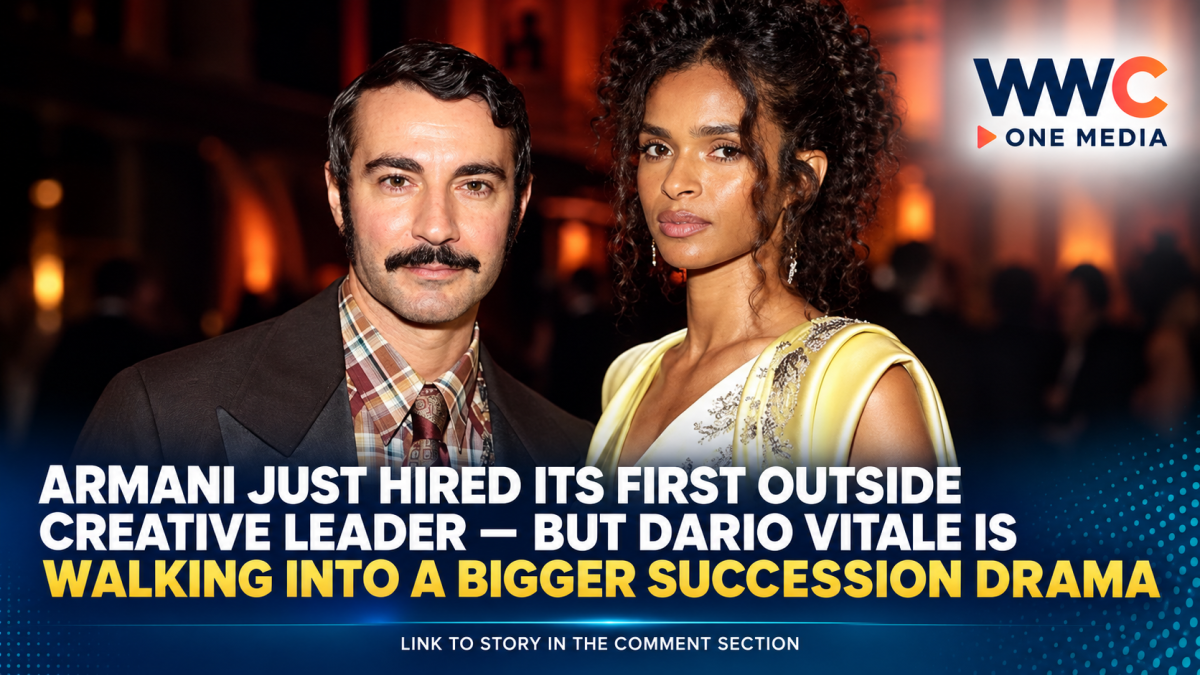
MILAN — Less than a year after leaving Versace following a single collection, Dario Vitale has landed one of Italian fashion’s most closely watched jobs.
The Armani Group has appointed the 43-year-old designer creative director of Emporio Armani and Giorgio Armani Accessories, effective immediately, making him the first designer from outside the Armani family to take creative control of one of the group’s major lines.
On the surface, it is a designer appointment.
In reality, it is much bigger.
Vitale arrives as Armani navigates the most consequential transition in its history: founder Giorgio Armani died in September 2025 at age 91, his heirs are preparing for a mandated sale of part of the privately held company, and one of Italy’s most fiercely independent fashion empires is being forced to answer a question it postponed for decades:
What does Armani become without Giorgio Armani?
For Vitale, the assignment is equally loaded. He helped shape Miu Miu during one of the strongest growth periods in contemporary luxury fashion, then became the first outsider to take over Versace — only to leave eight months later after Prada acquired the label.
Now he is being asked to modernise another legendary Italian house without erasing the design language that made it famous.
That balancing act may determine not only Vitale’s next chapter, but how attractive Armani looks to whoever eventually buys into the company.
What exactly will Dario Vitale control?
The distinction matters.
Vitale becomes creative director of Emporio Armani, giving him responsibility for its menswear, womenswear and accessories.
He will also serve as creative director of Giorgio Armani Accessories.
He is not, however, taking complete creative control of the Giorgio Armani mainline.
Giorgio Armani’s niece Silvana Armani remains responsible for the main label’s womenswear, while the founder’s longtime collaborator and partner Leo Dell’Orco continues to oversee menswear. Both spent decades working alongside Giorgio Armani and have been carrying forward the house’s core aesthetic since his death.
That structure allows the company to experiment with an outsider at Emporio while maintaining greater continuity at the flagship brand.
It is a significant move — but not a wholesale creative revolution.
Emporio Armani may be the smartest place to start
Giorgio Armani founded Emporio Armani in 1981 as a younger, more accessible expression of his fashion philosophy.
The label initially had a strong denim emphasis and evolved into a more metropolitan, casual alternative to the flagship Giorgio Armani collection.
That history makes it an unusually logical testing ground for Vitale.
Emporio was always intended to be freer and more experimental than the mainline. Silvana Armani and Dell’Orco described it in their announcement as a space built around freedom, experimentation and energy, saying they believed Vitale could interpret that spirit while respecting the house’s identity.
The strategy therefore looks relatively cautious.
Rather than asking an outsider to immediately redesign the entire Giorgio Armani universe, the group is giving Vitale a commercially important label where change is already part of the DNA.
CNA Luxury, republishing the Financial Times report, noted that some analysts estimate Emporio Armani generates roughly €700 million to €800 million in annual sales, although Armani does not publicly disclose revenue by individual brand.
That makes Emporio important enough to matter — but distinct enough to serve as a laboratory for what a post-founder Armani might look like.
Vitale’s first collection is not coming next week
There is another timeline detail worth getting right.
Emporio Armani will show its Summer 2027 collection on September 24 during Milan Fashion Week, but that collection is the final Emporio project designed under Silvana Armani and Leo Dell’Orco.
Instead of the label’s customary runway show, it will be presented in a different format.
Vitale’s own debut is expected with Fall/Winter 2027 early next year.
So anyone expecting to see his new Armani vision immediately during the September 24 presentation will have to wait.
What happens next week represents the end of one transition phase.
Vitale’s real test starts after it.
Why Armani picked a designer closely associated with Miu Miu
Vitale’s CV explains much of the attraction.
Before Versace, he spent around 14 years at Miu Miu, joining in 2010 and eventually becoming design director of ready-to-wear and head of image.
That period coincided with Miu Miu transforming from Prada’s smaller sister label into one of the most culturally influential brands in luxury fashion.
The company became particularly strong among younger consumers, powered by provocative styling, highly recognisable campaigns and products that repeatedly broke through into mainstream fashion culture.
Vogue Business noted that Miu Miu sales jumped 93% in 2024, highlighting the explosive momentum surrounding the brand during Vitale’s later years there.
It would be inaccurate to attribute that growth to Vitale alone — Miuccia Prada remained the brand’s defining creative force, and commercial growth involves far more than design.
But his long experience inside that machine gives Armani something highly valuable: a designer who understands how an established European label can speak to a younger generation without pretending it has no history.
That skill set is especially relevant to Emporio Armani.
Then came Versace — and one of fashion’s shortest high-profile tenures
Vitale left Miu Miu to take over Versace in 2025.
It was another historic appointment.
He became the first designer outside the Versace family to lead the house creatively, succeeding Donatella Versace after nearly three decades under her direction.
His debut Spring/Summer 2026 collection arrived in Milan in September 2025 and leaned into the sensual, colourful and provocative codes associated with Gianni Versace’s work in the 1980s and 1990s.
The collection received substantial fashion-industry attention, and Vogue Business described its reception as strongly positive.
But Vitale’s tenure ended almost as quickly as it began.
Prada Group completed its €1.25 billion acquisition of Versace from Capri Holdings in late 2025, and Vitale’s departure was announced shortly afterward.
He had lasted roughly eight months and produced only one collection.
The reasons were never publicly explained in detail. CNA Luxury reported industry speculation that Prada executives did not see Vitale as the right creative fit for their plans for Versace, but that remains reported speculation rather than a confirmed explanation from Prada.
That distinction is important.
His Versace exit should not automatically be framed as evidence that the collection failed.
Armani is facing an ownership question as big as its creative one
Vitale’s arrival comes as the group simultaneously prepares for a potential change in ownership.
Giorgio Armani famously resisted selling control of his company during his lifetime.
His will, however, set out a roadmap after his death.
It requires the heirs to sell an initial 15% stake within 18 months, with a further 30% to 54.9% stake to be sold to the same buyer between three and five years later.
The initial deadline falls in March 2027.
The will identified three preferred potential buyers: LVMH, L’Oréal and EssilorLuxottica.
Those names are not random.
L’Oréal already has a major licensing relationship with Armani in beauty, while EssilorLuxottica is connected to the brand through eyewear.
As of the latest reporting, however, no completed transaction has been announced.
CNA Luxury said none of the three had publicly made an offer at the time of its report.
An IPO has also been discussed as a possible longer-term route for the company.
So Vitale is walking into a brand that could have a substantially different ownership structure within a few years.
Armani’s €2.2 billion business also needs renewed momentum
The succession comes against a difficult backdrop for luxury fashion.
Armani reported €2.2 billion in 2025 revenue, down 2.8% at constant exchange rates. Including direct sales by licensees, total turnover reached approximately €4 billion, according to Vogue Business.
The decline does not make Armani an unhealthy company.
But it comes during a broader luxury slowdown in which many major houses have been struggling with softer demand, particularly after years of aggressive price increases and weaker spending by aspirational consumers.
That makes Vitale’s job commercial as well as aesthetic.
The company does not simply need clothes that fashion editors admire.
It needs products consumers want badly enough to buy.
Accessories could be particularly important.
Armani CEO Giuseppe Marsocci specifically described Giorgio Armani accessories as a significant opportunity while calling Emporio Armani strategically important to the group and its partners.
That helps explain why Vitale was given both responsibilities simultaneously.
Handbags, shoes, jewellery and other accessories can provide fashion houses with highly visible products and potentially attractive economics while reaching customers who may not purchase full ready-to-wear looks.
This is Armani’s first major test of creativity without its founder
For five decades, Armani was unusual among global fashion companies because the founder remained so deeply involved for so long.
Giorgio Armani started his company in 1975 and maintained influence across a sprawling universe that eventually extended well beyond suits and eveningwear into beauty, interiors, hospitality and multiple fashion labels.
His visual language was unusually consistent: softly constructed tailoring, restrained palettes, fluid silhouettes and an understated conception of luxury that often stood in deliberate contrast to louder Italian competitors.
That consistency became Armani’s strength.
It can also become a succession problem.
A house built so closely around one individual must eventually decide how much change constitutes evolution — and how much becomes a betrayal of the identity customers associate with the name.
Armani appears to be addressing that tension gradually.
Silvana Armani and Leo Dell’Orco provide continuity at the flagship label.
Vitale provides an external perspective at Emporio.
That division may let the company test how much change its audience is willing to accept.
Why Vitale could fit Emporio better than Versace
The two houses could hardly be more different.
Versace historically thrives on spectacle: saturated colour, sexuality, baroque motifs, celebrity glamour and a highly extroverted visual identity.
Armani built an empire around restraint.
Yet Vitale’s long Miu Miu experience suggests he is not necessarily tied to one aesthetic.
His strength may lie instead in reading a house’s existing vocabulary and translating it into something culturally current.
Luxury retailer Mytheresa executive Tiffany Hsu told the Financial Times that she considered Vitale a strong match for Emporio, citing his ability to respect house codes while bringing a forward-looking perspective and understanding contemporary market demands.
That is an industry executive’s assessment rather than a guarantee.
But it identifies the central challenge accurately.
Vitale does not need to turn Emporio Armani into Miu Miu.
He needs to make Emporio Armani feel necessary again.
The appointment also signals something about Armani itself
Perhaps the most significant fact is not Vitale’s résumé.
It is that Armani hired him at all.
For decades, the company remained unusually self-contained, creatively and structurally centred on its founder and a small group of trusted longtime collaborators.
Hiring the first outside designer to lead one of its lines marks a shift in that culture. Reuters described the appointment as Armani’s most significant addition to its design organisation since Giorgio Armani’s death.
CEO Giuseppe Marsocci called it an important milestone that strengthens Armani’s creative structure while allowing the group to evolve without abandoning the founder’s principles.
That makes Vitale more than the new designer at Emporio.
He is effectively the first public experiment in whether Armani can successfully absorb creative leadership that did not come directly from Giorgio Armani’s inner circle.
And this time, Vitale needs more than one collection
There is an obvious irony.
At Versace, Vitale became the first major outsider to inherit another Italian family fashion dynasty.
He got one collection.
Now Armani has chosen him to cross almost exactly the same boundary again.
The circumstances are different. Armani has appointed him directly during its succession process, while his exit from Versace followed Prada’s acquisition of that business.
But the comparison will be impossible to avoid.
When his first Emporio Armani collection arrives in early 2027, fashion insiders will be looking for several things at once.
Can he make the brand feel younger without chasing youth culture?
Can he introduce desirable accessories without turning Armani into another logo-driven luxury house?
Can he reinterpret Giorgio Armani’s loose tailoring and quiet sensuality without simply reproducing archive pieces?
And can he create enough momentum to help an €2.2 billion fashion group navigate both an industry slowdown and a potential ownership transformation?
That is why this appointment matters far beyond Milan Fashion Week.
Dario Vitale is not merely designing Emporio Armani’s next collection.
He is becoming one of the first people asked to prove that Giorgio Armani’s empire can change without losing the reason it became an empire in the first place.



Leave a Reply