
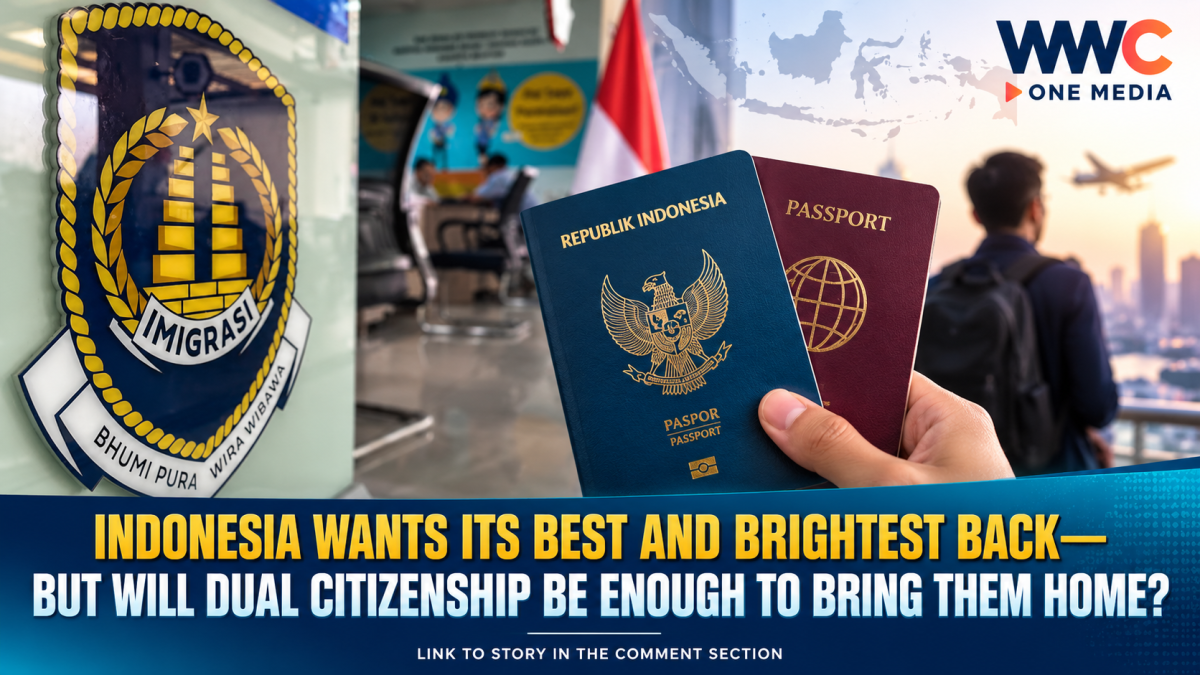
JAKARTA, Indonesia — Indonesia is considering one of its biggest changes to citizenship policy in decades, with President Prabowo Subianto proposing limited dual citizenship for selected members of the Indonesian diaspora whose skills and expertise are considered strategically important to the country.
The proposal has been welcomed by Indonesians living overseas, particularly professionals who have spent years building careers and families abroad. But as excitement grows, so do major questions: Who will qualify? How will “extraordinary talent” be defined? And can a second passport really convince Indonesia’s brightest minds to return?
President Prabowo first raised the proposal during his Aug. 14, 2026 address to parliament on the government’s 2027 budget plans, saying Indonesia should not force talented citizens abroad to choose between global career opportunities and their connection to their homeland. The government is considering legislative changes, but the final scheme has yet to be designed and would require further study and parliamentary action.
A New Offer for Indonesia’s Global Talent
Under the proposed policy, Indonesia could allow limited dual citizenship for selected individuals with skills the country urgently needs.
Potential beneficiaries could include:
- Scientists and researchers
- Doctors and medical specialists
- Engineers
- Artificial intelligence and technology experts
- Entrepreneurs and investors
- Artists and cultural figures
- World-class professionals
- Elite athletes, including footballers
The idea is straightforward: Indonesia wants to reconnect with highly skilled Indonesians who have moved overseas and, in some cases, adopted foreign citizenship to advance their careers or accommodate family circumstances.
But the proposal is not expected to create unrestricted dual citizenship for all Indonesians abroad.
The Indonesian government has stressed that any future programme would be selective and carefully regulated, with safeguards related to national interests, integrity and security.
Indonesia Currently Does Not Allow Adult Dual Citizenship
The proposal would represent a significant departure from Indonesia’s existing citizenship framework.
Currently, Indonesia generally does not recognise dual citizenship for adults. Children eligible for dual nationality, including many born to mixed-nationality parents, can temporarily hold two citizenships but are generally required to make a citizenship choice by adulthood under existing rules.
Former Indonesian citizens who acquire another nationality can also lose their Indonesian citizenship under the current system.
The issue has long been politically sensitive. In 2016, Indonesia’s citizenship rules drew national attention after Arcandra Tahar was removed as energy minister following reports involving his citizenship status.
Calls for greater flexibility have continued for years. In 2024, the Indonesian government was already discussing the possibility of dual citizenship as a way to attract skilled Indonesians overseas back into the country’s economy.
A Citizenship Bill Was Already Taking Shape
The latest proposal is also part of a broader discussion surrounding Indonesia’s Citizenship Bill.
In March 2026, Indonesia’s Ministry of Law said a proposed new Citizenship Bill was being developed to address problems affecting dual-nationality children and the Indonesian diaspora.
Among the proposals under discussion were:
- Extending the deadline for certain dual-nationality children to choose citizenship;
- Providing pathways for some people who missed citizenship deadlines to regain Indonesian nationality;
- Strengthening Indonesia’s relationship with its diaspora; and
- Creating selective citizenship opportunities for individuals considered exceptionally valuable or strategically important to Indonesia.
The ministry said the draft also recognised former Indonesian citizens and descendants with Indonesian connections as part of the broader diaspora community.
Diaspora Support Is Growing—But So Are Concerns
Many Indonesians abroad have welcomed the possibility of holding two passports.
For diaspora families, dual citizenship could make it easier to maintain family, business and property connections in Indonesia while continuing careers and lives in countries such as the United States, Australia and elsewhere.
But the enthusiasm comes with caution.
Members of the diaspora interviewed by CNA said they want clearer information about eligibility, taxation, fees, rights and obligations.
The biggest concern is the phrase “extraordinary talent.”
Who decides whether someone is valuable enough?
Would a scientist qualify but not a teacher? Would an entrepreneur qualify but not an ordinary professional who has spent decades contributing to Indonesia from overseas?
The Indonesian Diaspora Network has argued that citizenship should not create a hierarchy among Indonesians, warning that a talent-only system could exclude large parts of the diaspora.
Representatives of mixed-marriage families have also called for descendants and children with Indonesian parents to receive stronger consideration, arguing that citizenship based on family ties and descent should not depend solely on professional status.
Can Dual Citizenship Really Stop Indonesia’s Brain Drain?
This may be the biggest challenge facing the Prabowo administration.
Indonesia is not simply trying to offer diaspora members another passport. It is trying to make the country more attractive as a place to work, invest, conduct research and build businesses.
CNA reported that concerns about young Indonesians moving overseas have intensified in recent years, with surveys showing significant interest among younger generations in pursuing opportunities abroad.
The social media trend #KaburAjaDulu, roughly translated as “just escape first,” also became a symbol of frustration among some young Indonesians considering opportunities outside the country.
Government data cited by CNA showed that nearly 8,000 Indonesians applied to renounce their citizenship over a five-year period, with many of them young professionals and students.
That means citizenship may be only one part of the solution.
Analysts and diaspora professionals have pointed to deeper concerns, including:
- Higher salaries overseas;
- Limited high-skilled career opportunities;
- Research and innovation infrastructure;
- Regulatory complexity;
- Taxation;
- Access to capital;
- Legal certainty; and
- Overall quality of life.
For many highly skilled Indonesians abroad, the question is not whether they want to maintain emotional ties with Indonesia.
The question is whether Indonesia can offer them enough professional and economic reasons to contribute—or return.
As one diaspora entrepreneur told CNA, Indonesia must give overseas professionals compelling reasons to choose the country, particularly when many already have successful careers and established families elsewhere.
Indonesia’s Previous Diaspora Programme Had Limited Results
Indonesia has already experimented with another approach through its Global Citizenship of Indonesia (GCI) programme.
The scheme offers certain former Indonesians and people with strong Indonesian connections the ability to obtain indefinite permanent residency without restoring Indonesian citizenship.
However, CNA reported that by February 2026, only 11 people had applied.
Observers have suggested that costs, limited awareness and the programme’s relatively recent launch may have contributed to the low uptake.
The weak response raises an important question for the new proposal:
If permanent residency was not enough to attract large numbers of diaspora members, will limited dual citizenship be powerful enough to change their decisions?
The Real Test: More Than Just a Passport
Indonesia’s proposed dual citizenship policy could become a major turning point for millions of Indonesians living abroad.
For the first time, the country is seriously examining whether its citizenship system should adapt to a globalised economy where scientists, engineers, entrepreneurs and professionals often build careers across multiple countries.
The proposal could help Indonesia strengthen connections with its diaspora, attract investment and expertise, and potentially reverse some of the country’s brain drain.
But critics say the policy must avoid becoming exclusive, subjective or politically selective.
Clear eligibility rules will be essential.
So will transparency.
And perhaps most importantly, Indonesia will need to create an environment where talented people actually want to contribute.
Because for many members of the diaspora, the right to hold two passports may open the door—but better jobs, stronger institutions, research opportunities and economic certainty may ultimately determine whether they walk back through it.
For now, Prabowo’s dual citizenship proposal remains under study, with the government still needing to define eligibility, legal safeguards and the final structure before any changes can take effect.
Indonesia may be ready to ask its diaspora to come closer again. The bigger question is whether the country is ready to give them enough reasons to say yes.
WWC ONE MEDIA J.M.S




Leave a Reply