
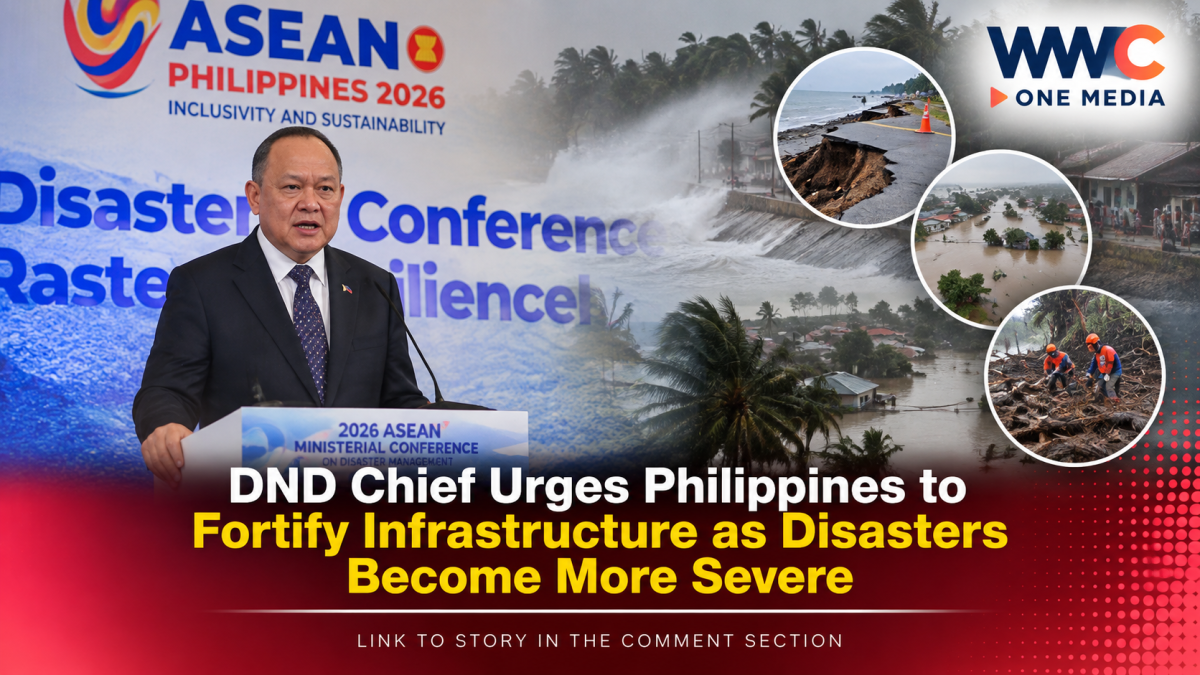
MANILA, Philippines — September 17, 2026 — The Philippines needs to accelerate investments in disaster-resilient infrastructure and climate adaptation systems as natural hazards become increasingly unpredictable and potentially more damaging, Department of National Defense (DND) Secretary Gilberto Teodoro Jr. said.
Teodoro made the call Wednesday during the ASEAN Ministerial Conference on Disaster Resilience 2026 in Pasay City, where disaster preparedness, early action and regional cooperation were among the major issues discussed.
He said the Philippines needs stronger infrastructure, response mechanisms and adaptation systems capable of dealing with increasingly complex emergencies.
Teodoro: Prepare for More Complex Disasters
Teodoro pointed to scenarios in which multiple hazards occur at the same time.
One example he cited was volcanic degassing combined with southwest monsoon rains, which can contribute to lahar hazards. He also highlighted the possibility of sharply contrasting conditions, with intense rainfall affecting one part of the country while another area experiences drought.
Such scenarios, he said, demonstrate why disaster resilience cannot depend solely on emergency response after a disaster strikes.
The country needs systems that can anticipate risks and respond more quickly, while infrastructure should be designed to serve communities not only during normal conditions but also during emergencies.
Disaster Resilience Is Becoming an Infrastructure Issue
The warning comes as the Philippines faces a broad range of natural hazards, including typhoons, flooding, earthquakes, volcanic hazards, storm surges and climate-related extremes.
The Philippine Ports Authority, for example, recently outlined measures to strengthen ports against typhoons and earthquakes, including upgrades designed to address storm surges, wave action, seismic risks and rising water levels.
The agency said ports are particularly important during disasters because they serve as lifelines for transporting food, fuel, medical supplies and relief goods between islands.
Philippines Joins Global Infrastructure Resilience Coalition
The push for stronger infrastructure also comes days after the Philippines formally became the 71st member of the Coalition for Disaster Resilient Infrastructure (CDRI).
The coalition promotes infrastructure that can withstand climate and disaster risks. The Philippine government said membership could expand access to international expertise, technical cooperation and risk-assessment tools.
The Climate Change Commission said resilient design needs to influence decisions ranging from where infrastructure is located and how it is designed to how projects are financed, maintained and protected.
ASEAN Adopts Manila Declaration
The call for stronger national infrastructure was made as ASEAN members adopted the Manila Declaration on advancing disaster resilience toward 2030 and beyond.
The declaration calls for faster implementation of the ASEAN Agreement on Disaster Management and Emergency Response work program for 2026–2030, stronger accountability and monitoring, and greater flexibility in responding to changing disaster risks.
Teodoro said regional cooperation should also include technology and financing because disasters frequently cross borders and affect multiple sectors.
Financing Could Determine How Fast Resilience Improves
BusinessMirror reported that ASEAN is also looking at ways to reduce the financing costs of disaster-resilient infrastructure.
Teodoro said the region could work with multilateral financial institutions and external partners to make disaster-risk investments more affordable, particularly at a time when governments face pressure on public finances.
The underlying approach is to invest in prevention and preparedness before disasters occur, potentially reducing the scale and cost of rebuilding afterward.
From Response to Anticipation
The latest push represents a broader shift in disaster management: prepare before the emergency instead of relying primarily on response afterward.
The Philippines already has a national disaster-risk reduction framework under Republic Act No. 10121, which covers risk assessment, early warning, preparedness, prevention and mitigation, response, and recovery.
For Teodoro, the challenge is now turning those frameworks into infrastructure and systems that can keep communities, public services and the economy functioning when severe disasters strike.
WWC ONE MEDIA G.A




Leave a Reply