
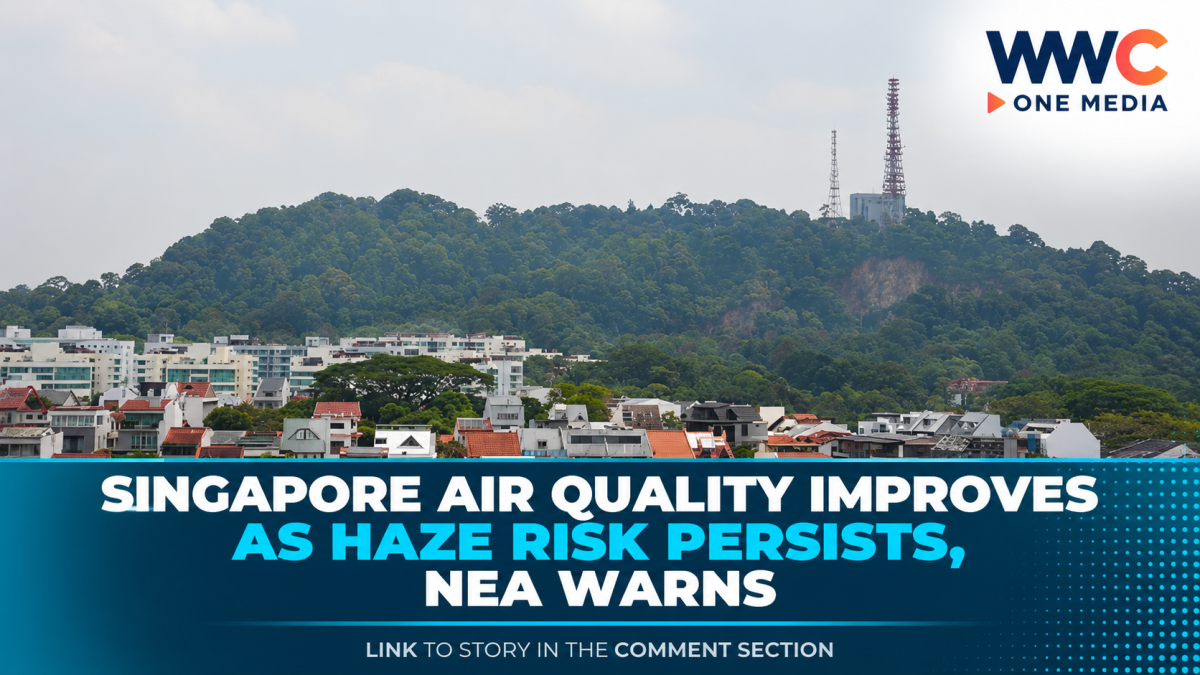
Singapore’s air quality improved on Wednesday, Sept. 16, after showers over parts of Kalimantan helped ease haze conditions — but residents were warned that the respite could be temporary.
The National Environment Agency (NEA) forecast Singapore’s 24-hour Pollutant Standards Index (PSI) to remain between the moderate and low unhealthy ranges over the following 24 hours, as smoke haze continued drifting from parts of Indonesia towards the island.
PSI readings return to moderate range
By 11am on Wednesday, the 24-hour PSI readings across all five regions of Singapore were in the moderate range.
At 5pm, readings ranged from 71 to 89, with central Singapore recording the highest figure at 89. Under Singapore’s PSI scale, readings from 51 to 100 are classified as moderate, while 101 to 200 are considered unhealthy.
The improvement followed showers over parts of Kalimantan, where hotspots had been detected.
However, NEA said the situation remained changeable.
Smoke continues to drift towards Singapore
NEA said satellite observations at about 1.41pm showed some smoke haze drifting from southern Sumatra towards Singapore.
Dry conditions were also expected to persist over southern and central Sumatra and parts of southern Kalimantan.
With prevailing winds forecast to come from the southeast or south, the agency said there remained a risk that haze could continue affecting Singapore.
The latest assessment comes after Singapore experienced a deterioration in air quality earlier in the week, with several regions entering the unhealthy PSI range.
PM2.5 readings also being monitored
The 1-hour PM2.5 readings, which provide an indication of more immediate air-quality conditions, were between 34 and 59 micrograms per cubic metre at 5pm on Sept. 16.
Most regions were within the normal band, while central Singapore recorded an elevated reading of 59. NEA classifies 56 to 150 micrograms per cubic metre as the elevated band.
NEA advises residents to use the 1-hour PM2.5 reading when deciding whether to undertake immediate outdoor activities, while the 24-hour PSI forecast should be used when planning activities for the following day.
What residents should do if PSI rises
For healthy people, NEA’s guidance is to continue normal activities when the 24-hour PSI is in the moderate range.
If the PSI enters the unhealthy range, healthy people should reduce prolonged or strenuous outdoor physical activity.
Elderly people, pregnant women and children are advised to minimise prolonged or strenuous outdoor activity when conditions become unhealthy. People with chronic lung or heart conditions should avoid prolonged or strenuous outdoor exertion at unhealthy PSI levels.
For immediate activities, residents should also check the latest 1-hour PM2.5 reading and the corresponding health advisory.
Haze situation remains weather-dependent
The latest improvement does not mean the haze episode is over.
NEA said cloud cover from nearby showers made it difficult to determine the full extent of the smoke haze through satellite imagery. Continued dry conditions in parts of Sumatra and Kalimantan, combined with prevailing winds, mean Singapore’s air quality could still fluctuate.
For now, Singapore has seen some relief — but the authorities continue to monitor the situation closely as regional fires and weather conditions evolve.
Editorial accuracy note
The Sept. 16 readings were in the moderate range, but NEA’s forecast was broader: moderate to low unhealthy for the following 24 hours. The forecast should therefore not be presented as a certainty that Singapore’s air quality would become unhealthy. The haze was also described by NEA as smoke drifting from parts of southern Sumatra, while showers over Kalimantan contributed to improving conditions.




Leave a Reply