
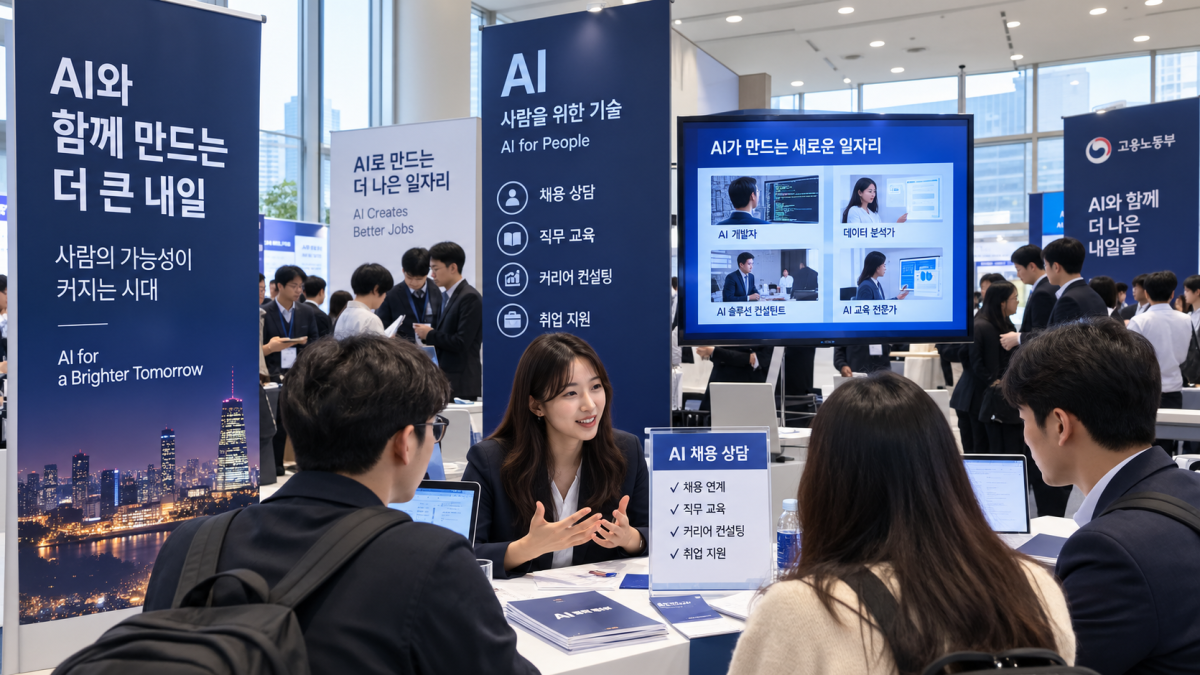
SEOUL — Artificial intelligence is rapidly changing South Korea’s hiring landscape — and the newest jobs are no longer limited to software engineers and data scientists.
AI-related recruitment expanded sharply during the first half of 2026, with companies increasingly seeking workers who can apply AI to planning, content, business strategy, education and other non-development functions, according to an analysis released by Korean recruitment platform JobKorea on Sept. 16.
JobKorea said more than 18,000 job postings containing the keyword “AI” were registered through June. Among them, positions specifically classified by companies as AI specialist roles increased 128% from the same period last year.
Non-Tech AI Jobs Are Growing Even Faster
One of the biggest takeaways from the data is the expansion of AI hiring beyond conventional technology roles.
JobKorea found that postings for non-development AI positions jumped 325% year over year.
Their share of all AI specialist postings consequently rose from 11.6% in the first half of 2025 to 21.6% during the first half of 2026.
In other words, more than one in five AI specialist postings was now categorized as a non-development position.
The positions include areas such as AI-related planning, business, content and education, suggesting that companies are increasingly looking for people who can connect AI technology with specific business functions.
Experienced AI Workers Are in Particularly High Demand
The increase has also been more pronounced among experienced workers.
JobKorea reported that AI specialist postings seeking experienced employees increased 140%, compared with a 55% increase in postings for entry-level workers.
The figures indicate that companies are not simply building future AI teams from scratch. Many are looking for people who can apply AI capabilities in existing workplaces and business operations.
That trend could make experience in both a particular industry and AI tools increasingly valuable as businesses integrate the technology into everyday operations.
Large Companies Are Driving Much of the Growth
AI recruitment also increased across different company sizes, although the largest increase came from major corporations and their affiliates.
JobKorea’s analysis found that AI specialist postings from large companies, including affiliates and subsidiaries, increased 187% year over year.
The corresponding increases were 167% among mid-sized companies, 124% among small and medium-sized enterprises, and 117% among venture companies.
The figures suggest that AI hiring is spreading across the Korean corporate sector rather than remaining concentrated exclusively among technology startups.
AI Is Becoming a Workplace Skill, Not Just a Job Title
The changing recruitment pattern reflects a broader shift in how companies view AI.
Instead of treating AI solely as a specialized engineering function, companies are increasingly seeking employees who understand how to use AI within existing roles.
That can include creating or managing AI-assisted content, incorporating AI into business planning, analyzing information, supporting product development or applying AI to education and other professional services.
A separate LinkedIn labor-market update cited in Korean media also found rising demand for AI-related skills across occupations beyond software engineering, including writing, marketing, business strategy and product management.
But Traditional Development Jobs Are Not Disappearing From the Data
The surge in non-development positions should not be interpreted as the end of conventional technology hiring.
JobKorea’s data show that demand is being redistributed across different AI-related functions. The same analysis reported that ordinary development job postings declined 6.6% over the period, while specialized AI recruitment increased substantially.
That points to a more complicated labor-market shift: companies may be changing the mix of technical skills they need while simultaneously adding AI capabilities to jobs outside traditional technology departments.
What the Numbers Mean for Korea’s Job Market
The latest figures arrive as South Korea faces a broader debate over how AI will reshape employment.
Earlier 2026 reporting showed AI-related postings had already been rising rapidly over several years, indicating that the current increase is part of a longer trend rather than an isolated jump.
For job seekers, the emerging pattern suggests that AI knowledge may increasingly complement — rather than simply replace — existing professional expertise.
A marketing specialist who can work effectively with AI tools, for example, may occupy a different type of role from an AI engineer building the underlying systems.
The distinction is becoming increasingly important as companies move from experimenting with AI to incorporating it into regular business operations.
Korea’s AI Hiring Market Is Entering a New Phase
The 128% increase in AI specialist postings is striking, but the more significant change may be where those jobs are appearing.
With non-development AI positions rising 325%, AI recruitment is moving deeper into departments that traditionally had little connection with artificial intelligence.
The result is a Korean job market in which AI expertise is increasingly crossing the boundary between technology and business.
The next phase of the AI employment race may therefore not be about how many programmers companies can hire — but how many workers across completely different professions can learn to work effectively with AI.

Leave a Reply