
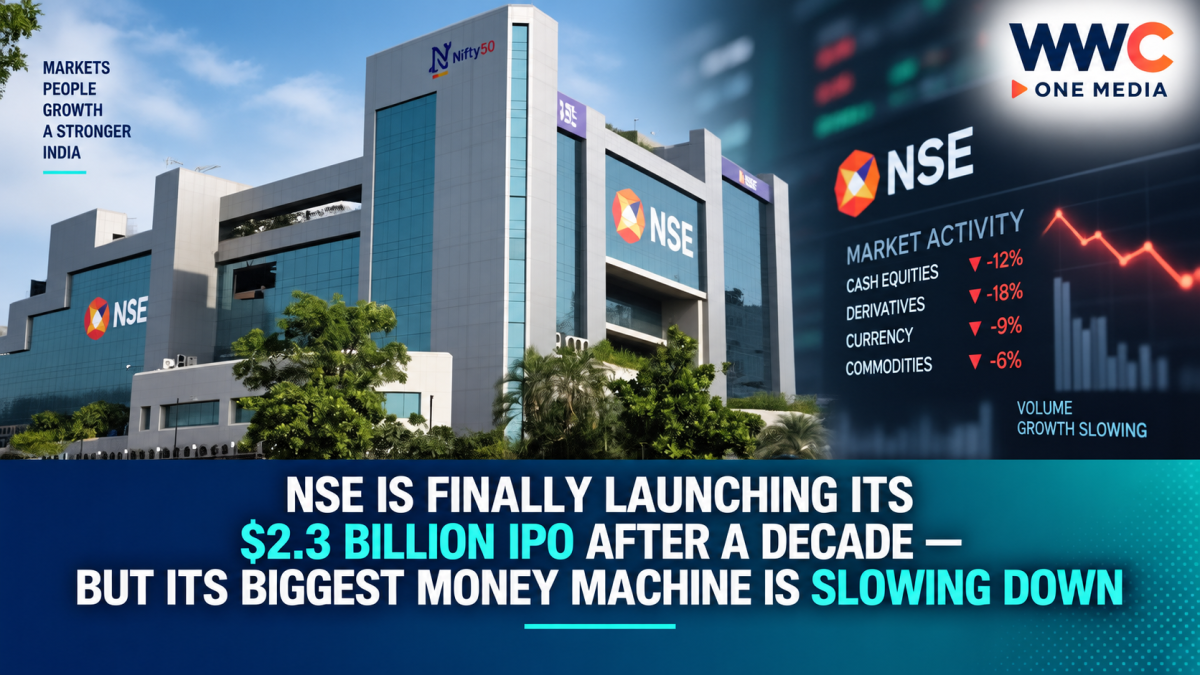
MUMBAI — After almost a decade of regulatory battles, governance controversies and repeated delays, India’s National Stock Exchange is finally entering the public market with one of the country’s biggest IPOs ever.
But the timing comes with an uncomfortable twist.
The business that helped make NSE one of the world’s most profitable and active exchanges—equity derivatives, especially options—is slowing just as investors are being asked to value the company at roughly $46 billion.
Anchor investors began bidding on Wednesday, September 16, ahead of the public subscription period from September 17 through September 21.
At the upper end of the ₹1,700 to ₹1,785 per-share price band, the offer is expected to raise around ₹225.6 billion, or roughly $2.3 billion, and value NSE at approximately ₹4.42 trillion.
Reuters says that would make it India’s third-largest IPO on record.
Yet none of that money will go to NSE.
The entire deal is an offer for sale, meaning existing shareholders are selling stock to new investors rather than the exchange issuing new shares to fund expansion.
That makes the IPO something unusual:
one of India’s most anticipated listings is arriving not because NSE desperately needs capital—but because long-time shareholders finally have an opportunity to cash out after years of waiting.
The IPO has been almost a decade in the making
NSE first announced plans to go public in 2016.
Those plans became entangled in regulatory investigations involving governance issues and allegations that certain brokers received preferential access to the exchange’s co-location infrastructure.
NSE consistently disputed allegations of wrongdoing, while the controversies triggered years of regulatory orders, litigation and compliance reforms.
The exchange ultimately overhauled governance structures, upgraded technology and strengthened its compliance framework.
A decisive breakthrough came on January 30, 2026, when NSE disclosed that the Securities and Exchange Board of India had issued the required no-objection certificate for its shares to be listed on a recognized exchange.
Further legal obstacles eased this year.
The Supreme Court in September disposed of SEBI appeals connected with the long-running co-location and dark-fibre cases, removing another major uncertainty around the listing.
NSE subsequently filed its offer documents, received in-principle listing approval from BSE in July and obtained SEBI’s observation letter on September 4.
The company is expected to begin trading on the Bombay Stock Exchange around September 24.
There is an irony in that destination.
India’s biggest stock exchange cannot list its own shares on itself, so NSE will trade on its longtime rival, BSE.
The original IPO was supposed to be bigger
Even before bidding begins, the deal has already been scaled back.
Existing shareholders originally planned to sell around 148.9 million shares, equivalent to roughly 6% of NSE.
That was cut by more than 15% to approximately 126.4 million shares, or around 5.2% of the exchange.
Why sell less?
Because some shareholders apparently think the IPO price is too low.
Reuters reported that investors including National Insurance, General Insurance Corporation, Stock Holding Corporation, Morgan Stanley-linked MS Strategic, Mahogany, Bank of Baroda and Indian Bank reduced the number of shares they planned to sell.
NSE business development chief Sriram Krishnan openly acknowledged the tension.
He said some shareholders believe NSE is worth more than the valuation implied by the IPO and think investors may be getting some upside left “on the table.”
That is unusual.
Sellers normally want the highest possible IPO price.
Here, several long-term investors appear willing to keep more shares because they believe the market price after listing could eventually be higher.
But the valuation has already been cut sharply
The offer price is not where bankers originally hoped it would be.
Reuters reported that the final price band implies a valuation 15% to 20% below levels discussed during pre-IPO roadshows.
It is also about 40% below valuations implied by private transactions in NSE shares during 2024.
Earlier marketing reportedly discussed pricing closer to ₹2,000 to ₹2,100 per share.
The official band eventually came in at ₹1,700 to ₹1,785.
That discount reflects a fundamental concern investors cannot ignore:
NSE’s biggest profit engine is no longer growing the way it once did.
Options created an extraordinary business
NSE occupies an unusually dominant position in Indian financial markets.
According to the Redseer industry report included with the IPO materials, NSE held approximately:
93.05% of India’s cash-market turnover,
99.72% of equity-futures turnover,
68.48% of equity-options turnover,
and effectively 100% of exchange-traded currency futures and options turnover
during the three months ended June 2026.
Globally, its derivatives scale is even more striking.
World Federation of Exchanges data cited in the offering material showed NSE was the world’s largest multi-asset exchange by several activity measures in fiscal 2026, including a 51.18% share of equity-derivatives contracts traded globally.
That volume made NSE extraordinarily profitable.
But it also created concentration risk.
Reuters reports that around 80% of NSE revenue comes from trading activities and roughly 60% is connected to options trading.
When options volumes rise, that concentration is extremely lucrative.
When regulators decide trading has become excessively speculative, it becomes a vulnerability.
India decided the derivatives boom had gone too far
Indian regulators have spent the past two years tightening rules around futures and options.
SEBI increased minimum derivative contract sizes, introduced higher margins on expiry days and sharply reduced the number of weekly index-expiry contracts available to traders.
The changes followed growing concern about heavy retail participation and losses among individual traders.
SEBI’s own analysis showed that after its first wave of reforms, index-options turnover fell 29% year over year in notional terms between December 2024 and May 2025.
Further restrictions arrived in 2026.
New funding and collateral rules introduced in July helped send average daily equity-derivatives turnover down 27.1% in a single month, to the lowest level since November 2023.
Index-options turnover fell 23.5% from the previous month.
Against the longer cycle, Reuters says NSE derivatives volumes have now fallen about 27% from their 2024 peak.
That is the central issue investors must price into the IPO.
NSE’s profits have already felt it
The slowdown is showing up in the financial statements.
For the fiscal year ending March 2026, NSE reported revenue of approximately ₹166.0 billion, down 3.1% from the previous year.
Net profit fell 15.5% to about ₹103.0 billion.
That is still an exceptionally profitable business.
But IPO investors generally pay for future growth, not merely current profits.
And Bernstein analysts cited by Reuters expect Indian equity-derivatives volume growth to slow to roughly 5% in fiscal 2027 as the regulatory changes work through the market.
The June quarter showed some recovery.
NSE’s profit rose 6.7% year over year to ₹31.2 billion, while revenue climbed about 13% to ₹45.6 billion.
That offers supporters of the IPO a counterargument:
the derivatives slowdown may be painful, but the broader exchange business is still growing.
NSE is trying to become less dependent on options
Management clearly understands the concentration problem.
Over roughly the past 15 months, NSE has launched or expanded products including electricity futures, natural-gas futures and electronic gold receipts, while also incorporating a national coal exchange.
CEO Ashish Chauhan has argued that as other businesses expand, weekly options should naturally become a smaller portion of the exchange’s overall revenue mix.
Krishnan made essentially the same argument before the IPO.
Over the longer term, he said, revenue could diversify enough that investors stop focusing so intensely on index options.
That is the bull case.
NSE already owns dominant liquidity, technology infrastructure, the Nifty benchmark franchise and relationships throughout India’s capital markets.
If India continues adding investors, companies, bonds, commodities and financial products, the exchange may have many ways to grow without repeating the extreme options boom of recent years.
But investors are being asked to pay for that future today.
And NSE is not exactly cheap
Even after cutting its valuation, NSE is priced at a premium to many global exchange operators.
Reuters reported that the IPO valuation implies roughly 35 to 38 times forecast fiscal-2028 earnings.
Comparable global exchange companies including Nasdaq, CME Group, Deutsche Börse, Hong Kong Exchanges and Clearing and London Stock Exchange Group were trading at roughly 23 to 31 times forward earnings.
That does not automatically make NSE overpriced.
India’s capital markets may grow faster than many developed markets, and NSE has extraordinarily high domestic market shares.
But it means investors are not being offered the company at an obviously distressed valuation.
They are still paying a substantial growth multiple.
The debate is simply about how much growth NSE can deliver after regulators have deliberately cooled one of its most profitable products.
Some of the world’s biggest investors still want in
The valuation cut has nevertheless attracted major institutions.
Reuters reported commitments or expected interest from investors including Abu Dhabi Investment Authority, Singapore’s GIC, Fidelity, Carmignac, Norges Bank Investment Management and India’s Life Insurance Corporation.
Separate reporting by Bloomberg and Moneycontrol said Goldman Sachs Asset Management, Franklin Templeton and several major hedge funds were also considering anchor allocations.
Not everyone is convinced.
Bloomberg reported that some major money managers were likely to skip the deal because of valuation concerns.
That division may actually be more telling than overwhelming demand would be.
Few investors dispute NSE’s dominance.
The argument is about what that dominance is worth when its fastest-growing activity is being constrained.
Existing shareholders could make enormous returns
For some long-time NSE investors, even the reduced offer price represents a substantial payday.
State Bank of India, overseas institutional investors and several insurers have held stakes for years.
Earlier Reuters estimates based on preliminary offer plans suggested that large shareholders could collectively realize billions of dollars from the listing.
The pure offer-for-sale structure means those shareholders—not NSE—receive the proceeds.
That is important for retail investors evaluating the deal.
The IPO is not funding a huge new data center, acquisition or nationwide expansion program.
Investors are purchasing an ownership stake in an existing, highly cash-generative market infrastructure company from current owners.
India’s IPO market is unusually busy at the same time
NSE is also arriving during a crowded period for Indian primary markets.
Moneycontrol counted 11 IPOs seeking roughly ₹245.7 billion in the holiday-shortened week beginning September 15.
NSE alone accounts for about ₹225.6 billion of that amount.
That means investors are being asked to absorb one of India’s largest share offerings while secondary markets are already dealing with rising oil prices, global interest-rate concerns and weakness in smaller companies.
India’s benchmark stocks were struggling with elevated crude prices and caution ahead of the U.S. Federal Reserve decision on September 16.
The IPO therefore has two separate timing risks:
NSE’s own derivatives slowdown—and a difficult global market backdrop.
Yet the company is almost impossible to ignore
Those risks do not change NSE’s extraordinary position.
It runs the market where much of India trades.
Its Nifty 50 is one of the country’s central financial benchmarks.
Its equity and derivatives platforms command enormous market shares.
And even after options activity cooled, the exchange still generated more than ₹100 billion in annual profit.
At the upper end of its IPO range, NSE would also rank among the 10 largest publicly traded stock-exchange operators worldwide by market value, according to Reuters.
That combination explains why the listing has been anticipated for so long.
It is rare for investors to get a chance to buy the dominant infrastructure underneath an entire national equity market.
The real test begins after the listing
For nearly 10 years, the question surrounding NSE was:
Will regulators ever allow it to go public?
That question has finally been answered.
The new one is harder.
Can NSE continue producing premium growth after authorities deliberately reduced speculative options trading—the very activity that transformed it into the world’s busiest derivatives exchange?
The IPO’s lower valuation suggests investors have already demanded compensation for that risk.
Its long list of interested global institutions suggests many still believe India’s long-term capital-market expansion outweighs the short-term slowdown.
And the shareholders who reduced their sales are effectively betting that the public market will eventually value NSE more highly than the IPO does.
So after a decade of waiting, NSE is finally giving investors the chance to buy the exchange itself.
But the biggest question hanging over India’s $2.3 billion market debut is no longer whether NSE can get listed—it is whether the business can prove it is worth a premium once the options boom that powered its rise is no longer growing at full speed.



Leave a Reply