
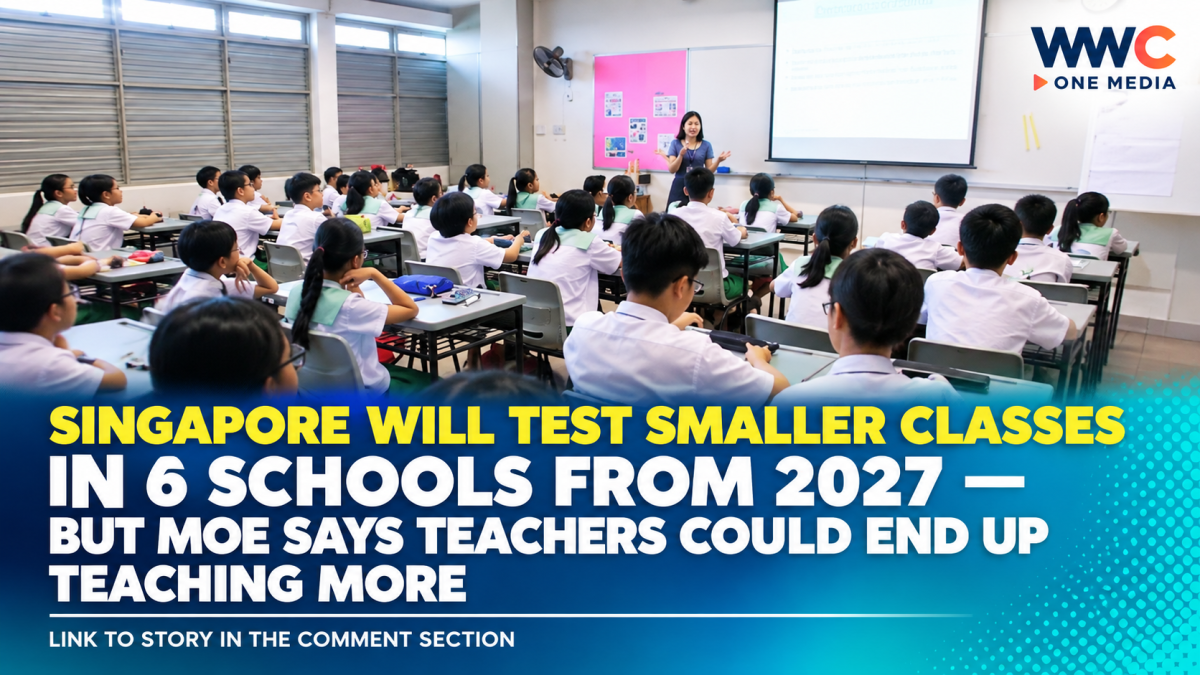
SINGAPORE — Singapore is preparing to experiment with something parents and teachers have debated for years: smaller classes.
But the Ministry of Education is deliberately avoiding a simple “fewer students equals better education” formula.
Starting in January 2027, six primary and secondary schools will take part in a pilot examining how classrooms, teacher workloads, technology and staffing can be redesigned together. One of the ideas is using smaller classes or groups where they could make the greatest difference to learning.
At the same time, MOE is considering a potentially significant change to what teachers do outside lessons.
Instead of routinely juggling form-teacher responsibilities, co-curricular activities and committee work, teachers in the pilot could concentrate on just two of those three areas, depending on the school’s requirements as well as the teacher’s strengths and interests.
Education Minister Desmond Lee said the objective is to give teachers more bandwidth for classroom teaching and meaningful interaction with students.
But he also delivered an important warning:
Smaller classes do not automatically mean lighter workloads.
If each class becomes smaller, teachers could end up teaching more classes — unless the rest of the school system changes with it.
That makes Singapore’s latest education experiment much bigger than the question of how many desks should fit inside a classroom.
Which Six Schools Are Involved?
The pilot will involve three primary schools and three secondary schools:
St Anthony’s Canossian Primary School, Woodgrove Primary School, Zhangde Primary School, Commonwealth Secondary School, Deyi Secondary School and Jurongville Secondary School.
The six schools will not necessarily implement identical changes.
MOE is using them to study a combination of approaches — including class configuration, teacher responsibilities, flexible learning spaces, additional non-teaching support and greater use of digital tools.
For example, The Straits Times reported that Woodgrove Primary will explore smaller classes aligned with pupils’ learning needs, giving teachers more room to experiment with teaching methods, provide targeted support and develop skills such as critical thinking and social-emotional competencies.
That is more precise than saying every class in all six schools will simply shrink next January.
MOE says it will evaluate what works before considering wider application.
Singapore Already Uses Smaller Classes — Just Not Everywhere
Smaller classes are not entirely new to Singapore schools.
MOE has used them selectively for years when it believes students need more individual support.
Primary 1 and Primary 2 form classes have been kept at around 30 pupils since 2006, helping younger children adjust to formal schooling.
Learning Support Programme groups can have only eight to 10 pupils, while classes at Crest Secondary School and Spectra Secondary School typically have around 20 students.
Full Subject-Based Banding has also made secondary-school subject classes more flexible, because students can be grouped according to the level at which they take individual subjects rather than remaining together for every lesson.
But Singapore’s typical form classes remain considerably larger than those targeted support groups.
MOE’s latest published statistical digest shows that in 2024, the average primary-school form class had 33.8 pupils, while the average secondary-school form class had 32.9.
Primary 1 averaged 29.3 pupils and Primary 2 averaged 29.6, while some upper-primary averages exceeded 35.
Those figures cover form classes. Actual lesson sizes may be smaller for particular subjects or support programmes.
Why Isn’t MOE Simply Cutting Every Class to 20 or 25?
Because reducing class size across an entire education system creates a staffing problem very quickly.
Imagine a level with 400 students taught in 10 classes of 40.
Reduce those classes to 25 students and the school suddenly needs 16 classes instead.
That requires more teachers, classrooms, timetabling capacity and potentially more facilities.
Lee said Singapore cannot simply recruit large numbers of additional teachers because the country’s workforce is limited. Any increase must also be sustainable without lowering recruitment standards.
MOE has already moved to increase recruitment.
In July 2025, Lee announced that the ministry intended to hire more than 1,000 teachers annually, up from previous recruitment of as many as about 700 a year, partly as the existing teaching workforce ages.
But the ministry’s latest strategy suggests it does not see recruitment alone as the solution.
It wants to change how existing teachers spend their time as well.
The Bigger Experiment May Actually Be Teacher Workload
For many teachers, the classroom lesson is only one part of the job.
They may simultaneously be responsible for a form class, CCA, committee, lesson planning, marking, parent communications, student counselling, professional development and school events.
Lee said teachers have told MOE that continually switching between those responsibilities consumes not merely hours but mental bandwidth.
MOE will therefore investigate whether teachers can concentrate on two of three major non-classroom responsibilities:
form teachership, CCAs or committee work.
The idea is not necessarily to eliminate those functions.
It is to stop every teacher from needing to carry the full combination simultaneously.
“With less switching between responsibilities, teachers can invest more of their bandwidth into stronger classroom practices and richer interactions with students,” Lee said.
The Workload Numbers Explain Why MOE Is Looking at This Now
An international survey released last year put teacher workload under renewed scrutiny.
The OECD Teaching and Learning International Survey 2024, which surveyed lower-secondary educators, found that full-time Singapore teachers reported working an average 47.3 hours per week, compared with an OECD average of 41 hours.
That ranked Singapore among the systems with the longest reported teacher working hours in the survey.
Interestingly, Singapore teachers actually reported spending less time teaching classes than the OECD average — 17.7 hours weekly compared with 22.7.
They spent more time on several other activities, including preparation, marking and administration.
The same survey found that 53% of Singapore lower-secondary teachers identified excessive administrative work as a significant source of stress, while 49% cited excessive marking and 45% cited responsibility for student achievement.
About 27% said they experienced “a lot” of work-related stress, compared with the OECD average of 19%.
MOE has separately said its own internal surveys — which cover teachers more broadly across school levels and use a different methodology — put average term-time workload at about 53 hours a week.
The two figures should not be treated as contradictory or directly interchangeable because the surveys cover different populations and use different methodologies.
Smaller Classes Could Actually Create More Teaching
This is where the class-size argument becomes less straightforward.
If a school keeps the same number of students but divides them into more classes, somebody has to teach those additional classes.
Lee noted that in some countries with smaller classes, teachers consequently spend more hours actually teaching.
So reducing Singapore’s class sizes without changing teachers’ other responsibilities could potentially exchange one workload problem for another.
That is why MOE is linking the class-size experiment to the workload experiment.
If teachers are required to teach additional smaller groups, the ministry says it must create enough capacity elsewhere to make that sustainable.
That could mean fewer committee responsibilities.
More help with CCAs.
More administrative staff.
More technology.
Or some combination of all four.
Coaches and Other Staff Could Take On More
MOE is also questioning whether every activity traditionally assigned to teachers really requires a trained teacher.
Lee framed the review around four questions: whether a task remains necessary, whether it can be simplified, whether technology can help and whether a teacher actually has to perform it.
CCAs and student-development programmes will remain central to Singapore’s education system, and teachers will continue to play important mentoring and developmental roles.
But MOE plans to examine greater use of coaches, instructors, non-teaching employees and outside partners, including for administrative work surrounding those programmes.
The ministry has already expanded support staffing considerably.
Over roughly the past decade, the number of allied educators in priority areas such as counselling and special educational needs has doubled from around 800 to 1,600, while administrative staffing per school has increased by about 50% on average.
That suggests the 2027 pilot is an extension of a broader policy direction rather than a sudden reversal.
AI Is Supposed to Take Some Paperwork Too
Another part of the strategy is technology.
MOE’s Teacher Workspace, currently piloted in around 20 schools, is scheduled to be introduced across all schools by 2027.
The platform brings student information, communications and everyday work processes into one system rather than requiring teachers to move between multiple tools.
MOE plans to add artificial-intelligence functions progressively.
One proposed use is automatically gathering relevant student information and creating first drafts of routine administrative reports, leaving teachers to review and refine them rather than constructing everything manually.
AI is also already being used for instructional work.
At Bukit Panjang Primary School, for example, an AI-enabled tool can analyse pupils’ written science responses and identify common misconceptions and learning gaps that previously required teachers to examine manually.
The promise is straightforward: let software handle more repetitive processing so teachers can spend more time on work that requires human judgment.
Whether that produces meaningful reductions in workload is another question the system will have to measure.
The Classroom Itself Could Change
MOE’s experiment is not just about teacher numbers.
The six-school pilot will also examine whether existing school spaces can be redesigned so one room can support different kinds of teaching.
That could include movable furniture, areas for whole-class instruction and spaces that can quickly be reorganised for small-group collaboration.
The broader curriculum direction is moving toward more inquiry-based and collaborative learning, in which students investigate questions, work on authentic problems and apply knowledge rather than simply receive information from a teacher.
Lee stressed that strong subject knowledge will remain fundamental, but students must increasingly be able to combine that knowledge, reason through open-ended problems and take more responsibility for learning.
Smaller groups could potentially help with those approaches because teachers have more opportunities to observe, question and respond to individual students.
But MOE’s position remains that class size is a tool rather than a goal in itself.
Falling Birth Numbers Add Another Layer to the Debate
The experiment also arrives as Singapore’s school-age population begins to shrink.
MOE announced earlier this year that the majority of primary schools will gradually reduce their Primary 1 intakes over the next several years because incoming cohorts are getting smaller.
For the 2027 intake alone, 61 of Singapore’s 179 primary schools are cutting P1 places, while 12 are increasing them based on local demand.
MOE has said P1 form classes will nevertheless remain at around 30 students for now.
A smaller student population could theoretically create opportunities to rethink how teachers, classrooms and schools are deployed.
But MOE has also said it wants to avoid excessive school mergers and maintain a good geographical spread of schools around Singapore.
That means falling enrolment does not automatically translate into every remaining class becoming smaller.
The Six Schools Are Essentially a Test Lab
That may be the most consequential part of Wednesday’s announcement.
MOE is not promising that Singapore schools will move from classes of more than 30 pupils to classes of 20.
It is asking a more complicated question:
Where does reducing class size actually improve learning enough to justify the additional manpower?
And if teachers must teach more classes as a consequence, what work can be removed, automated or handed to someone else?
The answers will be tested from 2027 across the six schools.
MOE says it will look at whether the changes produce better learning outcomes and more sustainable teaching, then share what it learns before deciding whether the approaches should spread more widely.
That means parents hoping for an immediate nationwide reduction in class sizes should temper expectations.
But it also represents a meaningful shift.
Instead of debating smaller classes purely as an abstract question of whether 20 pupils are better than 30 or 35, Singapore is going to test how class size interacts with teacher workload, technology, school staffing, classroom design and the way students actually learn.
And that could make the eventual result more consequential than simply changing the number of desks in a room.




Leave a Reply