
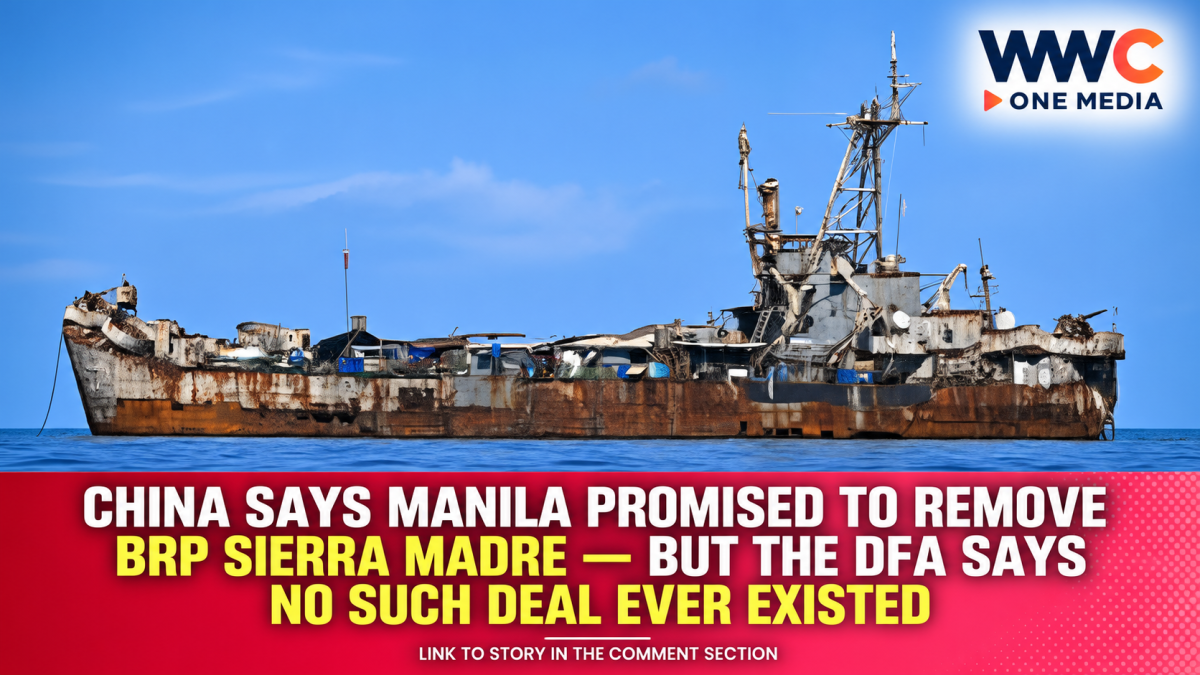
MANILA, Philippines — More than a quarter-century after the Philippines positioned BRP Sierra Madre at Ayungin Shoal, the aging naval vessel is once again at the center of a diplomatic clash between Manila and Beijing—this time over whether the Philippines ever promised to remove it.
The Department of Foreign Affairs has categorically rejected China’s renewed assertion that Manila repeatedly committed to towing the Philippine Navy ship away from Ayungin Shoal, also known internationally as Second Thomas Shoal.
The DFA said there is no agreement between the Philippines and China requiring the removal of BRP Sierra Madre, stressing that the ship remains a commissioned Philippine naval vessel stationed at the shoal.
The statement came after the Chinese Embassy in Manila again demanded that the Philippines remove the vessel, which Beijing calls an illegally grounded warship at Ren’ai Jiao.
But behind that familiar exchange is a bigger question: what exactly did Manila and Beijing agree to regarding one of the most sensitive flashpoints in the South China Sea?
China says there was a promise. Manila says there wasn’t.
Beijing maintains that after the Philippines grounded BRP Sierra Madre in 1999, Philippine officials repeatedly promised that the vessel would eventually be towed away.
In its latest statement, the Chinese Embassy accused Manila of failing to honor that alleged commitment and claimed that attempts to repair or reinforce the vessel were designed to transform it into a permanent Philippine military outpost.
China also reiterated its sovereignty claims over the Spratly Islands and demanded the withdrawal of Philippine personnel and facilities from features Beijing claims as part of its Nansha Qundao.
The Philippine government disputes that account.
The DFA said it rejects the assertion that Manila repeatedly promised to remove BRP Sierra Madre and reaffirmed that Ayungin Shoal falls within the Philippines’ exclusive economic zone and continental shelf under the United Nations Convention on the Law of the Sea, or UNCLOS, as reflected in the 2016 South China Sea arbitral award.
This is not the first time Manila has publicly denied such a promise.
Back in August 2023, President Ferdinand Marcos Jr. said he was unaware of any agreement requiring the Philippines to remove the ship. He went further, saying that if such an agreement did exist, he was rescinding it.
The Armed Forces of the Philippines has also rejected China’s version.
In August 2026, military officials again said no binding commitment had been made to remove BRP Sierra Madre.
But there is a separate Philippines-China understanding
The dispute can become confusing because Manila and Beijing do have a separate understanding involving Ayungin Shoal.
The DFA confirmed in July 2026 that the two governments have observed a “Provisional Understanding” covering rotation and resupply missions to Filipino troops stationed aboard BRP Sierra Madre since July 2024.
But Manila says that arrangement deals only with procedures intended to reduce the risk of confrontation during rotation and resupply—or RORE—missions.
It does not, according to the DFA, require Chinese permission for Philippine missions, give China the right to board or inspect Philippine vessels, or require Manila to remove BRP Sierra Madre.
Foreign Affairs Secretary Ma. Theresa Lazaro has described the arrangement as an exchange designed to avoid misunderstandings and miscalculations while preserving both sides’ national positions.
The DFA said in August that the arrangement had facilitated 15 incident-free rotation and resupply missions since it began in July 2024.
The department has also repeatedly stressed that the provisional understanding was crafted without prejudice to the 2016 arbitral ruling and does not limit Philippine sovereign rights and jurisdiction.
That distinction is crucial.
There is an understanding about how supplies and personnel reach the vessel. Manila says there is no agreement requiring the vessel itself to leave.
Why Ayungin matters
Ayungin Shoal is one of the most closely watched maritime flashpoints between the Philippines and China.
The Philippines deliberately grounded BRP Sierra Madre, a former U.S.-built landing ship, at the shoal in 1999 and has since maintained a small military presence aboard the vessel.
China claims sovereignty over the Spratly Islands and surrounding waters and refers to Ayungin as Ren’ai Jiao.
The Philippines, meanwhile, bases its maritime position on UNCLOS and the July 12, 2016 arbitral award.
The tribunal determined that Second Thomas Shoal is a low-tide elevation and that it lies within an area where the Philippines has exclusive economic zone and continental-shelf rights under UNCLOS. A low-tide elevation does not generate a territorial sea or other maritime zones of its own.
The arbitration did not decide sovereignty over land territory in the South China Sea. It did, however, reject the legal basis for China’s claim to historic rights exceeding the maritime entitlements permitted under UNCLOS.
China rejected the arbitration and continues to say it neither accepts nor recognizes the award.
That fundamental legal disagreement remains at the center of repeated encounters between Philippine and Chinese vessels.
The dispute has already produced confrontations
Ayungin has repeatedly become the site of tense encounters involving Philippine resupply vessels and China Coast Guard ships.
One of the most serious recent clashes occurred in July 2026, when Manila and Beijing gave sharply conflicting accounts of an encounter near the shoal. Philippine authorities said a Filipino serviceman was injured, while China accused Philippine personnel of provoking the confrontation.
The dispute became serious enough for the two governments to summon each other’s ambassadors.
Earlier confrontations have involved blocking maneuvers, water cannons and damaged vessels during Philippine resupply operations.
Those incidents are a major reason Manila says the provisional RORE understanding was created—to reduce the risk that routine missions spiral into larger confrontations.
But it has not resolved the underlying disagreement over who has what rights around the shoal.
Another argument: the Philippine Maritime Zones Act
The latest exchange also expanded beyond BRP Sierra Madre.
Beijing rejected the Philippines’ Maritime Zones Act, or Republic Act No. 12064, saying the legislation cannot affect what China considers its sovereignty and maritime rights in the South China Sea.
The DFA countered that the law is the Philippines’ exercise of its sovereign prerogative to establish and define its maritime zones consistently with UNCLOS and international law.
That disagreement mirrors the wider legal divide between the two countries.
Manila treats the 2016 arbitral award as final and binding under UNCLOS.
Beijing rejects the ruling and maintains its own sovereignty and maritime claims.
So is BRP Sierra Madre staying?
For now, Manila’s position leaves little ambiguity.
The DFA describes BRP Sierra Madre as a commissioned Philippine naval vessel permanently stationed at Ayungin Shoal and says no agreement obligates the country to tow it away.
The department also says the Philippines will continue lawful activities necessary to uphold its sovereignty, sovereign rights and jurisdiction while remaining open to diplomacy and peaceful dispute settlement.
China, meanwhile, continues demanding the vessel’s removal and insists the Philippines previously promised to do exactly that.
Neither side has publicly produced a mutually accepted document demonstrating an agreement requiring BRP Sierra Madre to be removed.
That leaves one of the South China Sea’s longest-running disputes exactly where it has been for years:
China says the Philippines made a promise. Manila says there was never such a deal—and the BRP Sierra Madre remains at Ayungin.


Leave a Reply