
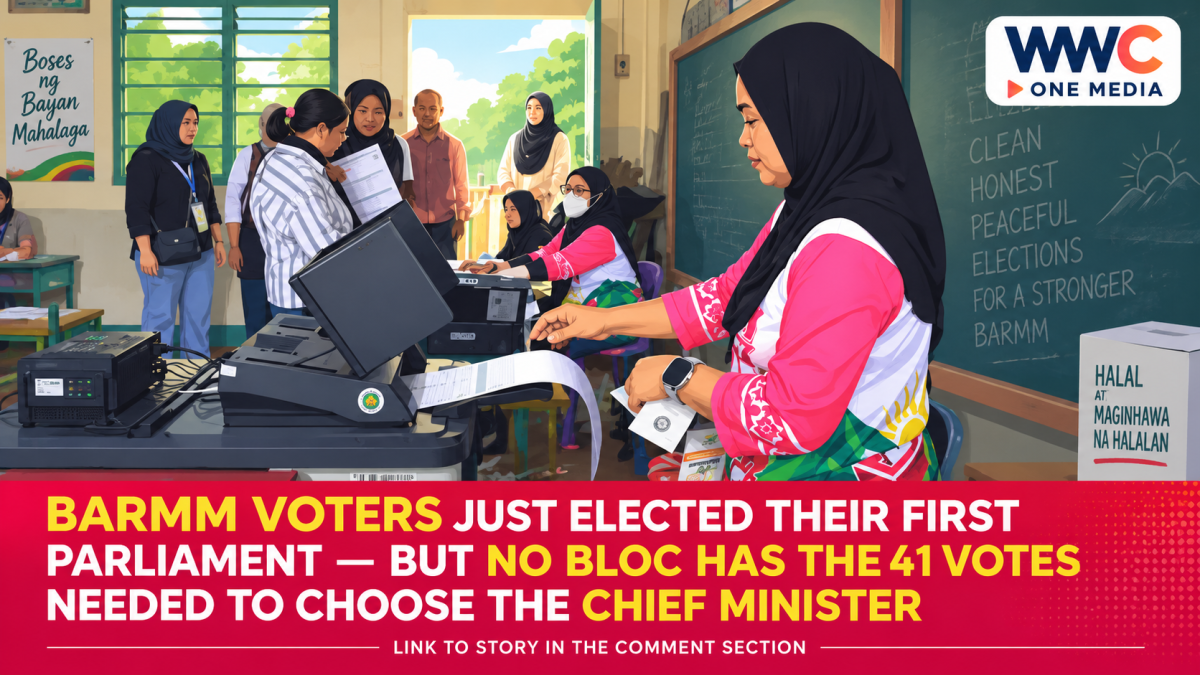
COTABATO CITY — After years of peace negotiations, transitional governments, legal battles and repeated election delays, voters in the Bangsamoro Autonomous Region in Muslim Mindanao have finally chosen their first regular parliament.
But election day did not settle the region’s biggest political question.
It created the next one.
The Bangsamoro Federalist Party, or BFP, secured 16 of the 40 proportional party-representation seats, while the United Bangsamoro Justice Party, or UBJP, received 15.
The BARMM Grand Coalition, or BGC, received eight.
The Raayat Democratic Party received one.
Those four parties were the only ones to clear the required threshold for representation in the regional party vote.
But those 40 seats make up only half of the Bangsamoro Parliament.
Another 32 members come from individual parliamentary districts.
Eight more represent constitutionally protected sectors.
And under the law governing the region, the chief minister is not directly elected by voters.
The 80 members of parliament elect the chief minister themselves.
That requires a majority of all members — 41 votes.
Reuters reported after the vote that no single political bloc had secured that number.
So after Bangsamoro voters finished choosing their representatives, the centre of political activity shifted almost immediately from the ballot box to the parliament chamber.
BFP received the largest share of the regional party vote
COMELEC’s final canvass allocated the 40 proportional seats as follows:
Bangsamoro Federalist Party — 16 seats
United Bangsamoro Justice Party — 15 seats
BARMM Grand Coalition — 8 seats
Raayat Democratic Party — 1 seat.
The BFP received 678,328 votes, while UBJP received 613,663.
BGC received 391,266, and Raayat secured 68,839.
The seat allocation is proportional rather than winner-take-all.
So even though BFP received the largest regional party vote, it did not take all 40 party seats.
Its vote translated into 16.
UBJP’s translated into 15.
BGC’s into eight.
Raayat’s into one.
That is a very different political structure from elections for president, governor or mayor elsewhere in the Philippines.
The BFP’s 16 seats do not mean it has 16 seats in the entire parliament
This distinction is crucial.
The Manila Standard headline refers specifically to the regional parliamentary political party component.
The Bangsamoro Parliament contains three types of representatives:
40 elected through the regional party vote;
32 elected directly from individual parliamentary districts;
and eight reserved for sectoral representation.
A political organisation can therefore gain influence in more than one way.
It may win party seats.
Its candidates may win local districts.
And affiliated candidates can also compete for certain sectoral positions.
That means the 16-15 BFP-UBJP result is only one layer of the final parliamentary arithmetic.
UBJP won six of the eight sectoral seats
The sectoral contests added another important piece to that arithmetic.
GMA News reported that UBJP-linked candidates won both seats allocated to settler communities, along with the seats for:
women;
youth;
the Ulama;
and traditional leaders.
The winners were:
Yul Adelfo Olaya and Mary Ann Arnado for settler communities;
Aida Silongan for women;
Sulffy Abbas for youth;
Muhammad Nadzir Ebil for the Ulama;
and Marjanie Macasalong for traditional leaders.
The remaining two sectoral positions represent non-Moro Indigenous Peoples.
They went to Leticio Datuwata of the Lambangian community and Jo Genna Jover of the Teduray community.
That sectoral structure is built into the Bangsamoro system specifically to guarantee representation for communities that might otherwise struggle to win seats through ordinary electoral competition.
The districts created another layer of political complexity
The 32 parliamentary districts use a different system.
Each elects one representative through a direct plurality vote.
The geography includes districts in:
Basilan;
Lanao del Sur;
Maguindanao del Norte;
Maguindanao del Sur;
Tawi-Tawi;
Cotabato City;
and the Special Geographic Area.
District races produced victories for candidates associated with BFP, UBJP and a range of other local organisations, alliances and independents.
For example, BFP candidates won three of Tawi-Tawi’s four parliamentary districts, while another went to a Pro Bangsamoro candidate.
In Maguindanao del Sur, UBJP won the first and second districts, while BFP won the fourth and fifth and an Itihad candidate captured the third.
That makes the full chamber considerably more complicated than the regional party vote alone.
Even the interim chief minister ran outside the party-label system in his district
Interim Chief Minister Abdulraof Macacua, who chairs the Bangsamoro Federalist Party, contested Maguindanao del Norte’s third parliamentary district as an independent and won.
That illustrates why simply adding party labels can be misleading.
Political relationships in BARMM can involve:
formal party membership;
local coalitions;
independent candidacies;
provincial alliances;
former rebel organisations;
and longstanding political families.
Reuters described the emerging parliament as one in which coalition negotiations would be necessary because no single bloc controlled a majority.
Exactly how individual MPs vote for chief minister therefore cannot be determined solely from the party-representation numbers.
There was no direct vote for chief minister
This may be the biggest adjustment for Filipinos accustomed to presidential and local-government elections.
Bangsamoro voters did not cast a ballot for chief minister.
They elected parliament.
The parliament chooses the chief minister.
The Bangsamoro Organic Law states that on the first day of session, MPs must elect the chief minister by a majority vote of all parliament members.
Because the parliament contains 80 seats, that means 41 votes.
If nobody reaches the required majority in the first round, the law requires a runoff between the two candidates receiving the highest numbers of votes.
That system makes coalition-building a built-in feature rather than an unusual political event.
This is why 16 versus 15 does not decide who governs
A 16-seat party delegation is significant.
So is a 15-seat delegation.
But neither comes close to 41 on its own.
Even if all party-list MPs vote as a bloc, a prospective chief minister must attract support from district MPs, sectoral members or other political groups.
That is the defining feature of parliamentary government.
The election determines the composition of the legislature.
The legislature then determines who heads the executive.
The process is structurally different from the national Philippine system, where voters directly elect a president for a fixed term.
BARMM is the Philippines’ only regional parliamentary government
The Bangsamoro Organic Law created a form of government unique inside the Philippine political system.
The regional parliament legislates and also elects the chief minister, who heads the Cabinet and exercises executive authority.
The Supreme Court has upheld that arrangement, explaining that the Constitution does not require an autonomous regional government to copy the presidential structure used nationally.
The court noted that the Bangsamoro government remains democratic because MPs are elected by the public and the chief minister is then chosen by those elected representatives.
That makes the 2026 vote more than another regional election.
It is the first real test of a parliamentary model inside the Philippines.
The system deliberately combines proportional, district and sectoral representation
The unusual 40-32-8 formula was not created by accident.
Half the chamber is elected proportionally through regional political parties.
That encourages parties to campaign across BARMM rather than relying only on local strongholds.
District seats ensure individual communities retain direct geographical representation.
Sectoral seats protect groups whose numbers or political position might otherwise make representation difficult.
In theory, that creates a parliament balancing:
regional political programmes;
local interests;
and minority or sector-specific representation.
Whether the arrangement produces stable government will now be tested in practice.
The election itself was almost a decade in the making
The origins of the vote stretch back well before election day.
The Philippine government and the Moro Islamic Liberation Front, or MILF, signed the Comprehensive Agreement on the Bangsamoro in 2014, intended to end decades of separatist conflict and create a more autonomous political structure in Muslim Mindanao.
Congress passed the Bangsamoro Organic Law in 2018.
A plebiscite followed in 2019.
The new Bangsamoro Autonomous Region replaced the old Autonomous Region in Muslim Mindanao.
The Bangsamoro Transition Authority, or BTA, then governed on an interim basis while institutions, ministries, laws and an electoral framework were built.
The Sept. 14 election finally moved BARMM from an appointed transitional parliament to one chosen by voters.
But the election was repeatedly delayed
The first regular parliamentary election was originally envisioned much earlier.
It was first expected in 2022.
Congress later extended the transition and moved it to May 2025.
It was postponed again to Oct. 13, 2025.
Then came one of the most consequential Supreme Court decisions in BARMM’s short history.
Sulu’s removal changed the electoral map
In September 2024, the Supreme Court upheld the Bangsamoro Organic Law but ruled that Sulu could not remain part of BARMM because voters in the province had rejected ratification of the law in the 2019 plebiscite.
Sulu had previously been included as part of the old autonomous region.
Removing it meant its parliamentary districts could no longer be used.
BARMM therefore had to redraw the electoral map.
That became legally complicated.
In 2025, the Supreme Court invalidated a redistricting law and ruled that the October election could not proceed without a constitutionally valid districting framework.
A new districting measure was eventually adopted, but COMELEC said it needed months to reorganise precincts, reassign voters, configure ballots and test the automated system.
Congress eventually reset the election to Sept. 14, 2026.
So Monday’s vote ended years of uncertainty
That history explains why election day carried such symbolic weight.
The Bangsamoro region had spent years governed by appointed transition authorities.
Each postponement raised new questions about when voters would finally get to select their own parliament.
Sept. 14 ended that waiting period.
Approximately 2.39 million people were registered to vote.
COMELEC Chairman George Garcia later reported final turnout of 84.34%.
That is a particularly high level of participation for an election using a political system unfamiliar to many voters only a few years ago.
The election was not entirely free of violence or irregularities
The historic nature of the vote should not obscure problems reported around election day.
Reuters reported that three people were killed and 15 wounded in election-related violence shortly before or around the start of voting.
COMELEC also encountered serious problems in Maluso, Basilan, after pre-shaded ballots were discovered in dozens of precincts.
Voting there was delayed, replacement ballots were ordered and the election later resumed.
The municipal canvass was eventually completed.
COMELEC placed Cotabato City under its control amid security concerns, while more than 20,000 police and military personnel had been deployed across the region for election security.
At the same time, election officials described the broader conduct of voting as generally manageable despite the isolated incidents.
The MILF itself entered the election divided politically
Another important development is the political split among figures associated with the former rebel movement.
UBJP has long been the political party associated with the MILF and is led by former interim chief minister Ahod “Al Haj Murad” Ebrahim.
BFP, meanwhile, is chaired by current interim Chief Minister Abdulraof Macacua and includes figures and supporters with roots in the same broader MILF political movement.
That meant the election was not simply a contest between the MILF and its historical rivals.
Important former allies were now competing against one another through different political organisations.
Reuters described BFP and UBJP as rival factions emerging from the MILF political environment.
That makes the post-election coalition process particularly significant for the region’s internal political relationships.
UBJP entered the campaign with a different institutional history
Before the vote, UBJP had been deeply associated with the transition government under Murad.
Macacua replaced Murad as interim chief minister in March 2025, while the transition authority was reconstituted ahead of the repeatedly delayed parliamentary election.
By the time the 2026 election arrived, Macacua headed BFP while Murad led UBJP.
COMELEC had earlier designated UBJP the “dominant majority” regional party and BFP the “dominant minority” party for certain election-administration privileges.
Those labels were procedural COMELEC designations based on accreditation criteria; they were not predictions of the election result.
The actual vote then placed BFP slightly ahead in the proportional component.
The BARMM Grand Coalition remains a substantial parliamentary force
BGC received eight of the 40 regional party seats after securing 391,266 votes.
Its political network also includes local organisations and prominent provincial figures, particularly in Lanao del Sur.
One BGC-allied local party, Serbisyong Inklusibo–Alyansang Progresibo, or SIAP, fielded district candidates there.
Reporting from Lanao del Sur indicated that BGC-linked local allies won several district contests.
That is another reason the eight-seat BGC party allocation should not automatically be treated as the coalition’s entire parliamentary influence.
The full picture depends on the actual affiliations and voting decisions of elected district members.
Raayat crossed the threshold and secured one party seat
The Bangsamoro Peoples’ Democratic Party, running under the Raayat Democratic Party label, secured one proportional seat with 68,839 votes.
The party’s representative is Jose Lorena, according to the final list published from the canvass.
Several other regional parties fell below the threshold required for a proportional seat.
That demonstrates one of the consequences of the parliamentary system.
A party can receive tens of thousands of votes across the region but still end up without representation in the 40-seat proportional component if it fails to reach the minimum threshold.
The first elected MPs take office on Oct. 30
Under the law resetting the elections, the officials elected in September begin their terms at noon on Oct. 30, 2026.
Their terms run until June 2031.
After that, regular Bangsamoro parliamentary elections are scheduled to align with the national electoral calendar and occur every three years.
Until the elected parliament assumes office, the Bangsamoro Transition Authority remains the interim governing body.
So the Sept. 14 vote ends the transition politically, but the formal transfer of authority occurs several weeks later.
The first session will immediately matter
Under the Organic Law, election of the chief minister takes place on the first day of the parliament’s session.
That means MPs will not have the luxury of treating coalition negotiations as an abstract future question.
Government formation is one of their first constitutional tasks.
The chief minister must be a member of parliament, a natural-born Filipino citizen and at least 25 years old.
Once elected, the chief minister appoints the Cabinet and heads the Bangsamoro government.
The parliament also elects two deputy chief ministers following nomination by the chief minister.
Government formation can involve more than one round
The law anticipates that no candidate may initially have enough support.
If nobody receives a majority in the first vote, parliament holds a runoff between the two candidates with the highest first-round totals.
That provision is especially relevant in a fragmented chamber.
It means parties and individual MPs may have to decide between alternative governing arrangements after the first ballot.
But the law does not prescribe in advance which parties must cooperate.
That is for elected MPs to determine.
The parliament can also remove a government later
The parliamentary structure does not stop with choosing a chief minister.
The Bangsamoro Organic Law also contains a vote-of-no-confidence mechanism.
A vote of no confidence supported by at least two-thirds of all MPs can lead to dissolution of parliament and a new election, with the chief minister and Cabinet remaining in caretaker roles until successors are chosen.
That is another major departure from the fixed presidential model used by the national government.
Political survival depends on retaining parliamentary support.
Coalition discipline therefore matters throughout a government’s life, not only during its formation.
The stakes extend far beyond who gets the chief minister’s office
BARMM was created as the institutional centrepiece of a peace process intended to move political grievances away from armed conflict and into democratic government.
The region has a population of roughly 4.5 million people, according to Reuters, and remains one of the country’s poorest areas despite recent economic growth and declining poverty.
It continues to confront:
poverty;
infrastructure gaps;
displacement;
private armed groups;
unfinished rebel decommissioning;
local clan rivalries;
and security threats from extremist organisations.
AP reported before the vote that the decommissioning process involving thousands of MILF combatants remains incomplete amid disagreements over commitments linked to the peace agreement.
That means the effectiveness of the first elected parliament will be judged on more than legislative procedure.
The election itself was part of the peace agreement
The 2014 agreement between Manila and the MILF was based on a fundamental bargain.
The MILF would move away from armed separatist struggle.
The national government would support creation of a stronger autonomous political entity with meaningful self-government.
The Bangsamoro Organic Law provided the legal structure.
The BTA provided the transition.
The parliamentary election was supposed to provide democratic legitimacy.
For years, the first two parts existed while the third was delayed.
Sept. 14 finally completed that electoral stage.
But elections alone do not finish a peace process
A parliament can be elected and still face instability.
Political competition can intensify local rivalries.
Coalitions can fracture.
Armed groups can remain outside formal politics.
Economic inequality can persist.
That is why international observers and civil-society groups have treated the BARMM election as a milestone rather than a conclusion.
Reuters quoted peace and civil-society figures describing effective government formation and political cooperation as central to maintaining stability after decades of conflict.
That assessment is descriptive rather than predictive.
What the elected parliament actually does will determine how the new system develops.
The 84% turnout suggests voters took the new system seriously
COMELEC’s reported 84.34% turnout is one of the clearest numerical signals from the election.
Nearly 2.4 million people had been registered.
For many, the ballot was unfamiliar.
Instead of simply choosing candidates for executive offices, voters had to understand a hybrid parliamentary system containing both party and district choices.
The region had undertaken extensive voter education before the election with support from COMELEC, BARMM agencies and organisations including the United Nations Development Programme.
The turnout indicates that the complexity did not prevent large-scale participation.
The next political contest takes place inside parliament, not at the polling station
This is where the election becomes unusual by Philippine standards.
There is no second public vote to choose the regional leader.
There is no separate chief-minister ballot.
There is no automatic rule saying the party with the most proportional seats gets the government.
Instead, voters have already completed their role in choosing parliament.
The MPs now have to create a majority.
Reuters reported no single bloc emerged with the 41 votes needed to control the 80-member chamber.
That means governing arrangements must be constructed through the parliamentary process.
The one-seat difference between BFP and UBJP is politically important — but incomplete
BFP’s 16 proportional seats give it one more than UBJP’s 15.
That is the straightforward election result contained in the Manila Standard headline.
But it is not equivalent to saying BFP “won the government”.
Nor does UBJP’s six sectoral victories automatically determine who will lead BARMM.
District MPs, sectoral representatives and political alignments across the chamber all matter.
The Organic Law deliberately makes the chief minister dependent on parliamentary majority support.
So the correct takeaway is narrower:
BFP finished with the largest allocation in the 40-seat regional party contest.
The government itself has not been chosen by that result alone.
This is the real beginning of BARMM’s parliamentary experiment
For seven years, Bangsamoro’s parliament was transitional.
Its members were appointed.
Its job was to establish institutions, enact fundamental codes and prepare the region for elected self-government.
Now the democratic accountability changes.
The next parliament will consist of people who obtained their seats through voters, district constituencies and protected sectoral processes.
They will enact budgets.
Pass regional laws.
Choose the executive.
And potentially remove that executive if parliamentary confidence collapses.
That is the system envisaged by the Bangsamoro Organic Law.
Sept. 14 was the first time voters were finally able to activate it.
The ballot has now answered one question:
Who sits in the first elected Bangsamoro Parliament?
The next question will be decided by those MPs themselves:
Who can assemble the 41 votes required to govern it?


Leave a Reply