
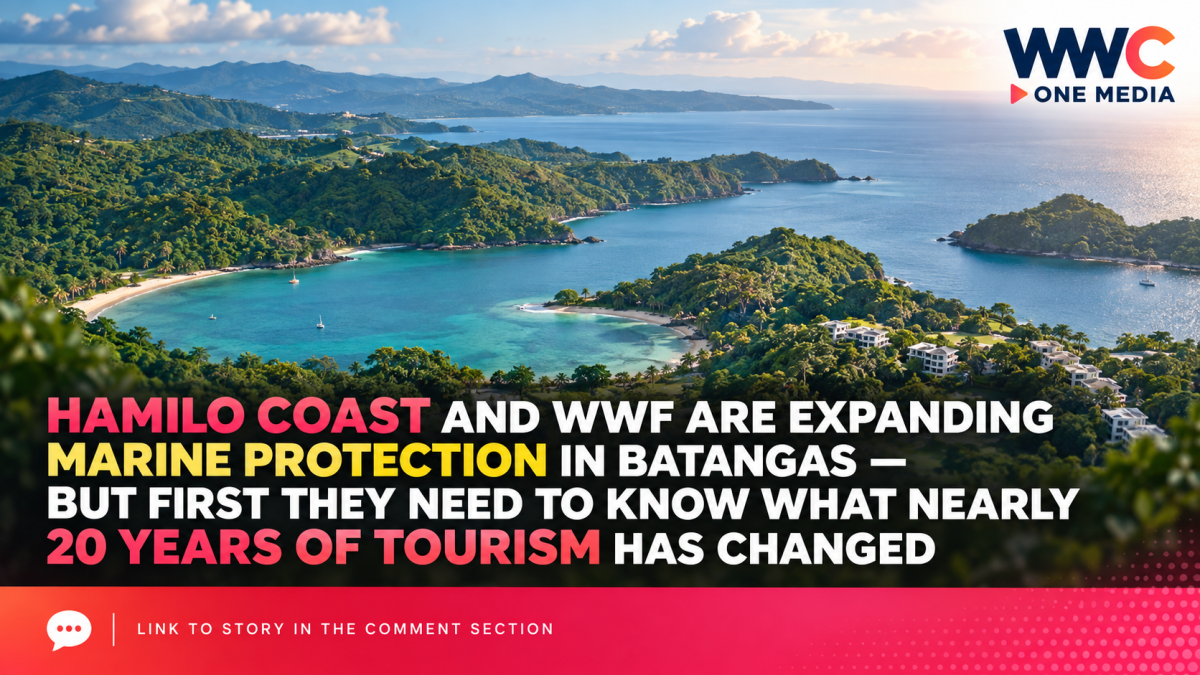
BATANGAS, Philippines — One of the Philippines’ best-known coastal resort estates is going back underwater to find out how well its marine ecosystems have survived nearly two decades of development, tourism and conservation work.
SM Prime Holdings subsidiary Costa del Hamilo Inc., the developer of Hamilo Coast in Nasugbu, Batangas, has renewed its partnership with WWF-Philippines, launching the fifth phase of a conservation programme that began in 2007.
The new phase will focus heavily on the waters surrounding three coves already designated as marine protected areas: Pico de Loro, Etayo and Santelmo.
Marine scientists are expected to assess coral and other seafloor cover, fish populations and invertebrates, update ecological baselines and recommend what needs to be restored, protected or managed differently.
There is also a more ambitious possibility.
WWF will examine whether Pico de Loro Cove is ecologically suitable for an artificial-reef project.
But that qualification matters.
No artificial reef has yet been approved under Phase V.
The current task is to determine scientifically whether one should be built at all.
That makes the latest agreement less of a ceremonial environmental renewal than an ecological audit.
After almost 20 years of partnership — and continuing real-estate and tourism development along the coast — Hamilo and WWF need updated evidence showing what is happening beneath the water.
The partnership dates back to 2007
Costa del Hamilo and WWF-Philippines began working together nearly two decades ago.
Previous phases covered coastal-resource management, mangrove restoration, solid-waste management, environmental education and a broader ridge-to-reef approach intended to treat forests, watersheds, coastlines and marine habitats as parts of the same ecological system.
That long relationship produced one of its biggest early milestones in 2009.
After environmental studies, consultations and lobbying involving WWF, Hamilo Coast, local communities and the Nasugbu government, the municipal council declared Pico de Loro, Santelmo and Etayo coves as marine protected areas.
The three areas were not originally given identical rules.
Santelmo was designated a marine sanctuary, effectively creating a no-take area where fishing was prohibited.
Pico de Loro and Etayo were classified as marine reserves where limited fishing could occur using approved methods such as hook and line. Contemporary reporting said restrictions included limits on the number of fishing boats operating within designated areas.
Those protections were designed not just for tourists who wanted clearer water.
They were intended to allow fish stocks and marine habitats to recover while helping sustain local fisheries beyond the protected zones.
Now WWF wants new measurements
Marine protection cannot be judged solely by the existence of a sign or ordinance.
Managers need to know what is actually happening underwater.
WWF’s Phase V project description says its scientists will examine benthic cover, fish communities and marine invertebrates across designated protected areas.
Benthic cover refers to what occupies the seafloor.
That can include living hard coral, soft coral, algae, seagrass, rock, rubble and sand.
Changes in those proportions can reveal whether a reef is improving, degrading or shifting into a different ecological state.
Fish surveys provide another layer.
Researchers can look at species diversity, abundance, size classes and the presence of ecologically important groups.
Invertebrate surveys can track organisms ranging from sea cucumbers to giant clams and other species that help indicate ecosystem condition.
Taken together, those measurements give managers something far more useful than saying a beach simply “looks clean”.
They create a baseline against which future change can be measured.
That baseline is especially important because Hamilo Coast is still being developed
Hamilo Coast is not an untouched nature reserve.
It is a large commercial leisure and residential estate.
SM Prime’s current corporate information describes the property as spanning about 5,900 hectares, with 13 coves along roughly 31 kilometres of coastline.
The estate includes residential projects, resort facilities and Pico de Loro Beach and Country Club, with new developments continuing to be marketed and built.
That makes the conservation challenge inherently more complicated.
The same coastline is expected to support tourism, property owners, recreational activity, local livelihoods and marine biodiversity.
Those objectives can coexist.
They can also come into conflict.
More visitors can mean more boats, wastewater, solid waste, shoreline activity and physical pressure on reefs.
Construction can increase sediment runoff if poorly controlled.
Recreational diving and snorkelling can damage coral when unmanaged.
WWF itself says increasing coastal-tourism pressure can contribute to pollution and habitat degradation, which is one reason Phase V is returning to intensive marine assessment.
This is what makes the renewed partnership more consequential
A developer saying it supports sustainability is relatively easy.
Demonstrating ecological results across decades is harder.
WWF-Philippines Executive Director Katherine “Trin” Custodio said businesses whose operations depend on nature have both an opportunity and a responsibility to protect the ecosystems around them.
For Hamilo Coast, that connection is particularly direct.
The commercial value of a coastal resort depends partly on the environmental qualities surrounding it:
clean water;
healthy beaches;
marine life;
forested hills;
mangroves;
and attractive reefs.
Environmental degradation would therefore eventually become a business problem too.
That creates a strong commercial incentive for conservation — but also makes independent scientific measurement important.
The artificial-reef proposal is only at the assessment stage
Artificial reefs are sometimes presented as straightforward solutions to degraded marine habitat.
In reality, they require careful site selection.
WWF’s own terms for the Phase V marine consultant specifically call for a site-selection survey identifying suitable locations based on ecological and environmental criteria before any possible deployment.
The consultant must then prepare a site-selection report, potentially including maps and recommendations.
That means the assessment could conclude that an artificial reef is appropriate.
It could recommend a different location.
It could require changes to the concept.
Or it could determine that intervention would not be ecologically justified.
That scientific sequencing matters.
Artificial structures placed in unsuitable environments do not automatically create healthy coral reefs.
An artificial reef also cannot substitute for addressing underlying problems such as poor water quality, sedimentation, destructive fishing or physical damage.
Santelmo was protected partly because of turtles and giant clams
The ecological importance of these coves has been documented for years.
When the marine protected areas were established in 2009, Santelmo was identified as habitat for marine turtles, including Olive Ridley turtles, as well as giant clams.
Pico de Loro was also associated with turtle nesting and giant-clam conservation.
Later Hamilo Coast accounts said almost 200 giant clams had been seeded in Pico de Loro and Santelmo as part of restoration work, while personnel received training in marine-turtle conservation.
Those historical programmes do not tell scientists what conditions look like in 2026.
That is precisely why updated assessments matter.
A conservation project cannot rely indefinitely on results measured years earlier.
The mangroves tell a similar story
Marine protection at Hamilo has also extended onto the shoreline.
SM Prime currently describes Hamilo Coast as having a substantial mangrove belt and says previous restoration work with WWF involved tens of thousands of propagules.
Earlier SM reporting described more than 10,000 mangrove trees across roughly 10 hectares, while later sustainability reports referred to a broader 24-hectare mangrove area. The figures appear to reflect different measurements, restoration stages or areas being described over time rather than one permanently fixed statistic.
What matters ecologically is why mangroves are there.
They provide nursery habitat for fish and other marine species.
Their roots help trap sediment.
They stabilise shorelines.
They can reduce the energy of waves and storm surges.
And mangrove soils can store large quantities of carbon.
That makes them simultaneously a biodiversity asset and a climate-resilience asset.
Mangroves and coral reefs are connected
This helps explain the project’s repeated use of the phrase ridge to reef.
A coral reef can be damaged by something that happens kilometres inland.
Clear vegetation upstream and rainfall can carry additional sediment into rivers.
That sediment eventually reaches the coast.
Cloudier water reduces the sunlight corals need.
Sediment can physically cover reef surfaces.
Likewise, poorly managed waste on land can eventually enter coastal water.
A mangrove belt can capture part of that sediment and pollution while providing habitat between land and offshore reefs.
Treating the forest, shoreline and reef as unrelated conservation problems therefore misses how the ecosystem actually functions.
Hamilo sits inside one of the richest marine regions on Earth
The location amplifies the stakes.
The Philippines is part of the Coral Triangle, the vast marine region shared with Indonesia, Malaysia, Papua New Guinea, Solomon Islands and Timor-Leste.
Official Coral Triangle Initiative data says the region contains roughly 76% of the world’s known coral species and 37% of global coral-reef fish species.
The Asian Development Bank similarly describes it as the world’s centre of marine life and notes that more than 100 million people depend on its ecosystems for livelihoods.
But the same region faces intense pressures.
Overfishing.
Destructive fishing.
Pollution.
Coastal development.
Mangrove loss.
And increasingly, climate change and coral bleaching.
That makes the Philippines simultaneously one of the world’s most biologically valuable marine countries and one of the places where conservation failures can have outsized consequences.
Protected areas work only when they are actually managed
Declaring a marine protected area is the beginning, not the end.
Effective protection requires enforcement.
Buoys have to mark boundaries.
Fishing rules have to be understood.
Illegal activity has to be detected.
Tourism has to be managed.
Scientific monitoring has to show whether fish and coral populations are improving.
Local communities need incentives to support rather than circumvent restrictions.
WWF’s early work at Hamilo included helping establish an MPA management council and strengthening Bantay Dagat patrols around Barangay Papaya.
DENR guidance on Philippine marine protected areas similarly stresses that effectiveness depends on governance, planning, management inputs, enforcement, ecological outcomes and community conditions — not simply legal designation.
That is another reason Phase V is important.
The real question after 17 years of MPA status is not whether Pico, Etayo and Santelmo remain coloured differently on a map.
It is whether protection has translated into healthier ecosystems.
Tourism is both beneficiary and pressure source
Hamilo’s conservation challenge reflects a much larger Philippine dilemma.
Healthy marine ecosystems attract tourists.
Tourism generates jobs and investment.
That creates an incentive to protect nature.
But successful destinations attract more visitors and development.
That can create the very environmental pressure capable of degrading the ecosystem tourists came to experience.
WWF’s Phase V project description explicitly recognises that balancing tourism development with marine conservation remains an ongoing challenge.
The solution is not necessarily to stop tourism.
It is to determine how much activity an ecosystem can absorb, where development should occur, what activities need limits and which habitats require stricter protection.
That requires data.
The Philippines is putting much more money behind the “blue economy”
The Hamilo project is also arriving during a broader national push to link marine conservation with economic development.
Earlier in 2026, the Philippines secured €200 million in financing from Germany’s KfW Development Bank for a programme intended to strengthen management of marine ecosystems and develop the country’s blue economy.
The programme is expected to support coastal resources and livelihoods affecting more than three million Filipinos.
The Asian Development Bank had separately approved a US$500-million policy-based loan in late 2025 for marine ecosystem management, coastal restoration, waste systems and a more climate-resilient blue economy.
Those programmes operate at a completely different scale from Hamilo.
But they reflect the same underlying policy shift.
Marine ecosystems are increasingly being treated not only as environmental assets but as economic infrastructure.
Healthy coral reefs support fisheries.
Mangroves provide storm protection.
Clean beaches support tourism.
Seagrass and mangrove systems store carbon.
Destroying those ecosystems can therefore create costs that eventually appear somewhere else in the economy.
WWF is increasingly using science to decide where intervention works
The Hamilo methodology also resembles WWF’s work elsewhere in the Philippines.
Instead of starting with a predetermined intervention, conservation programmes increasingly collect ecological data first.
WWF’s other marine programmes use fish surveys, habitat measurements, community management systems and monitoring to determine whether conservation actions are producing results.
That approach is particularly relevant to artificial reefs.
A visually dramatic installation may generate attention.
But the more important question is whether it improves habitat and biodiversity.
Phase V’s value will ultimately depend on what happens after the surveys are completed.
Environmental education is part of the new phase too
The renewed agreement is not confined to underwater science.
WWF and Costa del Hamilo also plan Education for Sustainable Development sessions involving employees, guests, property owners and members.
The programmes will cover marine conservation and solid-waste management.
That may sound less significant than coral surveys.
But visitor behaviour can directly affect protected marine areas.
Anchoring boats on coral, stepping on reef structures, leaving waste, disturbing nesting animals or improperly interacting with marine wildlife can create cumulative damage even when no single incident looks catastrophic.
WWF’s own coastal guidance tells divers and recreational users not to collect or damage marine life and warns that even a careless fin kick can break coral that took decades to grow.
A protected coastline therefore depends partly on the behaviour of the people enjoying it.
Hamilo’s real conservation test is becoming harder as the estate matures
There is a difference between protecting nature before development and protecting it while a destination is commercially successful.
Hamilo now has established residential communities, hotel and resort operations and continuing property development.
Its conservation system therefore has to function alongside actual economic activity.
That is the more difficult version of sustainability.
It requires proving that growth in tourism and property use does not steadily erode the ecological assets being marketed as part of the destination.
The next round of marine data could provide some of the evidence needed to make that judgement.
A healthy reef cannot be declared by press release
That may be the most important point in the new partnership.
Costa del Hamilo says the renewed programme is intended to strengthen biodiversity, ecosystem resilience and long-term value for surrounding communities and the environment.
Those are objectives.
Phase V now has to measure the results.
How much living coral remains?
Which fish are present?
Have populations improved?
What has happened to invertebrates?
Which parts of the protected areas are under stress?
Does Pico de Loro need an artificial reef?
Would restoration work better somewhere else?
Are existing management measures sufficient?
Those questions are more consequential than the signing ceremony itself.
Nearly two decades of conservation now have to face the data
When WWF and Hamilo Coast began working together in 2007, the project helped establish marine protected areas, strengthen community patrols and restore mangroves.
Seventeen years have passed since the three coves received protected status.
In that time, Hamilo Coast has also grown as a residential and tourism destination.
Now its fifth conservation phase is effectively asking whether those two stories — development and environmental protection — have actually remained compatible.
The answer cannot come from old photographs or promises.
It has to come from the reefs, fish, invertebrates and habitats scientists find when they return beneath the water.
Hamilo Coast and WWF already know these coves are worth protecting.
Phase V is about finding out what nearly 20 years of protection — and nearly 20 years of human activity — have actually done to them.



Leave a Reply