
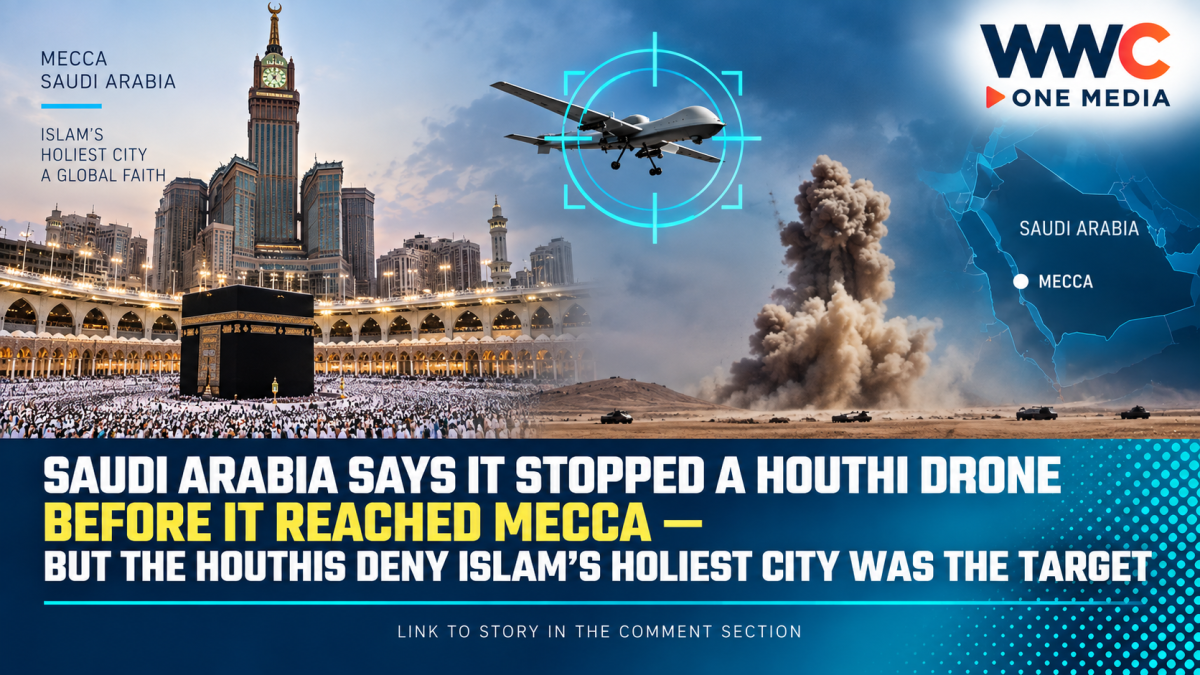
RIYADH — Saudi Arabia says its air defences destroyed a Houthi drone just south of Mecca before it could enter the holy city’s restricted airspace, escalating a rapidly widening conflict that has already reached Saudi military bases, oil infrastructure and some of the world’s most important shipping routes.
But one crucial fact remains disputed.
Riyadh says Mecca was the target.
The Houthis say that claim is false.
Saudi-led coalition spokesman Maj. Gen. Turki al-Maliki said Royal Saudi Air Defence forces intercepted the drone at around 6:50pm on Sept. 15, before it entered prohibited airspace around Mecca.
No damage to the Grand Mosque, the Kaaba or other holy sites was reported, and Saudi authorities announced no casualties from the interception.
The coalition responded with unusually forceful language, declaring the security of Islam’s holy sites and pilgrims a “red line” and warning that it would take what it called necessary deterrent measures against further attacks.
The Houthi movement rejected the allegation almost immediately.
Hazem al-Assad, a member of the group’s political bureau, called accusations that the Houthis had targeted Mecca a repeated falsehood.
That leaves the most explosive element of the episode — where the drone was actually intended to go — unresolved by independently available evidence.
And that distinction is particularly important because this was not merely another alleged drone attack on Saudi territory.
It involved the airspace around the holiest city in Islam.
The drone never reached Mecca
Saudi officials said the unmanned aircraft was destroyed south of Mecca, not over the Grand Mosque itself.
That means reports claiming that Mecca was struck, bombed or damaged would be inaccurate.
According to the Saudi account, the drone was intercepted before entering the city’s restricted airspace.
The publicly available information does not identify the precise model of drone, where exactly it was launched, how far south of Mecca it was intercepted or what specific site Saudi authorities believe it was intended to hit.
Saudi authorities also have not publicly released evidence establishing the intended target beyond the coalition’s attribution.
That is why the safest description is:
Saudi Arabia says a Houthi drone was heading toward Mecca; the Houthis deny targeting the city.
Why the allegation is so sensitive
Mecca is not simply another Saudi city.
It contains the Grand Mosque and the Kaaba, toward which Muslims around the world face during daily prayer.
Millions of Muslims travel to the city for the annual Hajj pilgrimage, while Umrah pilgrimages take place throughout the year.
Any deliberate attack on Mecca would therefore have political and religious consequences far beyond Saudi Arabia.
That helps explain the speed and intensity of the regional reaction.
The Organisation of Islamic Cooperation, whose 57 members represent Muslim-majority and Muslim-populated states around the world, issued a statement condemning what it described as Houthi attacks involving Mecca and the Medina region.
The OIC statement demonstrates diplomatic support for Riyadh.
It does not by itself independently establish the drone’s intended target.
Saudi Arabia says this has happened before
The coalition described the incident as another attempt by the Houthis to target Mecca and pointed specifically to a ballistic missile intercepted in July 2017.
That missile was destroyed over the Taif area, about 69 kilometres from Mecca, according to Reuters reporting at the time.
Saudi Arabia said Mecca was the intended destination.
The Houthis acknowledged launching the missile but said they had targeted King Fahd Air Base in Taif, not the holy city.
There is an important historical wrinkle.
A similar dispute had already occurred in October 2016.
Saudi Arabia said another Houthi ballistic missile had been launched toward Mecca and intercepted about 65 kilometres away.
The Houthis again acknowledged firing a missile into Saudi Arabia but said its intended target was King Abdulaziz International Airport in Jeddah.
So describing the Sept. 15 drone incident simply as the “second attempt” risks oversimplifying a disputed history.
There have been multiple previous Saudi allegations involving missiles near Mecca, and the Houthis disputed the target in those earlier cases too.
That does not make the launches harmless
Whether Mecca itself was the intended target is separate from the danger created by launching long-range missiles and drones toward heavily populated parts of Saudi Arabia.
Human Rights Watch said after earlier Houthi missile attacks that unguided ballistic weapons fired toward populated areas can create serious civilian danger because their accuracy is insufficient to reliably distinguish a military target from nearby civilian areas.
The current drone’s technical capabilities have not been disclosed.
But the central military problem remains similar.
Saudi cities, airports, bases, energy installations and civilian populations are increasingly within range of weapons launched from Yemen.
The Mecca episode came after an unusually broad Saudi security alert
The interception did not happen in isolation.
Saudi authorities had issued security warnings on Sept. 15 across several parts of the kingdom as Houthi attacks intensified.
Reuters reported alerts involving Mecca, Jeddah and other Saudi cities, while Civil Defence later issued all-clear notices in locations including Jeddah, Abha, Jazan, AlUla, Taif and the Red Sea oil port of Yanbu.
CNA reported that the Mecca warning was the first such alert there since the wider Middle East conflict erupted in February.
That tells a larger story.
Saudi Arabia is no longer watching the region’s escalating wars from relative distance.
The fighting is increasingly arriving on Saudi territory.
Thirteen people were wounded in earlier attacks
Only a day before the Mecca incident, Saudi Arabia said a wave of Houthi missile and drone attacks had wounded 13 people in the kingdom’s south.
The Houthis also claimed an attack on the Khamis Mushait airbase, saying it was retaliation for Saudi-led airstrikes in Yemen.
Saudi authorities reported damage from recent attacks and vowed a firm response.
This marks a sharp reversal from the relative calm that followed years of Saudi-Houthi confrontation.
The two sides had spent much of the period after the 2022 UN-brokered truce avoiding the scale of cross-border attacks seen during the earlier stages of Yemen’s war.
That restraint is now rapidly deteriorating.
Yemen’s civil war has roared back
The renewed Saudi-Houthi conflict is rooted in a much larger escalation inside Yemen.
The Houthis took control of Yemen’s capital, Sanaa, in 2014.
A Saudi-led military coalition entered the conflict in 2015 in support of the internationally recognised government.
Years of war followed, creating one of the world’s worst humanitarian crises.
A UN-mediated truce beginning in 2022 dramatically reduced major fighting even after its formal expiration.
But that fragile period has now broken down.
The United Nations told the Security Council on Sept. 15 that fighting along Yemen’s west coast had intensified, with the Houthis advancing toward the strategically crucial Bab al-Mandab Strait and reportedly capturing several Red Sea islands.
Government-aligned forces have launched counterattacks across several front lines.
Saudi and Yemeni aircraft have also struck Houthi positions.
The Houthis are moving toward one of the world’s most important shipping chokepoints
Bab al-Mandab is a narrow strait connecting the Red Sea with the Gulf of Aden.
Ships travelling between Asia and Europe through the Suez Canal generally pass through it.
That makes it one of the world’s critical maritime chokepoints.
The latest Houthi advance along Yemen’s western coast has therefore created consequences far beyond Yemen.
The group has seized strategic territory including positions near the strait and has threatened Saudi-linked shipping.
The Houthis say their maritime restrictions are directed against Saudi vessels rather than global navigation generally.
But shipping companies make decisions based on risk, not simply declarations of intended targets.
If insurers, shipowners or crews believe the Bab al-Mandab is becoming unsafe, they can reroute vessels around Africa.
That adds time and cost to global trade.
And the other major Middle East oil route is already under pressure
This is what makes the timing so dangerous.
The Strait of Hormuz — another critical oil chokepoint — has already experienced severe disruption during the wider regional war.
Saudi Arabia had been using its East-West Pipeline to move millions of barrels of oil across the kingdom toward the Red Sea, allowing exports to bypass Hormuz.
Then that pipeline was damaged in a drone attack.
Saudi Arabia has blamed militants operating from Iraq, not the Houthis, for that particular strike.
That distinction matters.
The current crisis involves several Iran-aligned armed groups operating from different countries.
Not every attack on Saudi Arabia should automatically be attributed to Yemen’s Houthis.
The damaged pipeline is a global economic problem
The East-West Pipeline stretches about 1,200 kilometres across Saudi Arabia and can move roughly 4 million to 5 million barrels of oil per day toward the Red Sea.
Its importance increased dramatically when shipping through Hormuz became more difficult.
After the attack, Saudi Arabia suspended some crude loadings at Yanbu and cancelled some European cargoes.
Reuters reported that the interruption potentially puts supplies equivalent to roughly 4% of global oil demand at risk if the outage persists.
Oil prices climbed sharply as markets assessed the combined threats to Hormuz, Saudi infrastructure and Bab al-Mandab.
Brent crude settled above US$108 a barrel on Sept. 15 before easing somewhat the following day.
A drone near Mecca is primarily a security and religious issue.
But the conflict surrounding it is also becoming an energy-price story for the rest of the world.
Saudi Arabia is looking for regional support
Crown Prince Mohammed bin Salman has intensified diplomacy as the confrontation widens.
He travelled to Egypt and met President Abdel Fattah al-Sisi, with both governments emphasising the need to protect navigation through the Red Sea and Bab al-Mandab.
Egypt has a direct economic stake.
Reduced Red Sea traffic means fewer ships using the Suez Canal.
CNA reported that canal revenue is already around half its level before Houthi attacks on Red Sea shipping began in 2023.
Qatar has also warned that any closure of Bab al-Mandab would have severe global consequences.
So what appears on the surface to be a Saudi-Yemeni confrontation increasingly affects Egypt, Gulf energy exporters, European refiners and global shipping companies.
Riyadh has also asked Washington for help
Reuters reported that Crown Prince Mohammed bin Salman sought U.S. military assistance as Houthi attacks escalated.
President Donald Trump did not approve direct American strikes against the Houthis in response to that request, according to Reuters’ sources.
Washington instead offered intelligence-sharing and targeting support.
The Saudi crown prince subsequently met the commander of U.S. Central Command, Admiral Brad Cooper, in Jeddah.
That puts Washington in a delicate position.
Supporting Saudi defence is one thing.
Directly re-entering large-scale combat against the Houthis would risk opening another front in an already broader regional conflict.
Iran’s role remains part of the confrontation
The Houthis are widely described by Reuters and other international outlets as Iran-aligned.
Tehran has supported the group politically and has long been accused by the United States, Saudi Arabia and UN experts of providing weapons technology and assistance.
The Houthis, however, have their own Yemeni leadership, domestic political objectives and battlefield decision-making.
Describing every Houthi action as simply an Iranian order would therefore go beyond the available evidence.
The distinction matters as regional actors attempt to determine whether the current escalation can remain geographically contained.
The human cost inside Yemen is rising quickly
Lost amid discussion of drones, shipping and oil is Yemen’s civilian population.
The International Organization for Migration said that by Sept. 13, 85,818 people had been newly displaced, including more than 82,000 since the start of September alone.
More than 2,000 people had fled across the sea to Djibouti.
More recent UN reporting cited by Reuters put displacement from the renewed conflict at more than 100,000 people.
Those figures changed rapidly because fighting was continuing.
Yemen entered this escalation already facing one of the world’s most severe humanitarian emergencies.
UNHCR estimates 22.3 million people in the country will require humanitarian assistance in 2026, while about 5.2 million people were already internally displaced from earlier crises.
The current Saudi-Houthi escalation is not simply a return to 2017
There are similarities.
Missiles and drones cross the Saudi-Yemeni border.
Riyadh intercepts projectiles.
The Houthis challenge Saudi military power.
But today’s strategic environment is much more dangerous.
During the earlier war, Saudi Arabia could still depend on relatively predictable oil-export routes.
Today, Hormuz is under pressure.
The East-West Pipeline has been damaged.
Bab al-Mandab is increasingly exposed to fighting.
The Houthis have more sophisticated long-range weapons.
Commercial shipping is already sensitive to Red Sea risk.
And the fighting overlaps with a much wider regional confrontation.
That makes even an intercepted drone potentially more consequential than its immediate military effect.
Saudi Arabia’s “red line” creates another question
The Saudi coalition has said it will not hesitate to take deterrent measures after the Mecca incident.
What those measures will be has not been announced.
Saudi and Yemeni forces are already conducting strikes against Houthi positions.
A significantly expanded Saudi campaign could potentially slow Houthi operations.
It could also widen the war further.
That is the central dilemma Riyadh faces.
Doing too little may encourage more attacks.
Escalating heavily could pull Saudi Arabia deeper into a war it spent years trying to exit.
The target matters enormously
If evidence ultimately established that the Houthis deliberately targeted Mecca, the political repercussions could be profound across the Muslim world.
The Houthis clearly understand that.
That is why they deny the accusation so strongly.
Saudi Arabia understands it too.
That is why Riyadh has framed protection of the Two Holy Mosques as a red line rather than simply another matter of air defence.
For now, the publicly established facts remain narrower.
Saudi Arabia says it detected and destroyed a drone south of Mecca.
It attributes that drone to the Houthis.
It says the holy city was the target.
The Houthis deny that last claim.
The public evidence released so far does not independently resolve the dispute over intended target.
The Grand Mosque was not hit
That fact deserves emphasis amid rapidly spreading headlines.
There was no reported strike on the Kaaba.
There was no reported explosion inside the Grand Mosque.
There was no reported damage to Mecca’s holy sites.
According to the Saudi military account, the drone was intercepted beforehand.
What makes the incident alarming is what might have happened if the Saudi account of its trajectory and intended target is correct — not destruction that actually occurred.
The larger danger is that Saudi Arabia is running out of places untouched by the regional war
Over the past week, Saudi Arabia has faced missile and drone attacks in its south.
Its East-West oil route has been disrupted by an attack Riyadh attributes to militants from Iraq.
Yanbu oil exports have been affected.
Security alerts have sounded across multiple Saudi cities.
The Houthis are advancing around the Red Sea.
And now Saudi air defences say they have intercepted a drone near Mecca.
That progression explains why this incident matters even though the drone was destroyed.
The weapon did not reach the holy city.
But the geography of the war did.
And for Saudi Arabia, the question is becoming increasingly urgent:
Can it protect its holy sites, oil infrastructure and shipping routes without being pulled fully back into the Yemen war it had spent years trying to leave behind?



Leave a Reply