
WASHINGTON — For decades, the United States talked openly about satellites that could watch wars, guide missiles, relay military communications and warn of incoming attacks.
This week, it crossed a different threshold.
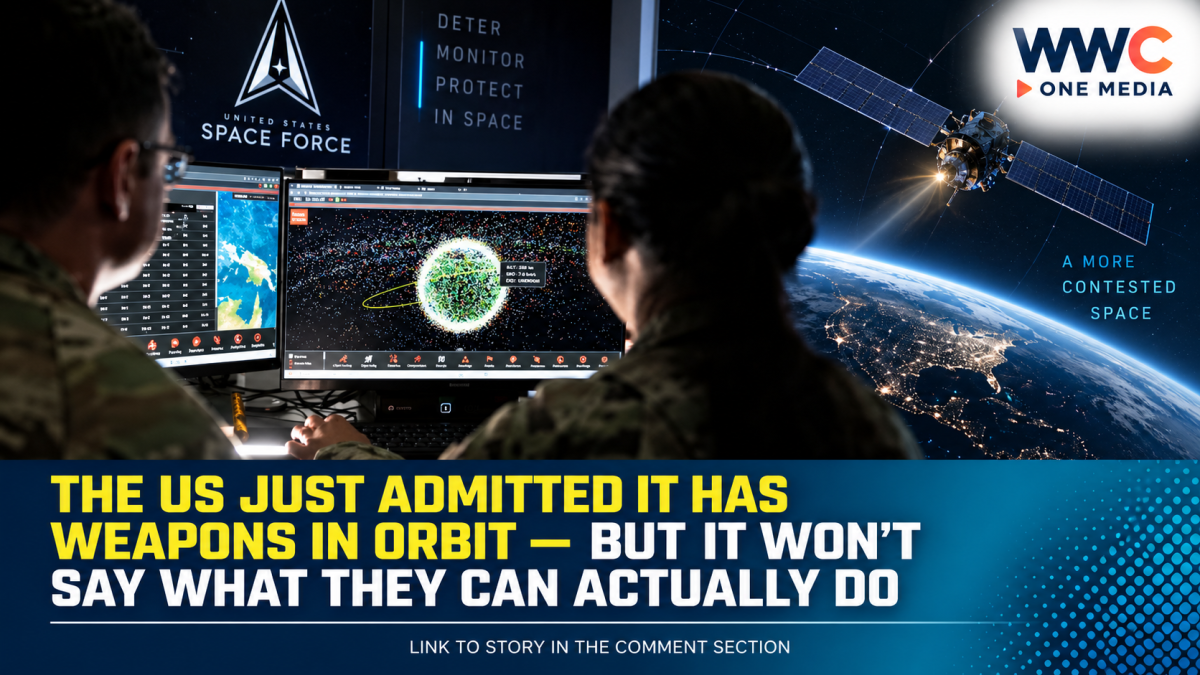
For the first time, the Pentagon has publicly acknowledged that the United States already has weapons deployed in Earth orbit.
Air Force Secretary Troy Meink said the U.S. Space Force now possesses “on-orbit space control weapons” capable of defending American forces against hostile actions. The admission was deliberate: Meink later said the wording had been carefully chosen, while declining to identify the systems or explain how they work.
A day later, senior U.S. military officials reinforced the message, describing the disclosure as important for deterrence as Washington confronts growing Chinese and Russian counter-space capabilities.
The announcement immediately produced a reaction from Beijing and Moscow.
China accused Washington of expanding its military buildup in outer space and urged the U.S. to avoid turning orbit into a battlefield. Russia warned that weaponisation could threaten long-term stability and the civilian infrastructure that increasingly depends on satellites.
But behind the dramatic headline is an enormous unanswered question:
What exactly did America put up there?
Washington confirmed the weapons — then classified almost everything else
Meink’s Sept. 14 statement at the Air, Space & Cyber Conference in Maryland was unusually explicit.
“The United States has on-orbit space control weapons capable of defending the Joint Force against hostile adversary action,” he said.
That sentence marks a significant change in public U.S. messaging.
American officials have discussed “counter-space” operations, orbital warfare and the need to defeat threats to satellites for years.
But Reuters said this week’s statements were the clearest public acknowledgement yet that the Pentagon is already operating weapons in orbit.
What officials did not disclose may be just as important.
They have not said:
- how many weapons are deployed;
- when they were launched;
- which orbital altitudes they occupy;
- whether they physically collide with targets;
- whether they use lasers;
- whether they interfere electronically with satellites;
- whether they can seize or move another spacecraft;
- or whether they are designed only to protect U.S. satellites rather than attack enemy ones.
Meink specifically declined to say whether the systems were kinetic or non-kinetic.
So images of missile-firing satellites should not be treated as confirmed descriptions of what the U.S. has deployed.
The Pentagon has admitted the capability exists.
It has not shown the public the weapon.
“Space weapon” does not necessarily mean an orbital missile
That distinction matters because warfare in orbit can take many forms.
A kinetic weapon could physically strike another spacecraft.
A non-kinetic system could potentially interfere with electronics, communications or sensors without smashing the target apart.
The U.S. Space Force’s own 2040 force-design document says its “Space Control” mission encompasses both offensive and defensive counter-space operations across kinetic and non-kinetic spectra.
It divides that mission into orbital warfare, electromagnetic warfare and cyberspace warfare.
That framework leaves a wide range of possibilities.
A satellite could conceivably manoeuvre close to another spacecraft.
A system might jam radio links.
A directed-energy device might interfere with sensors.
Cyber operations could attack command-and-control infrastructure.
Some approaches could be reversible.
Others could permanently disable or destroy a satellite.
Nothing in this week’s public announcement establishes which category the newly acknowledged U.S. weapons fall into.
The U.S. wants adversaries to know the capability exists — but not enough to counter it
That appears to be the logic behind the carefully limited disclosure.
Richard Palmer of U.S. Space Command told Reuters that acknowledging the capabilities is important to deterrence because potential adversaries need to understand that America can respond if its space systems are attacked.
But U.S. officials continue withholding technical details.
That creates what strategists call strategic ambiguity.
Tell competitors enough to make them cautious.
Do not tell them enough to design an easy countermeasure.
There is an obvious risk to that strategy.
If China and Russia do not know what the weapon does, they may assume a more threatening capability than Washington actually possesses.
Craig Albert of Augusta University told Reuters that incomplete information could lead competitors to invest in their own counter-space systems because they have to plan around the worst plausible interpretation.
In other words, secrecy can support deterrence.
It can also feed an arms race.
China responded within a day
Beijing’s response was direct.
Asked on Sept. 15 about the U.S. disclosure, Chinese Foreign Ministry spokesperson Guo Jiakun said China supports the peaceful use of outer space and opposes an arms race or attempts to turn space into a war zone.
He urged Washington to halt what Beijing describes as an expansion of military capabilities in orbit.
That is China’s stated diplomatic position.
It does not mean China lacks counter-space capabilities of its own.
Reuters reported that China has developed increasingly manoeuvrable spacecraft and in 2022 demonstrated an ability to use one satellite to grapple another spacecraft and reposition it in orbit. U.S. officials have cited such developments as evidence that American satellites need stronger protection.
Washington and Beijing therefore describe the competition very differently.
U.S. officials say they are responding to threats.
China says American deployments risk accelerating weaponisation.
Both sides portray their own policies as defensive while highlighting the other side’s capabilities.
Russia issued a similar warning
Russia’s Foreign Ministry said the American acknowledgement showed Washington was ignoring the potentially serious consequences of conflict in orbit.
Spokesperson Maria Zakharova argued that disruption of space infrastructure could affect economic and civilian services on Earth, not just militaries.
Washington has previously accused Russia of pursuing dangerous anti-satellite technology, including a potential space-based nuclear system.
Moscow has rejected Western allegations that it is driving weaponisation and has accused the U.S. of resisting proposals for broader bans on weapons in space.
Those claims remain part of a long-running diplomatic dispute.
What is not disputed is that all three major space powers increasingly treat satellites as strategic military assets that could become targets during a major war.
Ukraine changed the way militaries think about satellites
The reason is visible on modern battlefields.
Satellites are no longer peripheral military support systems.
They help provide communications.
They track troop movements.
They guide navigation.
They provide imagery.
They warn of missile launches.
They support targeting.
And commercial constellations can keep military forces connected even when terrestrial infrastructure has been damaged.
Reuters noted that wars in Ukraine and the Middle East have demonstrated how indispensable orbital systems have become to terrestrial warfare.
That creates a straightforward military incentive.
If a country’s armed forces depend heavily on satellites, an opponent may try to disrupt those satellites at the beginning of a conflict.
And if commanders expect that possibility, they begin building weapons to defend their orbital infrastructure — or to threaten the opponent’s.
The Space Force’s own force-design strategy explicitly says space capabilities now enable forces to sense, communicate, navigate, target and command globally.
The U.S. military is no longer pretending space is merely a support domain
The shift is visible in official doctrine.
The Space Force says its goal in “space control” is to preserve U.S. and allied freedom of action while, when necessary, denying an adversary the same freedom in particular regions for operationally relevant periods.
Its doctrine calls for integrating offensive and defensive orbital, electromagnetic and cyber capabilities when defensive measures are insufficient.
That language is considerably more direct than the way the U.S. military discussed space a decade ago.
The Pentagon is increasingly treating orbit the same way traditional armed forces treat land, air and sea:
as an operating domain that may need to be contested during war.
That does not mean war in orbit is inevitable.
It means the U.S. military is explicitly planning for the possibility.
The newly disclosed weapon is not the same thing as Golden Dome
This is one of the most important distinctions in the story.
President Donald Trump’s Golden Dome missile-defence initiative also calls for weapons in space, particularly space-based interceptors designed to destroy hostile missiles.
But those systems are still being developed.
Meink said the Space-Based Interceptor programme had moved from early contracting to flight-ready hardware in less than a year, while further testing and development continue.
Therefore:
The Space Force says it already has an orbital space-control weapon.
Golden Dome’s large constellation of missile interceptors is a different future capability.
Conflating the two would make the U.S. announcement sound much more specific than it really was.
Golden Dome shows just how expensive orbital warfare could become
Even the future missile-defence layer illustrates the extraordinary economics of putting weapons into orbit.
The Congressional Budget Office recently constructed a notional national missile-defence architecture — not an official Pentagon procurement plan — broadly consistent with administration objectives.
CBO estimated that such a system could cost roughly US$1.2 trillion over 20 years.
The most expensive element would be its hypothetical space-based interceptor layer.
CBO estimated approximately US$720 billion over two decades for a notional constellation of 7,800 interceptors, plus around US$1 billion annually to operate it. Because each satellite might last only about five years, the constellation would require continual replenishment.
Those figures should not be treated as the Pentagon’s actual Golden Dome budget.
CBO explicitly says the architecture is illustrative because the Defense Department’s final design remains uncertain.
But the estimate demonstrates something fundamental:
Orbital weapons do not become cheap merely because rocket launch prices have fallen.
Maintaining thousands of sophisticated spacecraft is an enormous long-term commitment.
The biggest danger may be debris
Physical destruction in orbit carries a problem that does not exist in quite the same way on land.
Debris stays up there.
If one satellite is shattered at orbital velocity, fragments can spread into paths used by other spacecraft.
Some pieces can remain in orbit for years.
Those fragments may threaten military satellites, commercial constellations, scientific missions and potentially crewed spacecraft regardless of who created them.
That is one reason many military planners are interested in non-destructive counter-space systems such as jamming, cyber effects or other reversible methods.
Germany, for example, has said its growing military-space programme will consider non-kinetic options while avoiding destructive orbital weapons that could create debris, according to Reuters.
The United States has not said whether its newly acknowledged system shares that approach.
The Outer Space Treaty does not ban every weapon in orbit
This is another area where headlines can easily become inaccurate.
The 1967 Outer Space Treaty does not categorically prohibit every conventional weapon from being placed in Earth orbit.
Article IV prohibits states from placing nuclear weapons or other weapons of mass destruction in orbit or otherwise stationing such weapons in outer space.
It also prohibits military bases, weapons testing and military manoeuvres on the Moon and other celestial bodies.
The treaty does not expressly impose the same blanket prohibition on conventional weapons orbiting Earth.
United Nations legal discussions have long acknowledged that gap.
Other principles of international law would still apply to military activity in space.
But simply saying “weapons in orbit violate the Outer Space Treaty” would be inaccurate unless the weapon fell into a prohibited category such as nuclear or another weapon of mass destruction.
Nothing publicly disclosed by Washington indicates that its newly acknowledged systems are nuclear weapons.
The U.S. has possessed anti-satellite capabilities before
This is also not the first time the United States has demonstrated an ability to destroy a satellite.
The U.S. Navy used a modified SM-3 missile launched from a ship to destroy a malfunctioning American satellite in 2008.
What makes the current disclosure different is where the weapon itself is located.
The Pentagon is now acknowledging a weapon already in orbit, rather than a terrestrial weapon that can reach an object in space.
That is the milestone.
No country is publicly known to have used one orbital weapon to destroy another country’s satellite in wartime
Despite years of testing, manoeuvres and escalating rhetoric, Reuters said no nation is known to have taken the particularly consequential step of physically attacking another state’s satellite in orbit.
That means the world is entering relatively untested territory.
Militaries understand conventional escalation on Earth through decades of doctrine and experience.
Orbital warfare has far fewer established rules.
What counts as an armed attack?
Does temporary jamming justify retaliation?
What if a satellite approaches another spacecraft but does not touch it?
What if an AI-controlled spacecraft makes an unexpected manoeuvre?
What if a military satellite shares infrastructure with civilian customers?
Those questions are becoming more urgent as spacecraft become more manoeuvrable and capable of interacting with one another.
The U.S. just held its biggest orbital exercise
This is not happening only in policy documents.
Reuters reported that the Space Force recently conducted Apollo Maneuvers, described as its largest orbital exercise.
The event involved spacecraft operating across multiple orbits along with international and commercial partners.
Exercises like this reflect a broader shift toward what military planners call dynamic space operations.
Historically, many satellites entered an orbit and then remained there with limited manoeuvring.
Future military spacecraft may need to change orbits, evade threats, approach other satellites or coordinate actions much more actively.
Orbit is becoming less like a parking lot.
And more like manoeuvre space.
Commercial companies are being pulled into the competition too
This creates another complication.
Much of today’s space infrastructure is not purely military.
Private companies operate communications satellites, imaging platforms, launch vehicles and enormous constellations.
The U.S. Space Force’s own doctrine specifically describes government, allied and commercial systems as part of its resilient architecture.
That can make military targeting more complicated.
A commercial satellite may simultaneously support ordinary consumers, businesses, disaster response and military customers.
If it contributes to military operations during a conflict, an opponent may view it differently from a purely civilian spacecraft.
The line between civilian and military space infrastructure is becoming increasingly blurred.
Europe is taking the threat more seriously as well
The space-security buildup is not confined to Washington, Beijing and Moscow.
Germany has announced a €35 billion military-space spending plan, with officials discussing new intelligence satellites, sensors and systems capable of interfering with adversary spacecraft.
European officials are also pushing for greater coordination among national satellite programmes, partly because fragmented systems could become a weakness during a crisis.
The message is increasingly global.
Countries that once viewed space mainly through civilian exploration and communications are now budgeting for it as a potential military theatre.
Why reveal the weapons now?
Washington has not provided a single definitive explanation.
Meink said acknowledging their existence contributes to deterrence but argued that disclosing technical details would undermine that objective.
The broader context offers several possible factors, though their relative importance is uncertain.
China is demonstrating increasingly sophisticated orbital manoeuvring.
Russia remains accused by Washington of pursuing anti-satellite systems.
Modern wars have demonstrated the military value of commercial and government satellites.
And the Space Force itself is shifting toward a doctrine that openly discusses orbital warfare and offensive counter-space operations.
The acknowledgement may therefore be intended to tell adversaries something very specific:
America’s satellites are not necessarily undefended targets.
Whether that message reduces or increases the chance of escalation remains contested.
China and Russia can now use the admission in their own arguments
That may be one consequence Washington cannot control.
China has long argued that it opposes weaponising outer space.
Russia has promoted proposals it says would prohibit weapons in orbit more broadly.
The United States has criticised some of those initiatives as incomplete or unverifiable while supporting other measures, including restrictions on destructive anti-satellite missile testing and nuclear weapons in orbit.
Now Beijing and Moscow can point directly to an official Pentagon acknowledgement that America itself operates orbital weapons.
Washington, meanwhile, can point to Chinese and Russian counter-space programmes as the reason those U.S. systems exist.
That is the classic security dilemma.
One side’s defence becomes the other side’s threat.
The second side builds its own defence.
And both insist the other moved first.
The milestone is less about one secret weapon than a disappearing taboo
That may ultimately be the most important part of this week’s announcement.
The U.S. military did not unveil a laser cannon.
It did not release photographs of an armed satellite.
It did not announce that a weapon had destroyed anything.
It did something subtler:
It stopped pretending that the existence of American weapons in orbit had to remain officially unspoken.
The Space Force now openly defines space control as involving offensive and defensive operations.
Its commanders train for contested orbital conditions.
Golden Dome is pursuing future space-based interceptors.
China and Russia are developing counter-space capabilities of their own.
Europe is increasing military-space investment.
And commercial satellites have become inseparable from modern military communications and intelligence.
The world has not yet seen a confirmed war in which spacecraft physically destroy one another in orbit.
But the preparations for one are becoming harder to hide.
America has now admitted the weapons are already up there.
The question it refuses to answer is what happens if anyone ever orders them to be used.




Leave a Reply