
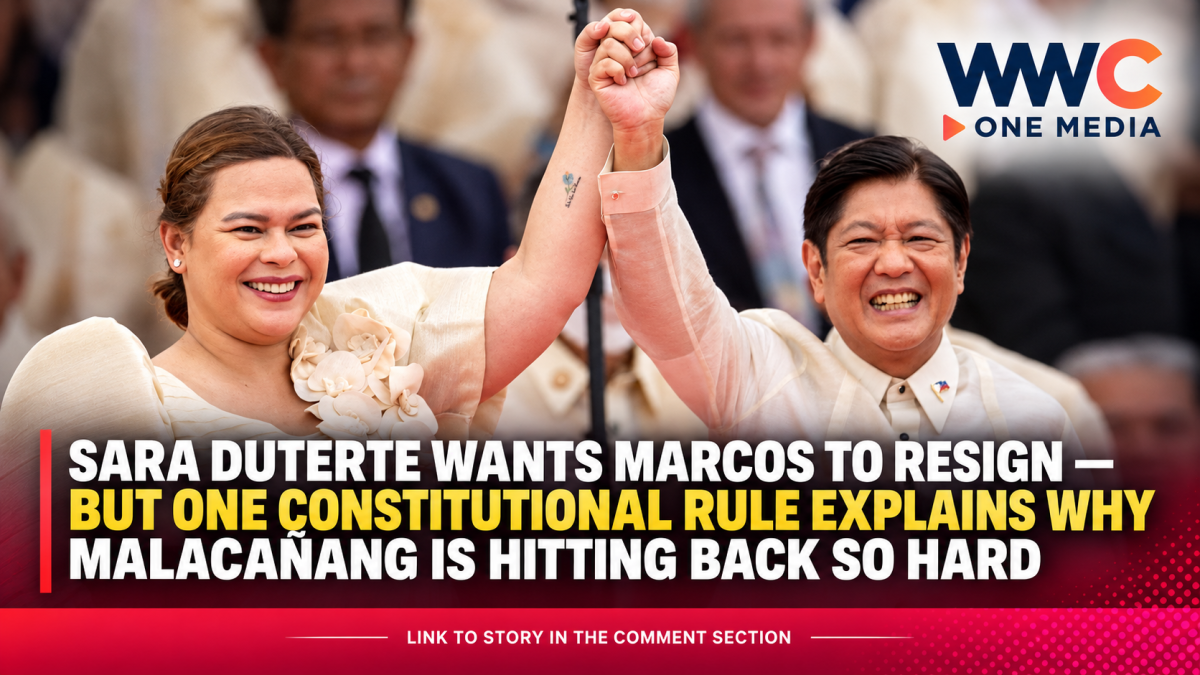
MANILA, Philippines — A political partnership that won the presidency and vice presidency together in 2022 has reached another extraordinary point: Vice President Sara Duterte is openly demanding President Ferdinand Marcos Jr.’s resignation, while Malacañang says her camp’s push is “absolutely delusional.”
The latest exchange unfolded over four days, beginning when Duterte told supporters on September 11 that Marcos should leave office and accused his administration of corruption, abuse and failing Filipinos.
Marcos responded two days later by portraying Duterte’s attacks as anger directed personally at him.
Duterte’s spokesperson then accused the President of trivializing serious allegations and declared him “not fit for office.”
By September 15, Palace Press Officer Claire Castro was firing back.
“The demand for the President to resign, without any legal basis, and in order to put in place the principal of the spokesperson, is definitely, absolutely delusional,” Castro said during a Palace briefing.
Behind the insults, however, is a serious constitutional reality.
If Marcos resigned, Duterte would become President automatically.
And that makes the dispute much more consequential than another exchange of political rhetoric.
Sara Duterte: Marcos should ‘resign’ and leave office
Duterte issued her call on September 11, after appearing at the Quezon City Hall of Justice for what had been scheduled to be her arraignment on three counts of grave threats.
The proceeding was deferred following a motion filed by her lawyers.
Speaking afterward to supporters, Duterte called Marcos the country’s “problem” and urged continued demands for him to leave office. She accused him of lying, corruption and abuse and said his administration had failed people struggling with issues including flooding and other difficulties.
Those were political accusations by Duterte; they were not findings by a court or investigative body in the context of her September 11 remarks.
She also tied her broader criticism of the administration to legal and political actions involving herself and members of the Duterte family, which she has characterized as harassment.
Malacañang has repeatedly rejected claims that Marcos personally controls the cases facing Duterte and has maintained that such proceedings should run through the courts and constitutional institutions.
Marcos’ response: ‘You cannot force anyone to love you’
When reporters in New Delhi asked Marcos about Duterte’s statements on September 13, the President declined to answer her accusations point by point.
Instead, he said he believed he had become the target of Duterte’s anger because of what she was going through.
“What can I do?” Marcos said, before adding: “You cannot force anyone to love you.”
The comment transformed the dispute again.
Rather than treating Duterte’s accusations as a substantive critique of government, Marcos framed the attacks as a personal reaction to her circumstances.
That interpretation angered Duterte’s camp.
Panelo: Marcos is ‘out of touch with reality’
On September 14, Duterte spokesperson Paolo Panelo Jr. accused Marcos of trivializing what the Vice President regarded as accusations involving corruption and abuses in government.
Panelo argued that reducing those claims to Duterte’s personal anger showed that Marcos was “out of touch with reality and not fit for office.”
He again called for the President to resign.
Panelo’s description of Marcos as “not fit for office” was a political assessment by Duterte’s spokesperson, not a medical or constitutional finding.
Likewise, Duterte’s accusations of corruption and abuse remain allegations unless supported and established through the appropriate investigative or judicial processes.
That distinction is especially important because both camps are increasingly using highly charged descriptions of one another.
Palace fires back: ‘Absolutely delusional’
Castro rejected Panelo’s argument during the September 15 Palace briefing.
She said Marcos’ “you cannot force anyone to love you” remark referred specifically to what the President regarded as Duterte’s personal anger toward him, rather than to allegations concerning broader government problems.
Castro then characterized the resignation demand as “absolutely delusional.”
She also argued that leading the country requires knowledge and preparation for issues including the West Philippine Sea and other strategic matters.
The Palace further suggested that Duterte’s camp had a direct political interest in Marcos leaving office because the Constitution places the Vice President next in the presidential line of succession.
That succession point is factually correct.
The political interpretation of Duterte’s motives is the Palace’s argument.
What actually happens if Marcos resigns?
The Constitution makes the succession process straightforward.
Article VII, Section 8 provides that in the event of the President’s death, permanent disability, removal from office or resignation, the Vice President becomes President and serves the remainder of the term.
So if Marcos voluntarily resigned while Duterte remained Vice President, there would be no new presidential election immediately.
Duterte would become President.
That helps explain why lawmakers allied with Marcos have portrayed her demand as politically self-interested.
House Deputy Speaker Paolo Ortega V, for example, told Duterte that she should resign first if she wanted to set an example.
House impeachment prosecutor Terry Ridon separately described Duterte’s demand as “self-serving,” pointing to the constitutional succession provision. That description is Ridon’s political interpretation, rather than a legal determination about Duterte’s motives.
Does a resignation call really need a ‘legal basis’?
This is where the Palace wording needs context.
There is no constitutional requirement that a citizen, politician or Vice President establish a legal case before calling on a President to resign.
Such a call is fundamentally political.
A President can voluntarily resign.
What Duterte cannot do simply by demanding resignation is legally compel Marcos to leave office.
If removal rather than voluntary resignation were sought, the Constitution provides other mechanisms, most prominently impeachment and conviction for the grounds listed in Article XI.
The Constitution also establishes a separate process for presidential inability under Article VII, Section 11.
So the constitutional distinction is:
Duterte can call for Marcos to resign. Marcos is not legally required to comply with that demand.
And unless a constitutional removal or incapacity process applies, the decision to resign remains the President’s.
The dispute comes while Duterte faces her own court case
The political fight is unfolding alongside a separate criminal proceeding involving the Vice President.
Duterte faces three counts of grave threats arising from statements made during a November 2024 online press briefing.
During that broadcast, Duterte said she had spoken to someone about killing Marcos, First Lady Liza Araneta-Marcos and then-House Speaker Martin Romualdez if she herself were killed.
A Quezon City court issued a warrant for her arrest on September 4, and Duterte posted bail the following day.
Her arraignment scheduled for September 11 was deferred after her lawyers sought the inhibition of the judge hearing the case.
On September 14, Quezon City RTC Branch 98 Judge Maria Angelica De Ramos rejected Duterte’s request that she recuse herself, finding insufficient evidence of actual bias or prejudgment.
Duterte’s lawyer Paul Lawrence Lim said the Vice President would pursue all available legal remedies.
The criminal case remains pending, and the filing of charges does not itself establish guilt.
An impeachment trial is unfolding at the same time
Duterte is also facing an impeachment trial in the Senate.
That proceeding is separate from the grave-threats criminal case and involves multiple allegations that must be judged on the evidence presented before the impeachment court.
The overlap of legal cases, impeachment proceedings and political confrontation helps explain the increasingly hostile rhetoric between the country’s two highest elected officials.
Marcos told reporters that he believes Duterte’s anger is linked to what is happening to her.
Duterte’s camp rejects that characterization and says her criticism concerns problems in government rather than a personal grievance.
Neither characterization establishes the other side’s motive as fact.
The ‘UniTeam’ partnership has been gone for more than two years
The confrontation is particularly striking because Marcos and Duterte campaigned together under the UniTeam banner in the 2022 elections.
Duterte joined Marcos’ Cabinet as Education secretary after their election.
But on June 19, 2024, she tendered her resignation as Education secretary and as vice chairperson of the National Task Force to End Local Communist Armed Conflict.
The resignation became effective July 19.
At the time, Malacañang said Duterte declined to give Marcos a reason for leaving the Cabinet.
Her departure was widely treated as a major public marker of the breakdown between the former allies, although political tensions between the Marcos and Duterte camps had already been escalating.
Two years later, the Vice President is no longer simply distancing herself from the administration.
She is openly asking its President to leave office.
The rhetoric is becoming increasingly personal
The latest exchange also demonstrates how far the dispute has moved beyond ordinary policy disagreement.
Duterte has used allegations concerning corruption, abuse and drug use against Marcos.
Marcos has suggested that Duterte’s attacks are driven by anger over her circumstances.
Panelo has called Marcos unfit for office.
Castro has described Duterte’s camp’s resignation push as “absolutely delusional.”
Those descriptions should be understood as statements by political adversaries, not neutral findings.
The factual questions underneath them are considerably narrower:
What evidence supports specific corruption allegations?
What decisions were made by Marcos himself?
What will courts decide in Duterte’s criminal proceedings?
What will senator-judges conclude in the impeachment trial?
Those matters require evidence rather than rhetoric.
The succession rule makes this fight different
Opposition politicians frequently demand that presidents resign.
What makes this confrontation unusual is who is making the demand.
Sara Duterte is not merely an opposition leader.
She is the constitutionally designated successor to Ferdinand Marcos Jr.
If he resigns, she does not simply gain political momentum.
She becomes President.
That does not prove that succession is Duterte’s motive for calling for his resignation.
It does mean the consequence of her demand is constitutionally clear.
And it explains why Malacañang and administration lawmakers have focused heavily on the question of who benefits if Marcos leaves office.
From ‘unity’ to a constitutional succession argument
In 2022, Marcos and Duterte sold voters a political partnership centered on unity.
In 2024, Duterte left the Cabinet.
By 2026, she was facing impeachment proceedings and a criminal case while openly calling for the resignation of the President with whom she won office.
Now Malacañang is answering by pointing directly to the constitutional consequence of that demand.
The rhetoric may continue escalating.
But the underlying legal position is simpler than the political fight surrounding it:
Marcos remains President unless he voluntarily resigns or another constitutional mechanism removes or displaces him. If he resigns while Duterte remains Vice President, she succeeds him for the remainder of the term.
Everything else—the accusations, counteraccusations and claims about motive—remains part of a political and legal struggle that is still unfolding.




Leave a Reply