
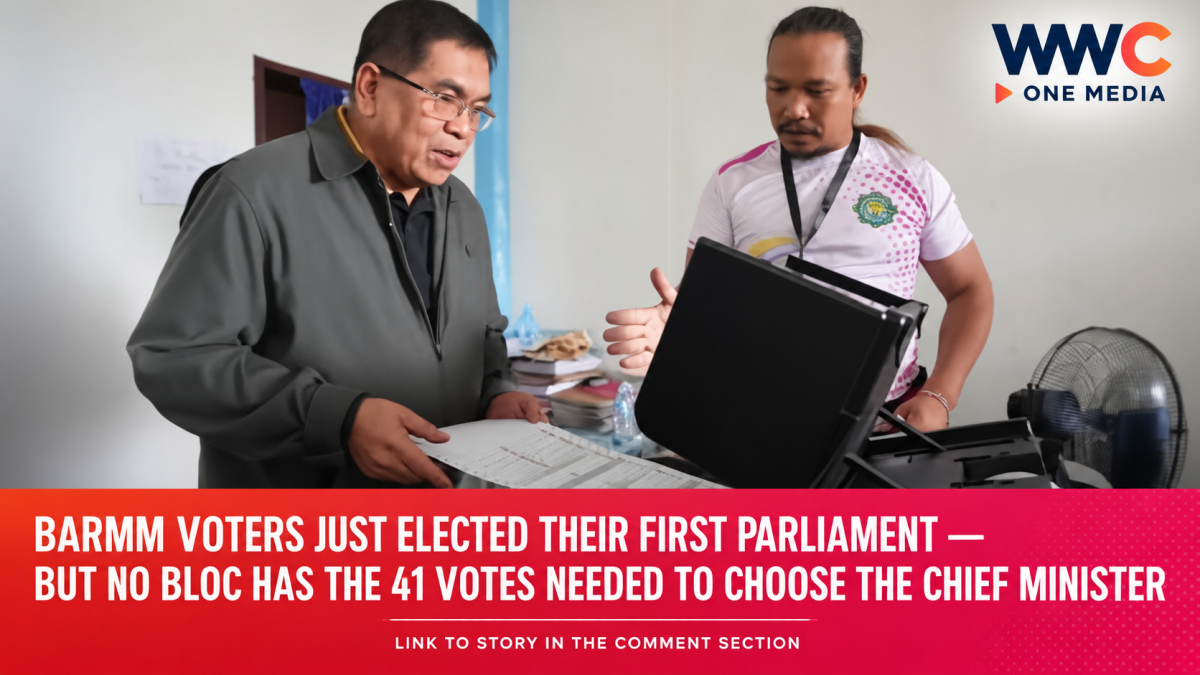
COTABATO CITY, Philippines — Bangsamoro voters have made history by electing their first regular regional parliament. But they did not hand any single political bloc enough seats to govern on its own.
That means the biggest decision in the Bangsamoro Autonomous Region in Muslim Mindanao may now be made not at a polling place, but inside the new 80-member Bangsamoro Parliament.
Results from the September 14 parliamentary election show a fragmented chamber in which no single party or aligned bloc has secured the 41 votes required to elect the region’s chief minister.
Under the Bangsamoro Organic Law, the chief minister is not directly elected by voters. Instead, members of Parliament choose the head of government by a majority vote of all 80 members. If nobody reaches a majority in the first ballot, the two candidates receiving the most votes advance to a runoff.
That makes coalition-building central to what happens next.
The election has therefore produced something unfamiliar in most Philippine politics: voters have chosen the legislature, but the legislature must still determine who controls the executive branch.
BFP gets 16 party seats, UBJP 15
The clearest official-style allocation so far concerns the 40 seats elected through regional proportional representation.
GMA News reported that the Bangsamoro Federalist Party, or BFP, secured 16 seats, while the United Bangsamoro Justice Party, or UBJP, obtained 15.
The BARMM Grand Coalition, or BGC, received eight, while the Raayat Democratic Party-Bangsamoro People’s Democratic Party secured one.
Those 40 seats represent only half of Parliament.
The full 80-member chamber consists of:
- 40 regional political-party representatives
- 32 parliamentary district representatives
- 8 sectoral representatives
That structure is required under the Bangsamoro Organic Law and implemented through the region’s electoral system.
The result is a Parliament that combines proportional party representation with constituency politics and guaranteed representation for selected sectors.
It also makes calculating political control more complicated than simply looking at which party received the most votes region-wide.
District seats changed the picture
BFP and UBJP both added lawmakers through the 32 single-member parliamentary districts.
For example, in Maguindanao del Norte, BFP candidates won three of the five proclaimed district seats, UBJP won one, while then-interim Chief Minister Abdulraof Macacua won the third district as an independent candidate.
In Lanao del Sur, the picture was very different.
Six of the nine district seats went to candidates from the Serbisyong Inklusibo-Alyansang Progresibo, or SIAP Party, while UBJP candidates won the other three.
In Tawi-Tawi, three of the four district winners came from BFP, while one seat went to a Pro Bangsamoro candidate.
In Maguindanao del Sur, UBJP won the first and second districts, BFP won the fourth and fifth, while an ITIHAD candidate won the third. The two seats in the Special Geographic Area went to UBJP candidates.
Those district victories matter because they can substantially alter each political grouping’s strength beyond the proportional-party vote.
Sectoral seats matter too
Another eight lawmakers enter Parliament through sectoral representation.
The Bangsamoro system reserves:
two seats for non-Moro Indigenous Peoples, two for settler communities, and one each for women, youth, ulama and traditional leaders.
Partial results reported by GMA showed UBJP-affiliated candidates leading several of the directly contested sectoral races, including representatives for women, youth, ulama and traditional leaders, as well as one of the settler-community positions.
Two non-Moro Indigenous Peoples representatives had already been selected through their prescribed sectoral process before election day.
This means the final balance of power cannot be understood solely by comparing BFP’s 16 regional-party seats with UBJP’s 15.
Every district, sectoral representative and independent lawmaker can matter when Parliament elects the chief minister.
Why 41 is the magic number
The Bangsamoro Organic Law is explicit.
The chief minister must be elected by a majority vote of all members of Parliament.
With 80 members, that means 41 votes.
If no candidate wins 41 votes in the first round, Parliament holds a runoff between the two candidates who received the largest number of votes.
This is fundamentally different from the presidential system used nationally in the Philippines.
A Philippine president can win a plurality of the nationwide vote and immediately possess a separate electoral mandate from Congress.
In BARMM, the executive government depends on maintaining sufficient support within Parliament.
That makes alliances, party discipline and legislative relationships especially important.
Why some reports call it a ‘hung parliament’
International news organizations including AFP and Reuters described the emerging result as a hung parliament, meaning no political grouping had enough seats by itself to command the required majority.
The term is common in parliamentary democracies.
It does not mean government has collapsed or the election has failed.
It means a party or bloc cannot form a majority government solely from its own seats and must instead obtain support from other lawmakers.
That support could take different forms depending on negotiations among elected members.
The Bangsamoro Organic Law establishes the voting requirement for chief minister but does not predetermine what coalition arrangements elected parties will make.
The two largest political forces share a complicated history
The contest is especially significant because BFP and UBJP are politically connected to the history of the Moro Islamic Liberation Front, or MILF, which spent decades fighting the Philippine government before signing the landmark 2014 peace agreement.
UBJP is the political party historically associated with the MILF.
BFP, established in 2026, includes figures who had previously been associated with UBJP and the MILF-led transition government. GMA described the new party as being composed primarily of former UBJP members.
Reuters similarly characterized BFP and UBJP as rival political formations emerging from divisions among figures linked to the former rebel movement.
One of the most prominent personalities is Abdulraof Macacua, who served as interim chief minister before the election and is associated with BFP.
Macacua contested the Maguindanao del Norte third parliamentary district as an independent and won the seat.
The UBJP, meanwhile, remains associated with former MILF chairman and former interim Chief Minister Al Haj Murad Ebrahim.
Those histories make the parliamentary negotiations significant beyond ordinary party competition: the new government will inherit institutions created through a peace process that transformed a separatist organization into participants in electoral politics.
The election is the end of a long transition
The September 14 election was the first regular parliamentary election in BARMM.
Until now, the region had been governed by the Bangsamoro Transition Authority, whose members were appointed rather than elected through the new parliamentary system.
BARMM emerged from the peace agreement reached between the Philippine government and the MILF in 2014.
Congress later enacted the Bangsamoro Organic Law in 2018, and voters ratified the new autonomous region through plebiscites in 2019.
The September election therefore represents a major institutional shift:
from a transitional authority created to build the new autonomous government to a Parliament chosen directly through the region’s own electoral system.
Nearly 2.4 million people were registered to vote. COMELEC-linked reporting indicated turnout of roughly 80 percent or more.
The electoral system was designed to prevent one kind of politics from dominating
BARMM’s parliamentary structure deliberately mixes several forms of representation.
Half the seats are awarded through proportional party voting.
Another 40 percent come from geographic parliamentary districts.
The remaining 10 percent represent designated sectors.
That makes the system very different from ordinary Philippine congressional elections.
Regional parties need at least 2.5 percent of valid party votes to qualify for representation under amendments adopted ahead of the 2026 election.
The lower threshold was intended to allow smaller political groups a greater opportunity to enter Parliament.
The election results demonstrate the consequence: the legislature can include major regional parties, smaller parties, local district organizations, independents and sectoral representatives simultaneously.
That diversity can broaden representation.
It can also make majority-building more complicated.
Election day was historic, but not entirely peaceful
The voting took place amid substantial security precautions.
More than 20,000 police and military personnel were deployed across the region, according to reporting ahead of the vote.
Deadly election-related incidents were reported around the polling period, including violence in Cotabato City, while authorities also confronted irregularities involving ballots in parts of Basilan.
COMELEC nevertheless said voting proceeded across most areas and described the overall election as successful.
In Maluso, Basilan, voting had to be extended after problems involving pre-marked ballots prompted election officials to take corrective action.
Transmission problems also delayed results from some precincts, particularly in Cotabato City, where weak communications signals required some election returns to be manually uploaded.
Those issues provide important context while final electoral documentation continues.
What happens now?
The public election determines who sits in Parliament.
The next constitutional step is different.
When the new Bangsamoro Parliament convenes, its members must elect the chief minister from among themselves.
That person will head the Bangsamoro government and appoint a Cabinet, a majority of whose members must come from Parliament.
The chief minister will also nominate two deputy chief ministers, who must themselves be elected by Parliament.
This means coalition negotiations can influence not merely who becomes chief minister, but potentially the distribution of executive and legislative responsibilities across the new government.
What those negotiations ultimately produce is not yet settled.
Statements by individual politicians about possible alliances should therefore be treated as negotiating positions until an actual parliamentary agreement or vote occurs.
BGC’s eight party seats could matter — but the final arithmetic goes beyond one party
The BARMM Grand Coalition secured eight of the 40 proportional seats, behind BFP and UBJP.
AFP and Reuters have highlighted BGC’s potential relevance to coalition discussions because neither of the larger political formations independently reached the 41-seat requirement.
But the chamber’s mathematics is broader than BGC alone.
District representatives from SIAP, Pro Bangsamoro, ITIHAD and other political groups, independents, and the eight sectoral representatives also form part of the 80-member Parliament.
That means several different combinations of lawmakers could theoretically supply the votes needed for a chief minister.
Which combination actually emerges will depend on negotiations and the formal parliamentary vote—not simply on the regional party rankings.
A parliamentary system makes the post-election period part of the political process
For voters accustomed to Philippine presidential elections, the absence of an immediately obvious executive winner may seem unusual.
But it is a normal possibility in parliamentary systems.
The electorate has already decided who will sit in Parliament.
Those elected lawmakers must now perform the second part of the process: determining which member can command majority support to lead the regional government.
That process was built into the Bangsamoro Organic Law from the beginning.
The coming negotiations therefore are not an extension of election day or an electoral irregularity.
They are part of how the Bangsamoro system was designed to work.
The stakes reach beyond who becomes chief minister
The first elected Parliament will inherit major unfinished responsibilities from the transition period.
BARMM remains central to the peace agreement that sought to end decades of conflict between the Philippine state and Moro separatist movements.
The autonomous government also faces continuing challenges involving economic development, poverty reduction, infrastructure, security, governance reform and the remaining elements of the normalization process connected to the peace agreement.
The region recorded economic growth of 5 percent in 2025, according to context cited by Reuters, but continues to confront development gaps rooted in decades of conflict and underinvestment.
That makes the formation of the first elected regional government more consequential than a routine change in political leadership.
The Parliament being assembled now will be the first to operate with a direct electoral mandate under the system envisioned by the Bangsamoro peace settlement.
The election is over. The majority is not yet assembled.
The September 14 vote answered one historic question:
Would Bangsamoro voters successfully elect their first regular Parliament after years of transitional rule?
They did.
But the results created another question immediately afterward.
Who can bring together at least 41 of the chamber’s 80 members?
BFP emerged with the largest allocation of proportional seats at 16.
UBJP received 15.
BGC obtained eight.
Raayat received one.
District and sectoral representatives complete the Parliament.
None of those party-list figures alone produces a governing majority.
So for the first time in BARMM history, the decisive political arithmetic is moving from ballots to Parliament.
Voters have chosen their representatives.
Those representatives must now choose who governs.

Leave a Reply