
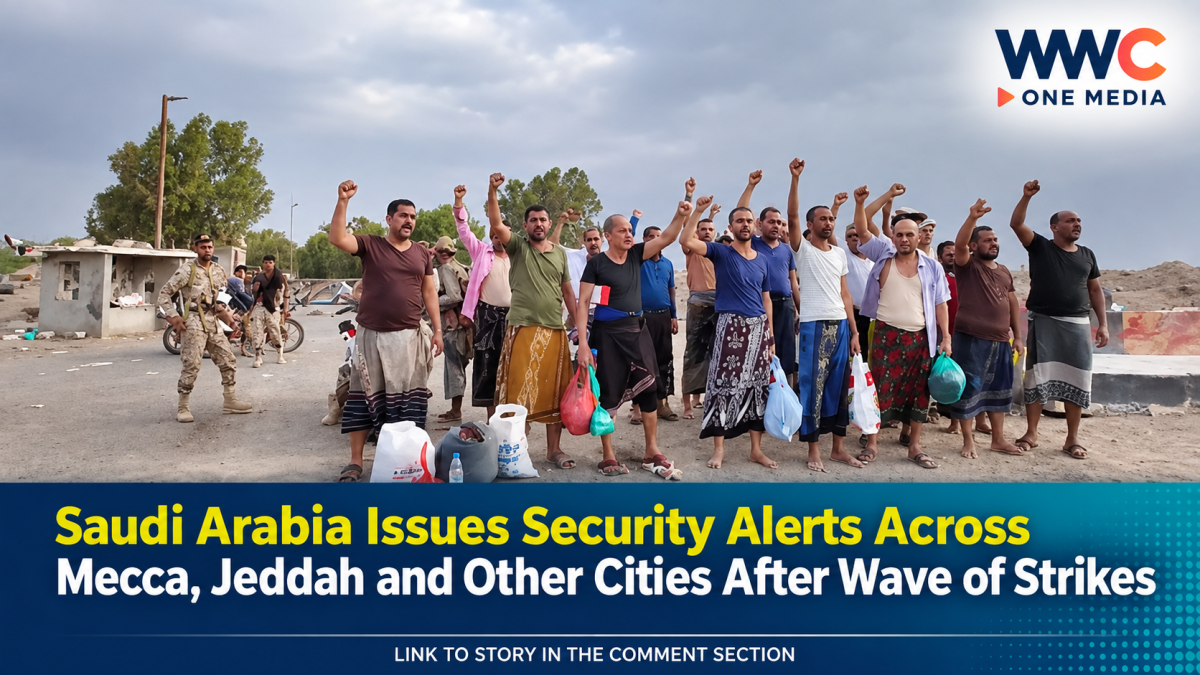
Saudi Arabia issued a series of emergency security alerts across several parts of the kingdom, including Mecca and Jeddah, following a week of escalating attacks linked to Yemen’s Iran-aligned Houthi movement. The warnings were later lifted, but the incidents highlight how rapidly the Middle East conflict is spreading toward Saudi territory.
RIYADH/DUBAI — Saudi Arabia issued unusually wide-ranging public safety alerts on Tuesday, September 15, warning residents of potential danger across multiple locations, including the holy city of Mecca and the kingdom’s second-largest city, Jeddah.
The alerts were subsequently lifted, with Saudi authorities issuing all-clear messages in several affected areas. Officials did not immediately confirm whether incoming projectiles had struck the areas covered by the warnings.
The alerts came after days of attacks involving drones and missiles and as Saudi Arabia has become increasingly involved in the widening conflict surrounding Yemen and the Red Sea.
Mecca included in security warning for the first time in the current conflict
The inclusion of Mecca in Tuesday’s warnings drew particular attention because of the city’s religious significance.
Saudi authorities have treated any threat to the city as exceptionally serious. On September 16, Saudi-led coalition spokesman Turki al-Malki said Saudi forces had intercepted and destroyed a Houthi drone south of Mecca before it could enter restricted airspace around the city.
Al-Malki described the security of Mecca as a “red line” and warned that Saudi Arabia would take deterrent measures against the Houthis.
The Houthis, however, denied targeting Mecca or other religious sites while claiming responsibility for other attacks against Saudi targets.
Security alerts spread across Saudi Arabia
The September 15 warnings were not limited to the country’s southern border.
According to Reuters, alerts were issued across a broad area, including Mecca and Jeddah, following a series of attacks during the preceding week.
The warnings were lifted relatively quickly, and Saudi authorities did not immediately announce that any projectiles had hit the locations covered by the alerts.
Saudi Civil Defence had already issued and lifted warnings several times during the preceding days.
On September 14, authorities issued alerts covering four southern cities before declaring that the danger had passed. Earlier, warnings were also issued around other southern areas as Houthi attacks intensified.
Houthis say attacks are retaliation for Saudi strikes
The Houthis have claimed that their attacks on Saudi targets are retaliation for Saudi-led military operations against Houthi positions in Yemen.
The conflict has intensified as Houthi forces have expanded their presence along Yemen’s Red Sea coast.
Reuters reported that the Houthis had seized strategically important territory and islands near the Bab el-Mandeb Strait, one of the world’s most important maritime chokepoints.
The developments are particularly significant for Saudi Arabia because the Red Sea provides an alternative route for some of the kingdom’s oil exports when shipping through the Strait of Hormuz becomes difficult.
Saudi oil infrastructure has also been hit
The security concerns extend beyond cities.
A strike on September 11 damaged Saudi Arabia’s East-West oil pipeline, according to Reuters reporting and satellite imagery reviewed by the news agency.
The pipeline is strategically important because it allows Saudi crude to be transported from the country’s eastern oil-producing region to ports on the Red Sea, providing an alternative export route that bypasses the Strait of Hormuz.
The attacks have therefore raised concerns about the security of both Saudi infrastructure and global energy supplies.
Reuters reported that shipping traffic through the Strait of Hormuz had fallen sharply amid the broader regional conflict. On Monday, only four commodity vessels were recorded transiting the waterway, compared with a pre-war average of around 125 daily transits.
A wider threat to global oil supplies
The latest developments come as the Middle East faces simultaneous pressure around two major maritime chokepoints: the Strait of Hormuz and Bab el-Mandeb.
Hormuz is crucial for global oil and liquefied natural gas shipments, while Bab el-Mandeb connects the Red Sea with the Gulf of Aden and the wider Indian Ocean.
The Houthi advance toward the Bab el-Mandeb region has raised concerns about another major disruption to energy and commercial shipping.
The Guardian reported that the Houthis had captured the Greater and Lesser Hanish islands as well as other strategic positions near the shipping route. The developments have increased concerns over Saudi oil exports and international energy markets.
Why the latest Saudi alerts matter
The latest warnings do not necessarily mean that Saudi Arabia has suffered a new attack in every location where an alert appeared.
Emergency alerts can be issued when authorities detect a potential threat before determining where, or whether, a projectile will land.
That distinction is important because some of the warnings issued during the past week were later followed by official all-clear messages.
However, the frequency and geographic spread of the alerts demonstrate how the security situation has changed.
Saudi Arabia had already experienced repeated attacks during the wider regional conflict, but the latest wave has increasingly involved the kingdom’s major cities, energy infrastructure and areas far from the traditional Saudi-Yemeni border conflict.
What happens next?
Saudi Arabia now faces pressure on several fronts: attacks from Houthi forces in Yemen, threats to oil infrastructure, instability around the Red Sea and the possibility of further disruption to international shipping.
The situation is also unfolding as diplomatic efforts over regional shipping security continue.
For now, Saudi authorities have lifted several of the emergency warnings issued over the past few days. But the September 15 alerts — particularly the inclusion of Mecca and Jeddah — show that the security risks associated with the expanding conflict are no longer confined to Saudi Arabia’s southern frontier.
SEO Keywords
Saudi Arabia security alert, Saudi Arabia latest news, Mecca security alert, Jeddah security alert, Saudi Arabia Houthi attacks, Houthis Saudi Arabia, Saudi Arabia missile attack, Saudi Arabia drone attack, Mecca drone attack, Saudi oil pipeline attack, Red Sea conflict, Bab el-Mandeb, Strait of Hormuz, Middle East conflict 2026, Saudi Arabia news today
SEO Headline
Saudi Arabia Issues Security Alerts Across Mecca and Jeddah After Wave of Houthi Strikes
Alternative Viral Headline
Saudi Arabia on High Alert: Mecca and Jeddah Among Cities Hit by Emergency Warnings After Houthi Attacks
Meta Description
Saudi Arabia issued wide-ranging security alerts covering Mecca, Jeddah and other areas after a week of Houthi attacks. Here’s what happened and why the latest escalation matters for Saudi oil and global shipping.




Leave a Reply