
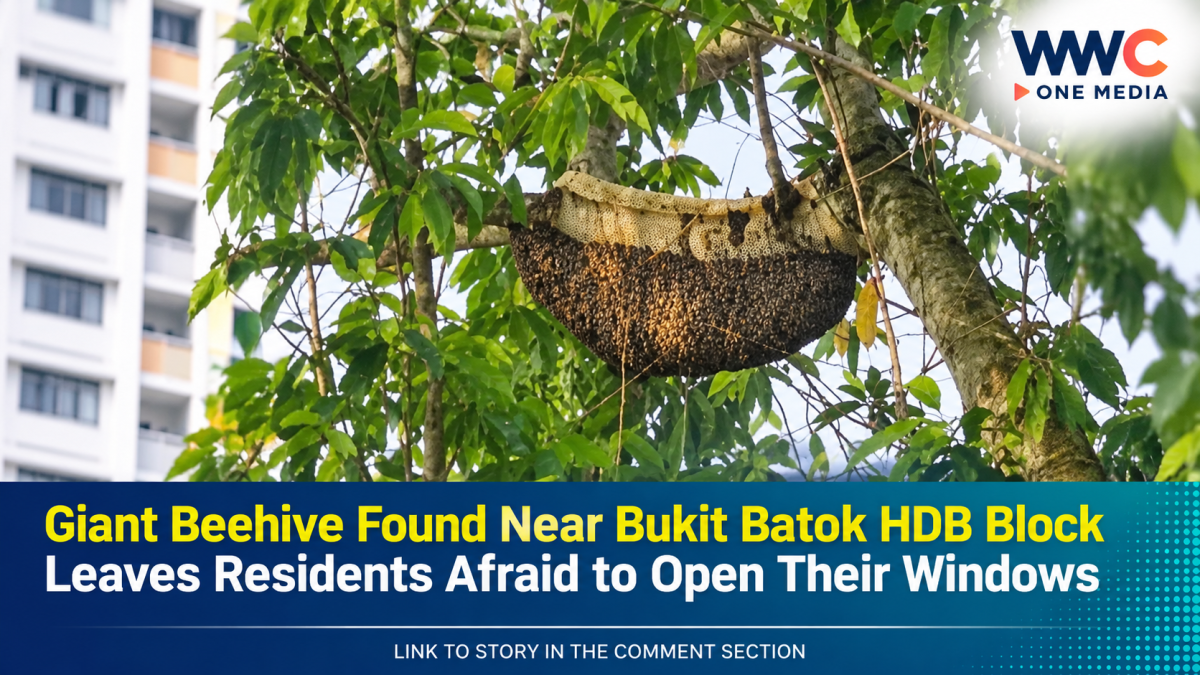
Residents at a Bukit Batok HDB estate were left alarmed after a huge swarm of bees appeared around their homes, with a large beehive discovered high in a tree just metres from their windows.
SINGAPORE — Residents of a Bukit Batok HDB block have been dealing with an unexpected problem after a large swarm of bees began hovering around their homes, forcing some residents to keep their windows and doors shut.
The bees were linked to a sizeable beehive found high on a tree outside the residential block, according to reports by Shin Min Daily News and subsequent coverage by The Independent Singapore.
The incident has raised concerns among residents, particularly those living on higher floors who found bees flying close to their units.
Residents spot ‘blackout’ outside their windows
A 75-year-old resident living on the ninth floor reportedly first became aware of the problem after a neighbour alerted her to what appeared to be a dark patch outside the window.
Her grandson later discovered that the apparent “blackout” was actually a large number of bees swarming around a tree.
A beehive was subsequently spotted on a branch roughly seven storeys above ground level.
The hive was reported to be around 30cm wide — substantial enough to attract a large swarm that residents could see from their flats.
For residents living nearby, the discovery was more than just an unusual sight.
Some were worried that the bees could enter their homes.
‘We can’t even open the windows’
One resident said the situation had become particularly frustrating because of Singapore’s hot weather.
With bees flying around the building, residents were reluctant to open their windows for ventilation.
Another resident living on the sixth floor said she had already noticed bees entering her home about a week earlier.
The discovery of the hive appeared to provide an explanation for why the insects had repeatedly been turning up inside the flats.
When reporters visited the area, bees were still seen around the block, with many reportedly gathering underneath illuminated corridor lights.
Residents turn to OneService for help
The residents reported the problem to the town council through Singapore’s OneService platform and hoped the authorities would take action to address the swarm.
The concern was not simply about inconvenience. A large active bee colony close to residential units can create a potential safety issue, particularly for people who may be allergic to bee stings.
However, the presence of a large hive does not automatically mean that the bees are attacking residents.
The reported incident involved bees gathering around the hive and flying around nearby areas; the available reports do not establish that residents were attacked or seriously injured.
The ‘1-metre beehive’ is actually a different Singapore case
The Bukit Batok story has also become confused online with another recent bee-related incident in Singapore.
A separate Yishun case involved a giant beehive reported to have stretched more than a metre. Residents in that case reportedly became so concerned about the swarm that they used protective measures while attempting to deal with the infestation, and pest-control workers were subsequently involved.
That means the headline “nearly 1m-long beehive in Bukit Batok” would be misleading.
For accuracy, the Bukit Batok hive should be described as approximately 30cm wide, based on the available reporting.
Experts warn against disturbing bee colonies
Although the sight of thousands of bees outside an HDB block can be frightening, residents should avoid attempting to remove an active hive themselves.
Bees can become defensive if their colony is disturbed, and attempting to knock down or spray an established hive can increase the risk of stings.
The safer approach is to keep windows and doors closed if bees are entering the home and report an established hive or significant swarm to the relevant estate or pest-management authorities.
Singapore also has groups that specialise in bee rescue and relocation, reflecting the fact that not every bee colony needs to be exterminated.
Why the bees may have gathered there
Honey bees form colonies around a queen and can establish new nests when a swarm leaves an existing colony in search of a new nesting location.
Trees can provide suitable temporary or permanent locations, particularly where there is shelter from rain and exposure to sunlight.
In the Bukit Batok case, however, the available reports do not establish exactly when the colony arrived or why it selected that particular tree.
A worrying sight — but also a reminder of Singapore’s wildlife
For residents accustomed to seeing birds, insects and other wildlife around HDB estates, a large bee colony can be an especially startling sight when it appears directly outside a high-rise home.
The Bukit Batok incident shows how wildlife can sometimes establish itself surprisingly close to densely populated residential areas.
For the affected residents, however, the immediate priority is safety — and finding a way to deal with the hive without putting people or the bees at unnecessary risk.




Leave a Reply