
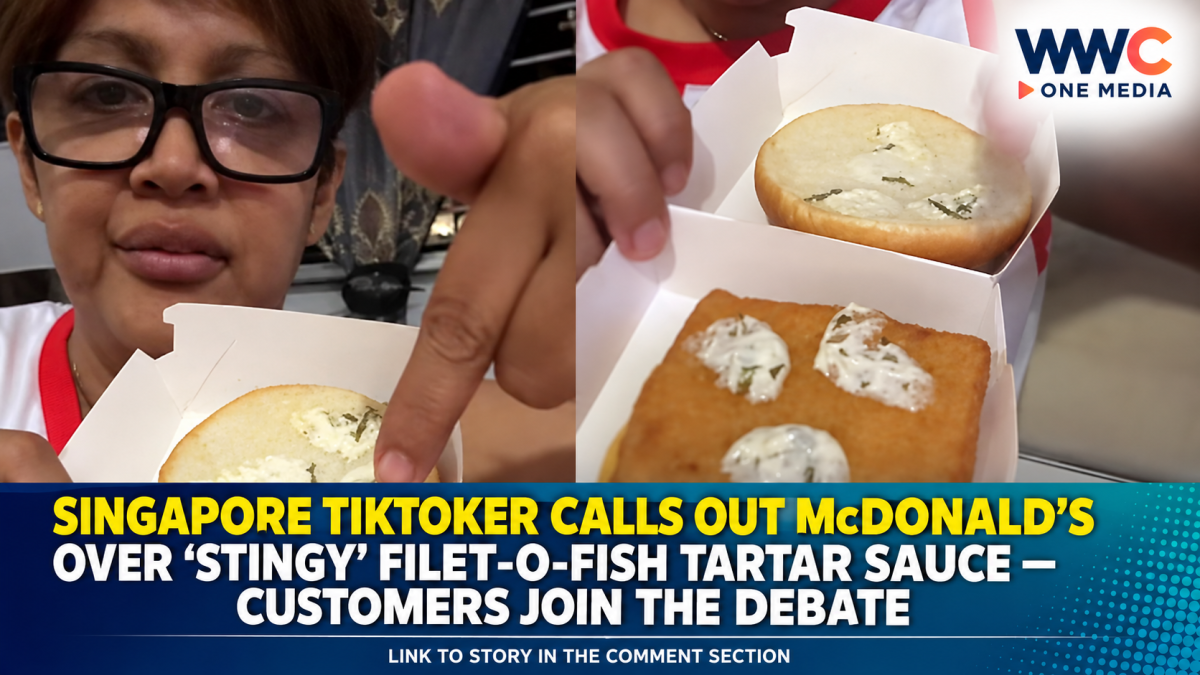
A Singapore TikToker has sparked an online debate after calling out McDonald’s over what he described as an unusually small amount of tartar sauce in a Filet-O-Fish.
The complaint has struck a familiar nerve among fast-food customers, with some online commenters questioning whether the amount of sauce served with the popular fish burger has become noticeably less generous.
The issue may sound minor, but for Filet-O-Fish fans, the tartar sauce is a key part of the sandwich — and the viral post has prompted others to share their own experiences with McDonald’s portions and condiments.
TikToker questions the amount of tartar sauce
The TikToker’s complaint centres on the amount of tartar sauce accompanying his Filet-O-Fish.
In the video, he appeared dissatisfied with the portion and questioned whether customers were getting enough sauce for the price of the burger.
The post quickly attracted attention because the Filet-O-Fish is particularly dependent on its combination of fried fish, steamed bun, cheese and tartar sauce.
The complaint, however, is a customer’s observation rather than evidence that McDonald’s Singapore has officially reduced its standard tartar-sauce portion.
Filet-O-Fish has long been associated with tartar sauce
McDonald’s Filet-O-Fish has been on the chain’s menu for decades. The sandwich was created in 1962 by McDonald’s franchisee Lou Groen in Cincinnati, Ohio, and was originally developed to attract customers who avoided meat on Fridays.
Its core combination has remained broadly recognizable: a breaded fish fillet, steamed bun, cheese and tartar sauce.
In Singapore, McDonald’s describes its Filet-O-Fish as a white-fish fillet served with tartar sauce, half a slice of cheese and a steamed bun. Current delivery listings also show the burger as a regular menu item.
That makes the sauce more than an optional extra for many customers — it is one of the defining components of the burger.
Singapore customers have complained about McDonald’s portions before
The latest complaint is not the first time McDonald’s Singapore has faced online discussion over portions, presentation or condiments.
In 2021, Singapore-based social media account McSenget gained attention by collecting photographs of badly aligned McDonald’s burgers, with Filet-O-Fish burgers frequently appearing among the examples.
Other customers have also taken to social media to complain about missing or insufficient condiments.
In one earlier case, a customer at McDonald’s Parklane questioned why she could not obtain curry sauce with a four-piece McNuggets order. McDonald’s Singapore’s stated condiment policy indicated that six-piece nuggets and larger orders qualify for at least one sauce, while four-piece nuggets can receive one sauce upon request. Additional sauces could also be purchased separately.
Recent customer reviews on food-delivery platforms likewise contain complaints about missing or insufficient sauces and condiments, although these individual reviews do not establish a company-wide change in portion sizes.
Is McDonald’s actually using less tartar sauce?
There is an important distinction between a viral customer complaint and a confirmed change in McDonald’s recipe or serving standard.
At present, the viral complaint does not by itself establish that McDonald’s Singapore has officially reduced the amount of tartar sauce in its Filet-O-Fish.
Portion appearance can also vary depending on how the sauce is dispensed and how the burger is assembled.
Unless McDonald’s Singapore confirms a change to its preparation standards, it would be premature to describe the incident as proof that the chain has reduced its tartar-sauce portions.
Why the complaint is striking a chord
The reaction appears to be about more than a single burger.
Singapore consumers have increasingly discussed food prices, portion sizes and the value they receive for their money. That has made photographs and videos showing apparently small portions particularly effective at generating online debate.
McDonald’s has also faced a number of viral Singapore food-related incidents over the years, ranging from complaints about condiments to unusual outlet experiences.
In May 2026, for example, another Singapore customer posted a TikTok after allegedly being told to wait around 20 minutes at the Bendemeer outlet because of a staff shift change. The incident prompted mixed reactions online, with some commenters defending the restaurant and others sympathising with the customer.
The recurring pattern is clear: everyday experiences at a major fast-food chain can quickly become social-media talking points when customers feel the service or portion does not match their expectations.
The Filet-O-Fish debate is nothing new
The fish burger has also generated plenty of discussion outside Singapore.
One recurring point of debate is its half-slice of cheese. That arrangement is intentional rather than the result of an accidentally small cheese portion; McDonald’s has explained that the smaller amount is intended to prevent the cheese from overpowering the fish.
Singapore customers have similarly debated the burger’s construction and portion sizes for years, particularly because the Filet-O-Fish is relatively simple compared with many of McDonald’s other burgers.
With fewer ingredients, every component — including the tartar sauce — becomes more noticeable.
So, is the Filet-O-Fish really getting stingier?
That depends on what customers are comparing.
The TikToker’s video shows his individual experience and has prompted others to discuss their own orders. But those anecdotes should not be treated as proof of an official McDonald’s policy change.
What is confirmed is that the Filet-O-Fish remains a standard McDonald’s Singapore menu item made with a fish fillet, tartar sauce, half a slice of cheese and a steamed bun.
For customers, however, the viral question remains simple:
When you pay for a Filet-O-Fish, how much tartar sauce is enough?
And judging from the online reaction, even a small squeeze of sauce can become a surprisingly big conversation.




Leave a Reply