
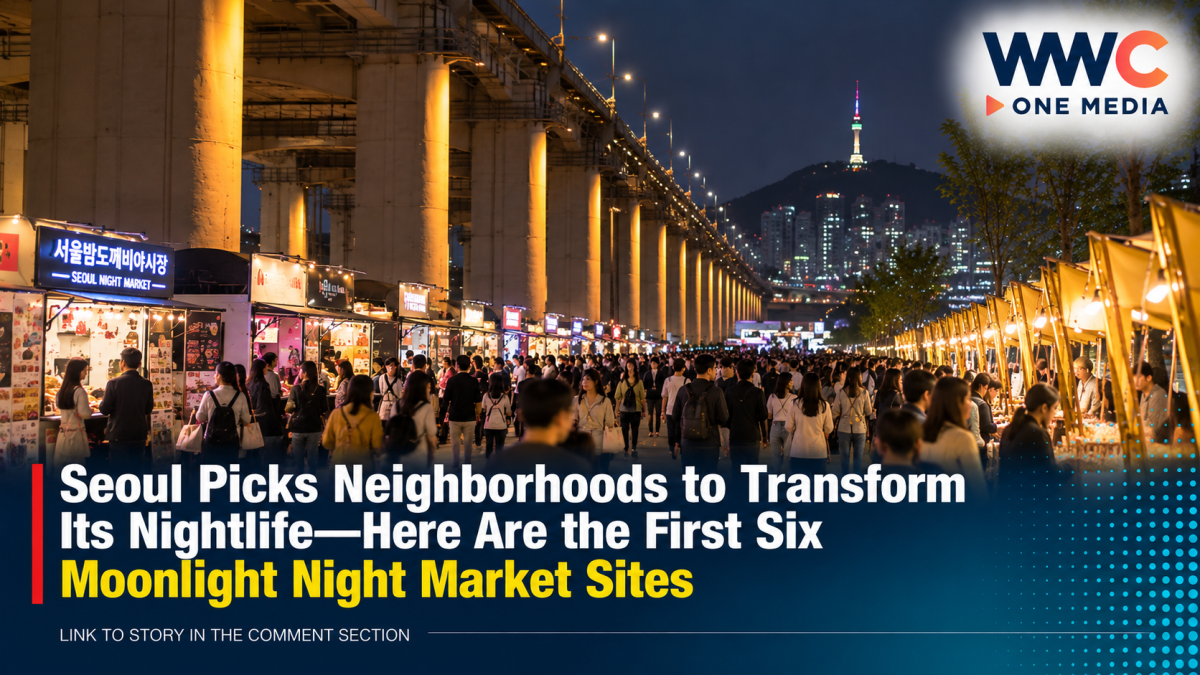
SEOUL WANTS ITS NEIGHBORHOODS TO COME ALIVE AFTER DARK
Seoul is taking its nighttime economy beyond the city’s biggest tourist districts.
The Seoul Metropolitan Government has selected the first six commercial areas for its new 2026 Seoul Moonlight Night Market program, an initiative designed to transform neighborhood streets into evening destinations filled with food, culture and local experiences.
The project is part of Mayor Oh Se-hoon’s broader strategy to strengthen Seoul’s nighttime economy by encouraging people to spend more time—and money—in local commercial districts after dark.
Rather than concentrating nighttime activity in famous areas such as Myeong-dong or Hongdae, the initiative aims to give neighborhood businesses a bigger share of Seoul’s evening economy.
SIX AREAS MAKE THE FINAL CUT
The final six locations selected after a citizen-participation evaluation are:
- Kondae Taste Street in Gwangjin District
- Sadang Entertainment Moonlight Night Market District in Gwanak District
- Chang-dong Station Commercial Area in Dobong District
- Sangbong Food Alley in Jungnang District
- Serosugil in Gangnam District
- Sadang 1-dong Food Alley in Dongjak District
These areas were chosen from 10 candidate locations that made it through the initial document review. The final selection was made through a citizen-participation evaluation held at Seoul City Hall on September 14.
That distinction is important: headlines describing Seoul as having “picked 10 night markets” refer to the 10 shortlisted candidates, while the final 2026 project currently starts with six selected districts.
WHAT WILL THESE NIGHT MARKETS ACTUALLY DO?
The program is designed to connect restaurants, local cultural resources and tourism attractions rather than simply placing food stalls on streets.
Seoul wants the selected areas to develop outdoor dining spaces, nighttime streetscapes and cultural programming that can encourage both residents and visitors to stay longer in the neighborhoods.
The goal is essentially to turn existing commercial districts into places where the evening itself becomes part of the attraction.
For local merchants, that could mean more customers during hours when some neighborhood streets traditionally become quieter.
FROM UNIVERSITY STREETS TO FOOD ALLEYS
Each selected area brings a different identity to the project.
Kondae Taste Street, located near Konkuk University and a major transportation hub, already attracts a large young population. Seoul sees an opportunity to combine its existing dining culture with nighttime market content aimed at younger visitors.
Sadang’s location near subway Lines 2 and 4 and metropolitan bus connections gives its nighttime district a strong transportation advantage. The plan also seeks to connect food and cultural experiences with nearby attractions.
Meanwhile, Chang-dong Station has been recognized for its potential to combine local food with culture, including the growing entertainment ecosystem around Seoul Arena.
Sangbong Food Alley already has a strong concentration of restaurants and pubs, while local cooperation between residents and merchants was cited as one of its strengths.
The two Gangnam and Dongjak selections—Serosugil and Sadang 1-dong Food Alley—will add further variety to the project, showing that the initiative isn’t limited to one type of neighborhood.
SEOUL IS PUTTING SERIOUS MONEY BEHIND THE IDEA
The city plans to provide selected districts with up to ₩2 billion in support, including resources for improvements and promotion.
The investment is part of a much larger plan: Seoul wants to expand the Moonlight Night Market concept from the initial locations to 25 districts by 2028.
The city is also planning a “Moonlight Love Gift Certificate” connected with the project, according to Asiae, adding a consumer-spending component to the effort to strengthen neighborhood commercial districts.
WHY SEOUL IS BETTING ON THE NIGHTTIME ECONOMY
The initiative reflects a broader shift in how major cities think about urban activity.
A neighborhood doesn’t necessarily have to compete with Seoul’s biggest tourist attractions during the day. Instead, it can build its own identity around evening dining, culture, entertainment and community activity.
That could be particularly valuable for smaller businesses that depend heavily on local customers.
Seoul’s strategy is therefore about more than creating another night market. It is an attempt to make ordinary neighborhood streets part of the city’s nighttime tourism and economic ecosystem.
THE BIGGER PLAN: A CITY THAT DOESN’T SHUT DOWN AFTER DARK
Seoul already has a reputation for late-night food, shopping and entertainment. The new program takes that culture and pushes it deeper into local neighborhoods.
If successful, the Moonlight Night Market project could give residents more reasons to stay close to home while giving visitors new areas to explore beyond Seoul’s established tourist hotspots.
The first six districts will effectively serve as a test of whether Seoul can turn its existing neighborhood businesses and cultural assets into sustainable nighttime destinations.
And if the strategy works, today’s six could become the blueprint for 25 nighttime districts across Seoul by 2028.
Seoul isn’t simply trying to make its nights brighter—it is trying to make more of the city worth staying out for.


Leave a Reply