
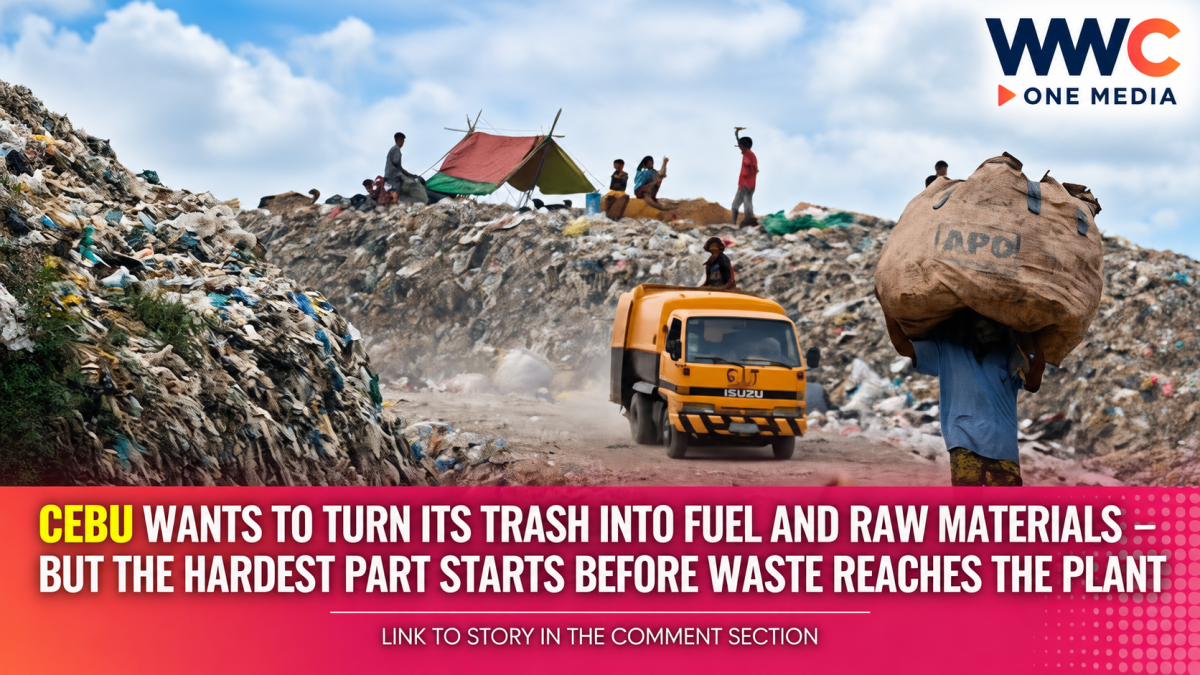
CEBU, Philippines — Cebu is studying a radical change in how it handles one of its most stubborn problems: instead of treating garbage simply as something to haul away and bury, the province wants to build an integrated industrial system that could turn discarded plastics, food waste, used oil, electronic waste and other materials into fuel, recycled raw materials and potentially other commercial products.
The Cebu Provincial Government and Japanese environmental company GUUN Co. Ltd. formally launched a feasibility study on September 11 for a proposed Green Transformation, or GX, Park, an eco-industrial waste-management hub designed around the principles of resource recovery and the circular economy.
The concept is ambitious.
Rather than relying primarily on landfills, the proposed GX Park would bring different waste-processing activities together in one coordinated system—sorting materials, recovering recyclables, treating residual waste and converting some of what remains into usable products or alternative fuels.
But Cebu officials are also confronting an uncomfortable reality:
technology alone will not solve the garbage crisis if households and businesses continue mixing waste at the source.
That may ultimately be the biggest test of the project.
What Exactly Is Cebu’s GX Park?
The proposed facility is not simply another landfill and should not automatically be described as a conventional waste-to-energy plant.
Earlier presentations to the Cebu Provincial Solid Waste Management Board envisioned the GX Park as an integrated resource-recovery hub capable of handling several different waste streams.
Potential technologies under study include:
- fermentation and drying of organic or other suitable wastes;
- production of recycled polyethylene and polypropylene pellets;
- conversion of residual plastics into fluff fuel;
- compression of PET bottles;
- filtering and recovery of used cooking oil; and
- dismantling and shredding of electronic waste.
That is what makes the project different from the traditional “collect-haul-dump” system.
In a circular-economy model, materials that would otherwise occupy landfill space are treated as potential inputs for another economic activity.
Plastic may become recycled pellets.
Residual combustible material may become industrial fuel.
Organic waste may be processed rather than buried.
Electronic products may be dismantled so valuable components and materials can be recovered.
The feasibility study is intended to determine which combinations actually make technical and economic sense for Cebu.
GUUN Already Has a Working Cebu Example
The project is not based entirely on an untested concept.
GUUN has been involved in recycling projects in Cebu for years.
Its current SM GUUN Environmental Company Inc. facility in Tayud, Consolacion can process roughly 50 to 75 tons of waste per day, according to the Department of Environment and Natural Resources’ Environmental Management Bureau in Central Visayas.
The plant receives materials including plastics, paper, Styrofoam, sacks, fabrics and cardboard.
They are segregated, shredded, compressed and processed into “fluff fuel,” which can substitute for a portion of the coal burned by cement manufacturers.
GUUN says its Cebu recycling work originally grew from a Japanese development-support program aimed at turning waste plastics into refuse-derived fuel.
The resulting fuel is used by a local cement plant as a coal substitute, creating both a waste-diversion route and an industrial use for materials that might otherwise be discarded.
In 2024 alone, SM GUUN reported converting more than 6,000 metric tons of non-recyclable waste into fluff fuel.
That existing plant is important because Cebu does not have to imagine from scratch whether certain kinds of residual waste can be recovered.
It already has a working example.
The harder question is whether that approach can be expanded into a province-wide system capable of handling much larger and more varied waste volumes.
Cebu’s Garbage Problem Is Already Measured in Millions of Kilos
The pressure to find alternatives is substantial.
DENR-EMB Central Visayas said in March 2025 that Cebu Province was generating approximately 3.2 million kilograms of waste every day, with nearly half classified as biowaste.
A separate EMB regional environmental report estimated Cebu’s 2024 waste generation at about 1.95 million kilograms per day, accounting for roughly two-thirds of all waste generated in Central Visayas under that dataset. Differences in the figures likely reflect datasets, coverage and estimation methods, so they should not be treated as directly comparable.
Either way, the underlying issue is clear:
Cebu produces an enormous stream of waste every day, while recycling, segregation and landfill capacity remain constrained.
Rapid urbanization, tourism, manufacturing and population growth only increase the pressure.
Cebu City’s Landfill Crisis Changed the Conversation
The urgency became even harder to ignore after the January 2026 collapse at the Binaliw landfill, which killed 36 workers and disrupted Cebu City’s existing waste-disposal system.
With Binaliw unavailable, Cebu City began transporting much of its garbage farther away.
City officials said hauling waste to Aloguinsan could cost roughly ₱6,000 per ton, equivalent to around ₱4.2 million a day at certain disposal volumes.
Cebu City has recently been generating roughly 600 to 700 tons of garbage daily, according to local reporting, although municipal estimates have varied depending on whether figures refer to generated, collected or hauled waste.
That means waste management is no longer simply an environmental issue.
It has become a major fiscal, infrastructure and public-safety problem.
Every ton diverted from long-distance hauling or landfill disposal can potentially reduce pressure on both city budgets and landfill capacity.
Cebu City Already Has a Smaller Test Facility
Cebu City opened an Eco Station at the South Road Properties in June 2026 as a smaller-scale attempt to recover more value from garbage.
The facility includes composting equipment, plastic and paper shredders, fertilizer production and black soldier fly farming for biodegradable waste.
Initially, the facility was expected to process approximately 15 to 20 tons of waste daily.
That is small compared with Cebu City’s overall garbage stream, but city officials see it as a testing ground for a more decentralized system in which less waste ultimately needs to be transported to a landfill.
Mayor Nestor Archival said the SRP Eco Station is now being considered among the priority sites in the broader GX Park feasibility work.
That does not mean the final GX Park will definitely be built there.
The study is still evaluating options.
Danao Has Already Offered Land for a Northern Hub
The provincial government has also been discussing more than one integrated facility.
During a May visit to the GUUN plant, Gov. Pamela Baricuatro said Cebu wanted one integrated solid-waste facility serving the northern part of the province and another serving the south.
Danao City Mayor Ramon “Nito” Durano III offered at least one hectare of public land for a potential northern GX Park.
At the time, provincial officials said they were still searching for an appropriate southern site.
That earlier plan suggests the final system could involve multiple waste-processing hubs, rather than one giant facility serving the entire island.
Consultants have also said the feasibility study should determine whether Cebu ultimately needs more than two GX Parks.
That could make practical sense because hauling garbage over long distances is one of the costs Cebu is trying to reduce.
Japan Is Helping Fund the Study
The GX Park initiative is closely tied to Cebu’s growing environmental cooperation with Japan.
Provincial officials earlier said the feasibility study would receive technical funding support from the Japanese government, with GUUN involved in implementation and other Japanese specialists providing expertise.
Baricuatro and Cebu officials visited Yokohama earlier this year to study Japanese circular-economy and waste-management systems.
Among the projects examined was Yokohama’s Kanazawa Reclamation Industrial Area, where recycling and waste-related industries are clustered so companies can exchange materials, heat and energy rather than operate as isolated facilities.
The idea resembles what Cebu hopes to achieve:
one company’s waste can potentially become another company’s fuel or raw material.
That industrial “symbiosis” is the central economic logic behind eco-industrial parks.
Cebu Has Also Joined a Bigger Asian Circular-Economy Push
The project is tied to the Asian Circular Cities Declaration, or ACCD, an initiative coordinated by ICLEI Japan that encourages Asian local governments to collaborate on reducing waste and keeping materials in productive use for longer.
Cebu Province was among 17 new local governments announced as signatories in September 2026, expanding the ACCD network to 43 cities and regions across 11 countries.
Cebu City was already listed among the initiative’s founding signatories.
The declaration itself is not legally binding.
ICLEI describes it as a common aspirational commitment rather than an enforceable obligation.
But participation gives Cebu access to case studies, technical exchanges and other cities experimenting with similar circular-economy models.
For a province attempting an integrated system it has never operated before, that knowledge could matter.
The Philippines Is Also Pushing Waste-to-Energy
Cebu’s plan arrives as the national government revives interest in converting residual waste into energy.
In August, the Department of Energy said it was accelerating its waste-to-energy program and had increased the targeted capacity under a special Green Energy Auction round from 230 megawatts to 400 MW.
Energy Secretary Sharon Garin said residual materials that can no longer be reused or recycled should, subject to environmental safeguards, potentially be converted into useful energy rather than dumped in landfills or waterways.
But Cebu’s GX Park proposal is broader than energy generation alone.
Its emphasis is on recovering the highest possible value from different waste streams first, with alternative fuel forming only one part of the system.
That distinction matters.
A genuine circular-economy strategy generally prioritizes waste prevention, reuse and material recycling before resorting to energy recovery or disposal.
Businesses Could Have a Big Role
The proposed park could also create new opportunities for Cebu’s industrial sector.
Manufacturers could supply recoverable waste.
Cement companies could use processed alternative fuels.
Recycling companies could purchase separated materials.
Retailers and large corporations subject to the Philippines’ Extended Producer Responsibility framework could potentially use qualified recovery channels to meet plastic-waste obligations.
Under the country’s EPR law, large companies covered by the rules face progressively rising recovery targets for plastic packaging, reaching 60% in 2026, 70% in 2027 and 80% from 2028 onward.
That creates an economic incentive for more formal collection, recycling and recovery infrastructure.
A successful GX Park could therefore operate not only as a government waste project but also as part of a wider marketplace for recovered materials.
But Cebu’s Biggest Problem May Begin at the Household Bin
Provincial officials have repeatedly warned that even sophisticated equipment will fail if Cebu does not fix waste segregation.
Rodel Bontuyan of the Provincial Environment and Natural Resources Office stressed during the GX Park discussions that education and enforcement have to work together, particularly at household level.
That problem is already visible throughout the province.
Mixed garbage is harder and more expensive to recycle.
Organic material contaminates paper and plastics.
Hazardous items can be mixed with ordinary household refuse.
And materials that have economic value when clean and separated can become worthless after they are combined inside garbage trucks.
The Philippines’ Ecological Solid Waste Management Act has required waste segregation and proper ecological waste management for decades, but enforcement remains uneven.
Lapu-Lapu City, for example, launched a purok-based waste-management system this year requiring households to segregate garbage and follow scheduled collection after the city’s waste generation exceeded 250,000 kilograms per day.
The challenge facing the GX Park therefore begins long before garbage reaches the facility.
It begins in homes, restaurants, markets, malls and factories.
The Feasibility Study Still Has Big Questions to Answer
For all the excitement surrounding the GX Park, several crucial details remain unresolved.
There is no final project cost yet.
There is no single confirmed final location.
There is no announced construction start.
There is no final financing structure.
And there is not yet a definitive list of technologies that will be built.
Earlier provincial discussions suggested the project could eventually use a public-private partnership model involving LGUs, GUUN, SM Prime and local waste-management operators, but the feasibility study still has to determine what structure is viable.
It must also answer practical questions:
Can the park receive enough properly segregated material to operate economically?
Who will pay for collection and transport?
Who owns the recovered products?
Will local governments commit long-term waste volumes?
How much landfill diversion can realistically be achieved?
And how will environmental permits, emissions standards and hazardous-waste rules be enforced?
Those questions will ultimately determine whether GX Park becomes a landmark circular-economy project—or remains an interesting concept on paper.
Why This Could Be a Turning Point for Cebu
For decades, much of solid-waste management has followed a straightforward pattern:
collect it, haul it and bury it.
Cebu’s mounting garbage volumes, limited landfill capacity and rapidly rising disposal costs are exposing the weaknesses of that model.
The GX Park proposes something fundamentally different.
Instead of asking only, “Where do we dump this?”
Cebu is beginning to ask:
“What can we recover from it before anything is dumped?”
GUUN’s existing Cebu operation has already demonstrated that some difficult-to-recycle materials can be converted into industrial fuel.
Cebu City’s Eco Station is testing composting and smaller-scale resource recovery.
Danao has offered land for a larger northern facility.
And Japan is now helping finance the feasibility work needed to connect those ideas into a broader system.
That does not mean Cebu has solved its waste crisis.
Far from it.
The GX Park still has to survive technical studies, financing decisions, permitting, political changes and—perhaps hardest of all—the daily challenge of convincing millions of people and thousands of businesses to segregate their garbage properly.
But if Cebu can make the system work, its biggest mountain of trash could start looking less like something to bury—and more like a supply of materials that the economy has been throwing away.




Leave a Reply