
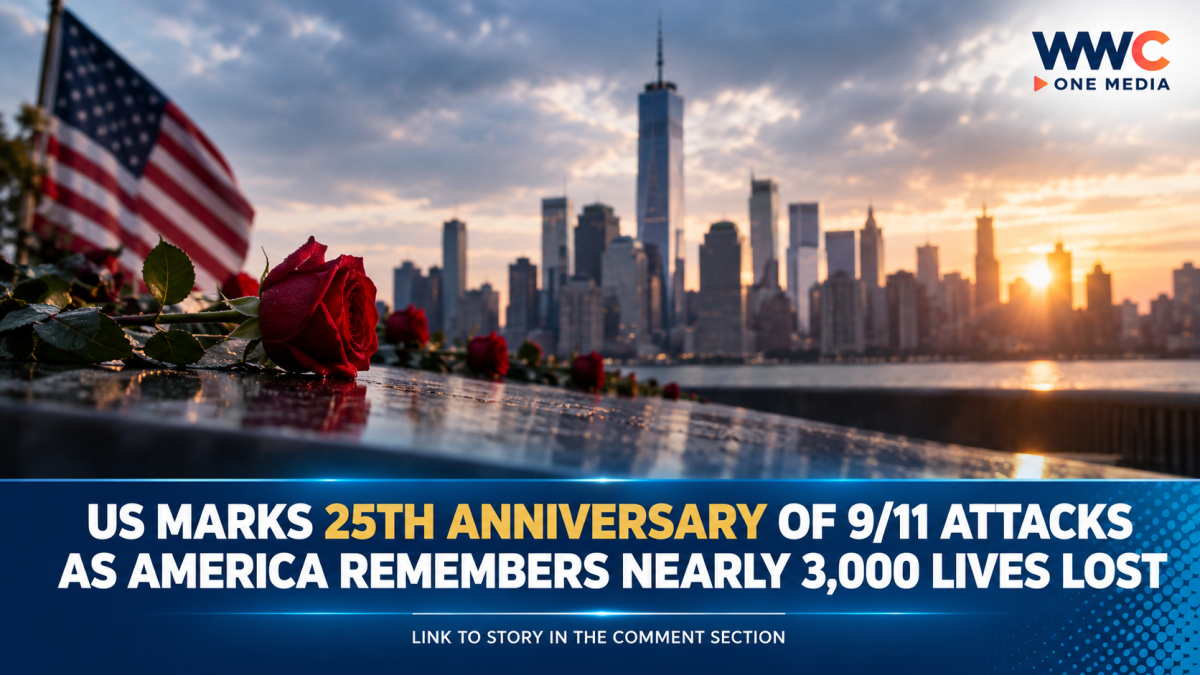
WASHINGTON/NEW YORK — The United States marked the 25th anniversary of the September 11, 2001 terrorist attacks on Friday, September 11, 2026, with solemn ceremonies across the country honoring the nearly 3,000 people killed and reflecting on an event that permanently changed American society, security and foreign policy.
From New York City to the Pentagon and Shanksville, Pennsylvania, victims’ relatives, first responders, political leaders and members of the public gathered to remember those who died a quarter-century ago.
Names, silence and memories at Ground Zero
At the National September 11 Memorial in lower Manhattan, relatives of victims read the names of those who died in the attacks, continuing one of the most enduring traditions of the annual commemoration.
The ceremony included moments of silence corresponding to key moments of the attacks. The 25th-anniversary observance also included a seventh moment of silence honoring people who later died from illnesses linked to exposure after the attacks, underscoring how the human toll of 9/11 extends far beyond September 11, 2001.
The gathering also drew an extraordinary group of political figures, including Vice President JD Vance and former presidents George W. Bush, Bill Clinton, Barack Obama and Joe Biden, according to CBS and other reports.
Pentagon and Shanksville also remember the victims
The remembrance extended to the Pentagon in Arlington, Virginia, where American Airlines Flight 77 crashed after being hijacked, killing people inside the building and aboard the aircraft.
President Donald Trump attended the Pentagon ceremony, where he spoke about the attacks and their enduring impact on the United States.
In Shanksville, Pennsylvania, another ceremony honored the passengers and crew of United Airlines Flight 93. The aircraft crashed into a field after those aboard attempted to confront the hijackers.
Together, the three locations represent the principal sites where the attacks unfolded on U.S. soil.
A tragedy that reshaped America
The September 11 attacks killed 2,977 people, according to U.S. authorities and major news organizations, after 19 al-Qaida hijackers seized four commercial aircraft.
Two planes struck the World Trade Center towers in New York. Another hit the Pentagon, while Flight 93 crashed in Pennsylvania.
The attacks triggered sweeping changes in American national security and foreign policy. The United States launched the war in Afghanistan and later expanded counterterrorism operations around the world.
The aftermath also produced major changes at home, including the creation of the Department of Homeland Security and expanded counterterrorism and surveillance programs. The U.S. Department of Justice has described the attacks as a turning point that placed terrorism prevention at the center of national-security policy.
The legacy is also a public-health story
Twenty-five years later, the consequences of 9/11 are still being felt by survivors, firefighters, police officers, rescue workers and others who were exposed to hazardous conditions after the attacks.
Reuters reported that hundreds of firefighters have died from illnesses associated with 9/11, while thousands of other people have experienced serious health consequences connected to exposure to toxic dust and debris.
That continuing toll has increasingly become part of how the anniversary is remembered: not simply as the day the attacks happened, but as the beginning of a decades-long aftermath.
A new generation is inheriting the memory
The 25th anniversary also carries a generational significance.
Millions of Americans alive today were either children or had not yet been born when the attacks occurred. For younger generations, 9/11 is increasingly understood through family stories, photographs, documentaries, memorials and history lessons rather than personal memory.
That has placed a greater emphasis on preserving firsthand accounts and ensuring that the stories of victims and survivors remain part of the national record.
The National September 11 Memorial & Museum’s anniversary programming has emphasized not only loss but also the acts of service and solidarity that followed the attacks.
25 years later, the questions remain
The 2026 anniversary was therefore more than a commemoration of a historic tragedy. It was also an opportunity to examine how profoundly 9/11 changed the United States — from national security and foreign policy to public health, immigration, civil liberties and the experiences of Muslim Americans.
The anniversary comes at a time when the United States remains deeply involved in international conflicts and security debates, making the lessons and legacy of 9/11 politically relevant once again.
After a quarter-century, the ceremonies continue to make one point unmistakable: the attacks ended in hours, but their consequences have lasted for generations.



Leave a Reply