
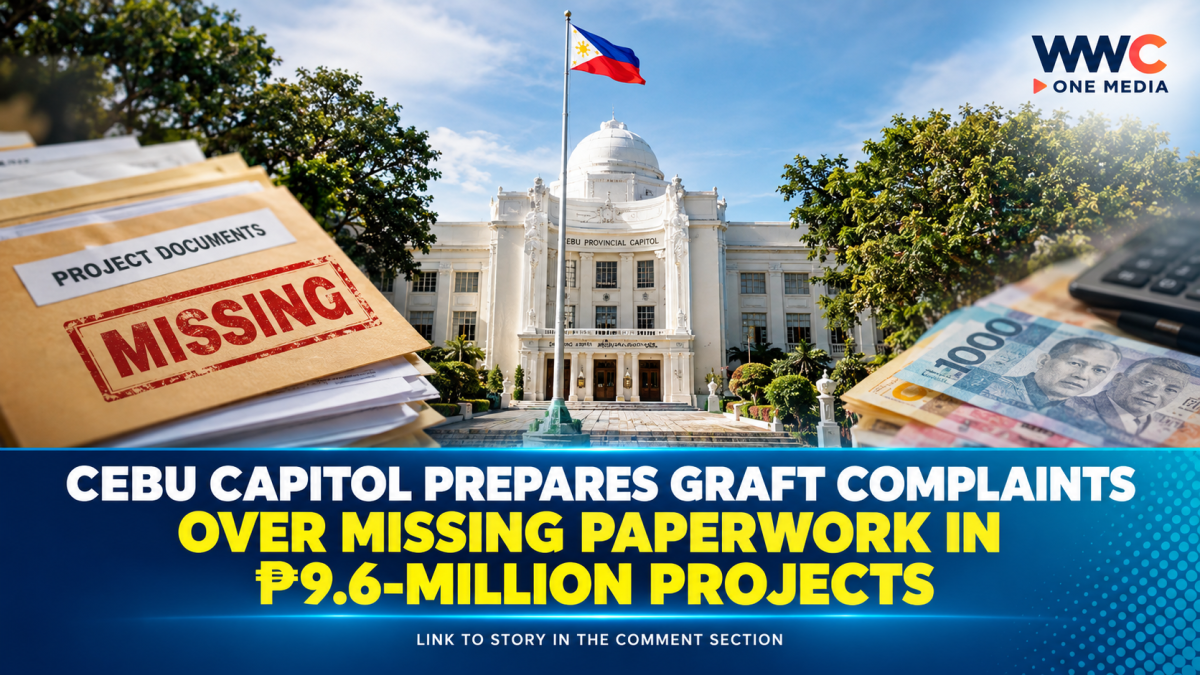
CEBU, Philippines — The Cebu Provincial Government is preparing possible graft complaints after an investigation found that mandatory procurement documents for several public-works projects worth millions of pesos could not be accounted for, prompting the Capitol to freeze payments to contractors.
The controversy centers on 15 infrastructure projects with missing procurement records. Four of the projects involve about ₱9.6 million in public funds, according to the latest report from SunStar Cebu. The Provincial Legal Office is preparing to submit its findings to the Office of the Ombudsman, where potential administrative and criminal liabilities may be evaluated.
Missing documents trigger investigation
The issue emerged after Cebu Gov. Pamela Baricuatro ordered an audit of 20 flagged payables in July 2025.
By September of that year, the Provincial Engineering Office had issued suspension orders affecting the projects while officials searched for the missing records.
Some documents were eventually recovered, including paperwork for five contracts. But 15 project folders remained incomplete or unresolved, raising questions about how the procurement records were handled during the province’s leadership transition.
Three of the project folders were reportedly found completely empty of procurement records.
Among the projects cited were contracts for lamp posts and road works, including:
- ₱580,000 for 112 lamp post units in Asturias, Barili, Carmen and Toledo City;
- ₱2.4 million for 466 lamp post pedestals in Balamban and Toledo City;
- ₱4.7 million for road shoulder concreting in Aloguinsan; and
- ₱1.9 million for a road-concreting project in Balamban, whose folder was found but still lacked several required documents.
Projects were reportedly real — but the paper trail wasn’t
One important distinction has emerged from the investigation: the missing documents do not automatically mean the projects were nonexistent.
Inspectors reportedly conducted physical checks with provincial engineers and confirmed that several of the structures were actually built.
The problem is the missing procurement trail — documents that are normally necessary to establish how contracts were awarded, what requirements were met and whether public procurement rules were followed.
That distinction is crucial because the current investigation concerns accountability for the missing records and the circumstances surrounding them, rather than establishing that the projects themselves were “ghost projects.”
Leadership transition under scrutiny
The missing paperwork has been linked to problems during the 2025 transition of provincial leadership.
Baricuatro’s administration assumed office in mid-2025 after the gubernatorial transition. Ahead of the June 30 turnover deadline, the incoming administration had raised concerns over the handover of government files, procurement records and financial documents.
When the new procurement personnel took over, they reportedly inherited archives that were disorganized and lacked proper turnover documentation.
The Capitol’s investigation is now seeking to determine how the records disappeared, who was responsible for maintaining them and whether anyone should face legal or administrative consequences.
Possible Ombudsman and NBI cases
The Provincial Legal Office is preparing to transmit its findings to the Office of the Ombudsman, which has jurisdiction over complaints involving alleged misconduct and corruption by public officials and employees.
Separately, a private complainant is reportedly preparing a complaint before the National Bureau of Investigation (NBI).
However, the preparation or filing of a complaint does not establish guilt. Any individuals ultimately accused would still be entitled to due process, and the appropriate investigative and judicial bodies would have to determine whether the evidence supports criminal or administrative charges.
More procurement safeguards introduced
The controversy has also pushed the Capitol to tighten its procurement procedures.
The provincial administration has reportedly reconstituted its Bids and Awards Committee through Executive Order No. 7, introduced public livestreaming of bidding sessions and brought in third-party observers to strengthen transparency.
These measures are intended to reduce the possibility of another breakdown in documentation and make procurement activities easier for the public to monitor.
Why the missing paperwork matters
Government procurement is built around documentation. Bid records, contracts, clearances, insurance documents and other supporting papers provide the audit trail needed to determine whether public money was spent properly.
The investigation therefore puts the spotlight on an issue that can sometimes appear administrative but carries much larger consequences: when the paper trail disappears, accountability becomes harder to establish.
For Cebu officials, the next major question is whether the missing records were the result of administrative negligence, a breakdown during the leadership transition or conduct serious enough to warrant prosecution.
For now, the provincial government is moving toward possible complaints while investigators and prosecutors will ultimately determine whether the evidence supports graft charges.
The money may have funded actual projects — but the missing paperwork has opened a much bigger question: who allowed the public records to disappear, and will anyone be held accountable?




Leave a Reply