
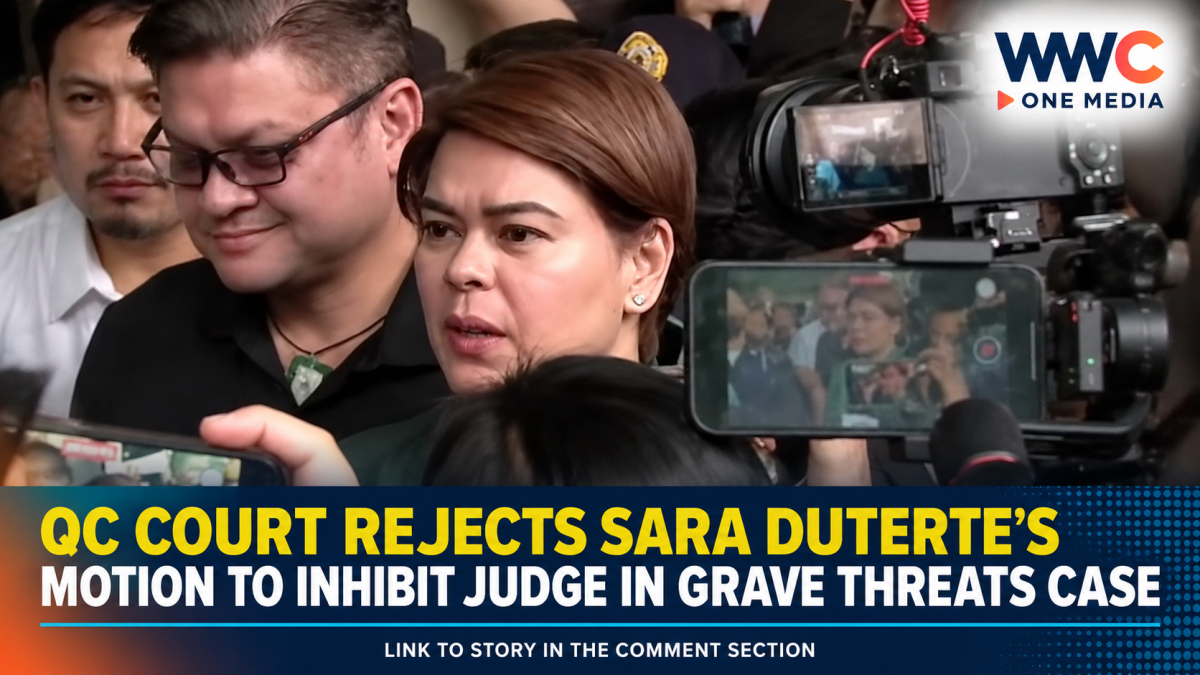
The legal battle surrounding Vice President Sara Duterte’s grave threats case has taken another turn after a Quezon City court rejected her request for the presiding judge to step aside.
Quezon City Regional Trial Court Branch 98 Presiding Judge Maria Angelica De Ramos denied Duterte’s motion for inhibition or voluntary recusal in an order dated September 14, 2026, ruling that the request lacked merit.
The decision means De Ramos will remain the judge handling the criminal cases unless Duterte’s camp obtains relief through another legal remedy.
Duterte’s camp accused court of bias
Duterte’s lawyers filed the motion on September 10, one day before her scheduled arraignment.
The defense argued that the court had allegedly shown “manifest partiality, bias, and favoritism,” particularly after it directed prosecutors to submit digital evidence that was not included in their original submission.
The defense maintained that the prosecution’s failure to initially submit the digital evidence should have been fatal to the government’s effort to establish probable cause for the alleged grave threats made through online livestreams.
Duterte’s camp also questioned the judge’s impartiality because De Ramos and her son had been appointed during the administration of President Ferdinand Marcos Jr., whom Duterte has identified as a political opponent.
The court, however, found no sufficient basis for the judge to recuse herself.
De Ramos said there was no clear and convincing evidence of actual bias, prejudgment or an improper connection that would reasonably call her impartiality into question.
Arraignment was already postponed
The dispute over the judge’s inhibition had already affected the criminal proceedings.
Duterte’s arraignment, originally scheduled for September 11, was deferred after her lawyers filed the motion seeking De Ramos’ inhibition. The court had previously indicated that the prosecution would be given an opportunity to respond to the defense motion.
The Daily Tribune reported that the arraignment had been tentatively moved to October 9, although the latest developments surrounding the inhibition motion could affect the timetable.
Duterte’s lawyers vow to pursue available remedies
Following the ruling, Duterte’s counsel Paul Lawrence Lim confirmed that the defense had received the court order.
Her legal team said the Vice President would exercise all available legal remedies.
The defense also acknowledged an order directing both sides to comply strictly with the sub judice rule, which restricts public discussion of matters that are actively before the court.
This means the latest ruling does not end Duterte’s legal challenge. Her camp can still pursue remedies available under the rules, although the specific course of action will depend on the legal strategy of the defense.
What is the grave threats case about?
The criminal case stems from remarks Duterte made during an online press conference in 2024.
Prosecutors allege that she said she had spoken to someone about killing President Ferdinand “Bongbong” Marcos Jr., First Lady Liza Araneta-Marcos, and then-House Speaker Martin Romualdez if an alleged plot against her succeeded. The Department of Justice subsequently filed three counts of grave threats against her.
Duterte has disputed the prosecution’s interpretation of her statements, previously arguing that her remarks were taken out of context.
The same controversy has also figured prominently in the impeachment proceedings against Duterte before the Senate, where alleged threats against Marcos, the First Lady and Romualdez form part of the accusations against her.
Arrest warrant was issued, but Duterte posted bail
The QC RTC issued an arrest warrant against Duterte on September 4 after finding probable cause to hold her for trial on all three counts.
The court set bail at P120,000 for each count, bringing her total bail to P360,000. Duterte posted bail the following day.
The issuance of the warrant came after the court rejected her earlier efforts to defer or recall the warrant and to quash the criminal information.
The DOJ said the case would proceed to trial following the court’s finding of probable cause.
Supreme Court challenge remains part of the wider legal battle
The QC RTC case is not the only legal front Duterte’s camp has pursued.
Her lawyers have also brought issues surrounding the grave threats prosecution before the Supreme Court, including a request for relief and an urgent application involving a temporary restraining order.
Meanwhile, the QC judge has come under public scrutiny following the issuance of the arrest warrant. A nationwide organization of trial court judges, Kapunungan sa mga Pilipinong Hukom, previously defended judicial independence after Judge De Ramos became the subject of online attacks and allegations of bias. The group stressed that judges must be able to decide cases without fear or pressure.
What happens next?
For now, Judge De Ramos remains on the case, while Duterte’s defense weighs its next legal steps.
The immediate focus is likely to remain on the pending criminal proceedings and the eventual arraignment, while Duterte’s broader legal challenges continue through the available judicial channels.
The latest ruling therefore does not resolve the grave threats case itself. It simply removes one of the defense’s immediate requests: having the current QC RTC judge step aside.
The bigger question now is whether Duterte’s next legal move can delay or alter the proceedings before the case reaches the actual trial stage.




Leave a Reply